Online training login

Angela is a speech and language therapist in Northern Ireland where she works with people with learning disabilities. She worked with John who had some difficulties with eating and drinking. Together they used Talking Mats to help John understand his risk of choking and identify foods which were easy or difficult to eat. Watch this film clip where John describes how Talking Mats helped him to understand and manage his risk of choking.
My name is Karin Torgny, I’m from Sweden. My background is in journalism and culture studies. I used to work in “The Development Centre for Double Exposure” for many years, and our mission was to improve and spread knowledge about violence against women with disabilities. My special interest during these years was AAC. Today I work for Unicef and in different projects on human rights issues.
A year ago I did my accredited Talking Mats training in Stirling, Scotland. Since then I have given my first course in using Talking Mats when talking about abuse and harm. It was a great experience and an opportunity to work with an enthusiastic group of women who were open and willing to communicate using symbols. They are all in an organisation working with girls/women with intellectual disability exposed to violence and oppression in the name of honour.
I think Talking Mats is a good tool when approaching difficult subjects and I hope to run more courses like this in Sweden in the future. Lately I was interviewed on the Swedish Radio and talked about the use and possibilities with Talking Mats when someone is exposed to harm and abuse.
For those who know Swedish (!), here is a link to that program, http://t.sr.se/1mxZv9W
I am also curious if someone else is doing something similar. If so I would be interested to know more. Send an e-mail to: karin.torgny@gmail.com
Have a look at how Talking Mats has been used in Scotland to support people with a learning disability to disclose issues of concern: Survivor Scotland
Congratulations to our 5 new accredited trainers from Edinburgh City Council , Lothian NHS, Perth Kinross Council and SENSE Scotland
We had a great two days working together, exploring the Talking Mats framework and thinking about skills in terms of training and implementation of the Mats. Lots of chat but some key thoughts emerged that are worth sharing
- Keep calm with Talking Mats and have a blether
- Talking Mats gives the thinker the power to say ‘No’
- Open questions create open dialogue
- Children do but don’t get enough time to say
- Recap; Talking Mats provide a visual summary of the conversation
- It is easy to feel drowned out by other voices Talking Mats keeps the focus on the person
- It is good to have 1 to 1 time and not just when things go wrong
- The health and being resource is a perfect fit for the outcomes focused approach
There were lots of exciting ideas for future projects and further blogs which will expand on these ideas a bit more. So watch this space as the new trainers develop their ideas more.
If you are interested in becoming an accredited trainer click here
To mark Dementia Awareness week the Talking Mats team is keen to provide family training for relatives who care for someone with a communication difficulty.
Thanks to a generous donation from Miss Hendry Charitable Trust and support from Alzheimer Scotland, training has been carried out with family members at the Clydebank Alzheimer Scotland Resource Centre. Eight people who care for a relative with dementia (6 caring for a spouse and 2 caring for a parent) and one member of staff attended. None of the participants knew about Talking Mats before the training. They all cared for people who had difficulty expressing themselves and several told the group about the frustrations and despair they sometimes felt.
The training was carried out over 2 sessions.
Session 1 included an explanation to the background and purpose of Talking Mats, a demonstration, watching and discussing DVD examples, hands on practice, discussion of topics to be used at home with their relative and planning for next session.
Each participant was given a set of materials and by the end of the day all participants had understood the principles involved in Talking Mats and had gained the skills required to use it with their relative. They all said how much they had enjoyed the day and how much they had gained from it. They all committed to trying it with their relative and to bringing back their views to the follow up session. Each participant was given a post-it note at the end of the day and was asked to write any comments- positive or negative about the day.
Some of the comments:
• This was a very positive course today. It has made me feel very hopeful about establishing a time of coherent dialogue with my mother – albeit in a focused way and also in providing a tool for her to communicate in a simple way, her own thoughts, Thank you.
• Informative, informal, surprising. I enjoyed the course and felt I had gained from it.
• Could be a useful tool. Can’t wait to try it with my wife. Thank you.
• The course was very informative and well worth the time spent. Talking Mats is a very simple idea which seems to be working very well. I’m looking forward to trying it out and hearing how the others coped and what the outcomes will be.
• This was a very informative day and hopefully gives us a great way of communicating to find out my husband’s views on subjects.
The participants were assured that they could get ongoing support by phone or email and the staff member at the resource offered to provide local support.
Six participants plus two staff came to the second session. The others were unable to attend due to their relative being unwell. We had lively and helpful discussions where each person shared their own personal stories of how they had used Talking Mats and what it meant for them.
Overall they felt that Talking Mats was a powerful and helpful tool and that it gave them quality time together with their relative with dementia. The following comments illustrate this:
– small changes made a big difference
– It gives me time to sit down and listen to him
– It slows you down which is needed with someone with dementia
– It helps me know where he is at the moment
– It showed my husband the things he CAN do rather than what he CAN’T do
Relatives found out some things about their partner that they didn’t know e.g. one person with dementia had revealed that they didn’t like having the radio on all the time; another had toothache which the partner was unaware of; another said that food had become tasteless and he no longer enjoyed mealtimes as a result. The relatives were all able to do something as a result to help the situations – e.g. reduce the background noise of the radio, make a dental appointment, add more spice to their cooking.
One couple now use Talking Mats every few days on a regular basis to help the person with dementia think about issues and compare his mood from week to week
– He always feels up after he’s done a Talking Mat
This couple had also given a demonstration of using Talking Mats to a family meeting at the resource centre
Overall the participants found Talking Mats very helpful although two felt it had not been successful. We discussed the reasons for this and the group were very supportive and suggested that the staff could help by introducing Talking Mats as a group activity at the resource centre where these two people could be included. The staff at the centre were also very positive and plan to use Talking Mats both with individual people and with groups.
Overall it was agreed that Talking Mats is a very useful tool both for individual families and for dementia centres. We discussed future plans for individuals and also for the centre. This included designing a Talking Mat to discuss football and another to allow the people with dementia who attend the centre to be involved in planning the centre’s new allotment.
We plan to continue our involvement with the Clydebank Resource Centre and are now in the middle of running the same course in other Dementia Resource Centres.
Anyone wishing further information about Talking Mats training for family members, please contact us at info@talkingmats.com
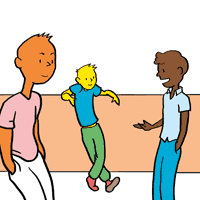 Teens are comfortable using communication tools in the form of social media. They can feel less comfortable with direct communication and often find it hard to put their feelings into words. Using a Talking Mat when talking to teenagers provides a communication tool which takes the focus off face to face interaction. It gives a thinking space to help them to express their feelings. It also allows you to have a balanced conversation because it talks about the positive things in daily life as well as the opportunity to talk about difficult things.
Tina is a 13 year old girl who initially had coped well with the transition to High School but in February had started to refuse to come to school. She was unable to explain what the problem was and when asked about the reason for her absence, would say “ I hate school”.
The “Consulting children and Young people -secondary resource” was used to consult with Tina. She was presented with some of the options from “My body and Skills” to think about how she was feeling. Tina used the top scale Happy(Things are going well and Not happy (things are not going well).
During the Talking Mats interview she opened up about how she felt about travelling to school (she hated going on the school bus and felt embarrassed) She clearly identified the fact that she has specific learning needs as she has difficulty understanding and concentrating in class and often falls behind with her written work. Attending her maths class was particularly difficult and she did her best to avoid going. She also talked about her difficulty with talking to adults and also to her peers. Often she feels excluded in conversations as although she is listening, she doesn’t always understand what they are discussing and doesn’t know what to say. She has a problem with sleeping and feels her mood is low a lot of the time. She also commented that she can feel extremely angry and this has a negative effect on her behaviour. On the positive side, she loves to read and feels happy about her diet and her weight.
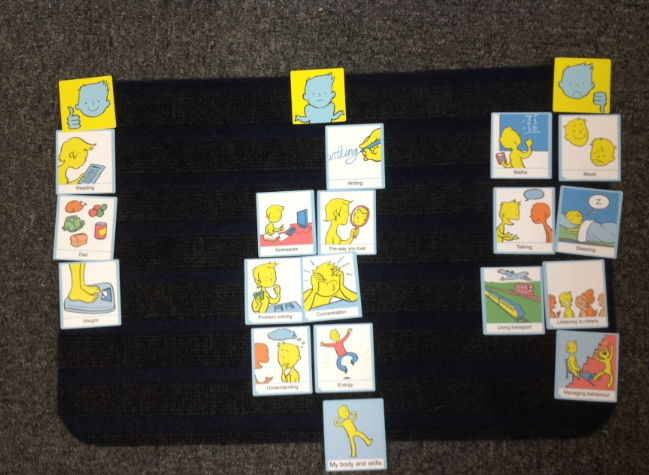
Helping Tina to grade her feelings about specific issues helped to identify what needed to be done in the first instance to get her back to school.
Alternative travel arrangements were put in place, extra support provided for her in class and from the learning support base.
She is attending school again and the pupil support team are gathering together the appropriate “team around the child” to explore her difficulties further.
Find out more about how to use Talking Mats by signing up for a training course at Talking Mats.
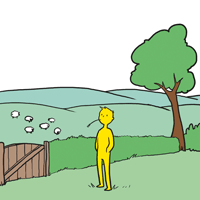

The communities where children grow up can have a significant impact on the well-being of both children and families. The Consulting Children and Young people pack contains the topic “My Wider World”. This topic allows exploration of the impact of both school and life out of school as well as the support systems available to them. The World Health Organisation reminds us of the importance of gathering environmental information from children. As a child develops the environments of their everyday life are closely connected to home and school and finding out how the child feels will give insight into their independence and activity. Negative environmental factors often have a greater impact on children than on adults. In order to promote a child’s well-being, effort needs to be given to enhancing a child’s physical environment as well as their social or psychological environment.
Daniel is an 11 year old boy with a diagnosis of Asperger’s Syndrome. He completed a Talking Mat to explore the impact of his environment on his condition. He was asked to grade his responses using the top scale Happy (Things are going well) and Not happy (things are not going well).

He immediately commented about how he felt about school (“yeah –it’s okay”) He expressed a strongly negative reaction when asked about where he lived. He was very unhappy about the location of his house as it is in an extremely remote location and he can never have any friends round to play. He never gets visitors to his house apart from an uncle that may drop by. He feels bad that he doesn’t have any neighbours and would love to live somewhere that has got other houses nearby. He has talked to his mum about it but she says, “she can’t take me places – too much petrol” He knows that his mum is worried about money. He also really dislikes “out of school care” as he is rarely allowed to play on the computer. He is happy with his teacher, support from health services and the emergency services.
Daniel was clearly upset about his lack of social integration and contact with his wider community.
Environmental support included supporting the care-givers in the “out of school club” by providing training and advice about Asperger’s Syndrome.
Social work became involved to help to help locate local youth groups and finance.
Find out more about how to use Talking Mats by signing up for a training course at Talking Mats.
Talking Mats is fun! Whether you are sitting on the floor completing your mat or sitting at a small table, young children enjoy the fact that they can give information through multiple channels – Talking Mats is visual, auditory and tactile. It is an engaging tool to use when consulting children.They can express a view without words if they want to or they can have a conversation if they enjoy chatting. Watching a young child thinking and reflecting about where they place their symbol on the mat can be a humbling experience. Some adults still consider young children as incapable of expressing their views or opinions but in reality they can often express strong views about things and are very capable of grading their responses. Sometimes we just don’t take the time to ask them about the issues in their lives and free up some time to listen.
Talking Mats has created a specific Early years resource to make consulting young children easier. The symbols have been graded according to their developmental stage. When using the picture symbols it is important to remember:
- Most of the symbols in the Early years pack are concrete and you can quickly identify the shared meaning for example – “drawing”

- Others are concrete but have a broader meaning. An example of this is when asking about “eyes”
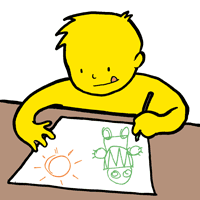
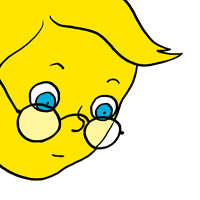
We have found that it is best to allow the child to interpret the meaning at their level so it maybe they have sore eyes; they don’t like their glasses or they have brown eyes. Try not to be too prescriptive when presenting the option to the child; a symbol can act as a jump off point capturing what fits for the child at the time. Just allow the meaning to emerge.
• The abstract symbols do need a bit more explanation because they ask about more complex concepts such as safety. The Early years pack asks about safety in relation to the road, physical safety and safety around others.

Asking about daily routines will give insight into how nurtured and cared for they feel. Let the child lead the discussion as much as possible.
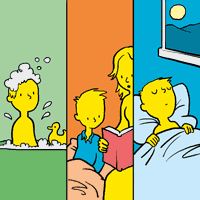
Using visual communication is a great way to have a conversation with children in the early years and a good tool to involve children in decision making. Listening to the child’s view is essential for the GIRFEC process in Scotland and for co-producing Education Health care plans in England and Wales. Talking Mats has created a unique resource which is based on the “International Classification of Functioning, Disability and Health – Children and Youth version” Talking Mats uses a framework which helps children to express themselves in a way they feel comfortable with. As adults we need to be able to facilitate the conversation.
We find that to realize the full potential of Talking Mats it is best to attend a Talking Mats course . The courses allow you to focus on your situation and how you can be creative and apply it in your own work,
During a research project funded by the Joseph Rowntree Foundation in 2007, Joan Murphy and Cindy Gray developed the Dementia Communication Difficulties Scale (DCDS) to help identify the communication difficulties that a person with dementia might be having and therefore help carers and staff to understand these difficulties and therefore support the person with dementia. The scale comprises 13 statements that are based on existing definitions of the communication problems commonly experienced by people as dementia progresses (Kempler, 1995; Health Education Board for Scotland, 1996):
In early stage dementia, the person
- may have difficulty coming up with words
- may tend to digress and repeat themselves.
In moderate stage dementia, the person
- may find it hard to understand what is said to them, particularly when being given complex information
- may have difficulty maintaining a conversation topic without losing track
- may use semantically empty words (e.g. thing, stuff) in place of content words
- may be difficult to understand.
In late stage dementia, the person
- may make little sense
- may not be able to understand what is said to them, even when simple language is used
- may often repeat what other people have said to them
- may communicate mainly in non-verbal ways
The DCDS requires a third party who knows the person with dementia well (a paid carer or family member) to assess various aspects of their communication on a 5-option scale. People are asked to circle the option that most closely describes the person in question.
Each DCDS option is assigned a score: for example ‘Never’ = 0, ‘Sometimes’ = 1, ‘Often’ = 2, ‘Always’ or ‘Says too little for me to judge’ = 3. A person’s DCDS rating is obtained by totalling their scores for all 13 statements. DCDS ratings can therefore range from 0-39, with a higher rating indicating a greater degree of communication difficulty.
The following stages of dementia group definitions were produced:
• DCDS ratings between 0 and 10.5 = early stage
• DCDS ratings between 11 and 19.5 = moderate stage
• DCDS rating between 20 and 39= late stage.
The Dementia Communication Difficulties Scale is brief, straightforward and quick to complete, and may therefore provide a highly useful tool for the care staff, clinicians and practitioners involved in assessing the needs of people with dementia.
If you would like a copy of the scale please click here: Dementia Communication Difficulties Scale
References:
Kempler, D. (1995). Language Changes in Dementia of the Alzheimer Type. In R. Lubinski (Ed.), Dementia and Communication, San Diego: Singular Publishing Group.
Health Education Board for Scotland (1996). Coping with Dementia: A Handbook for Carers. HEBS.
In the Health and Well-being resource, we have provided four sets of symbols to help people consider how they feel about their communication. Because communication is complex and often abstract, it can be particularly difficult for people to express their views about it, especially if they have existing communication difficulties. To make this easier, we have divided communication into four topics:
- Expression
- Understanding
- Learning and thinking
- Relationships.
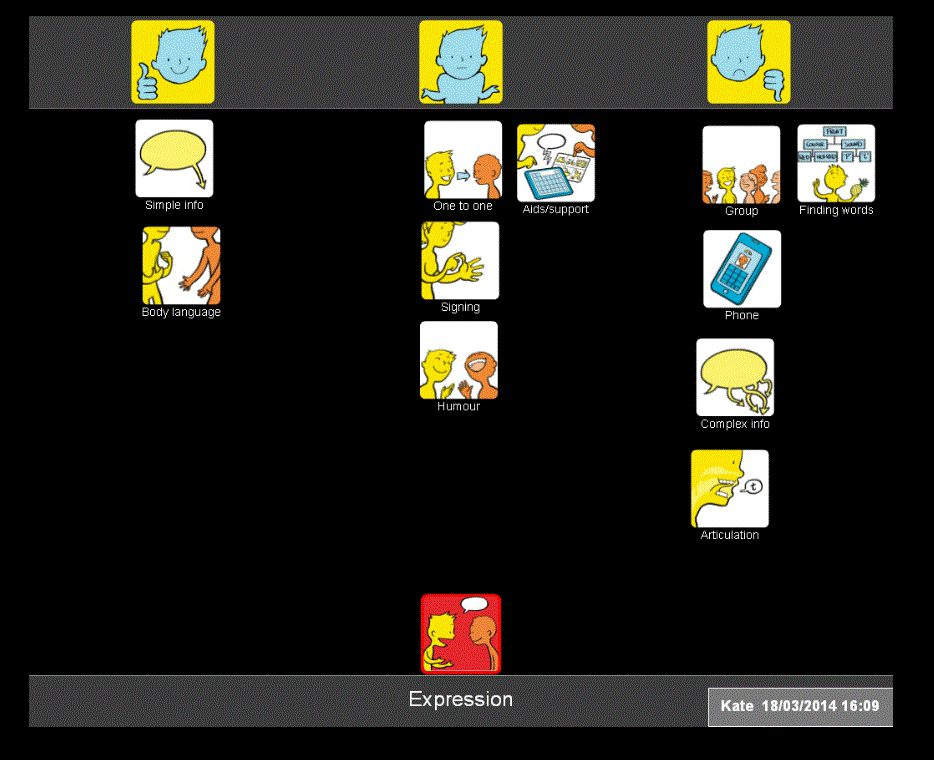
In the following example, I show how each topic can be used to build up a picture of how someone feels about different aspects of their communication. I worked with Kate, a 42 year old woman who had a stroke which left her with severe expressive and receptive aphasia. She was able to communicate through vocalisations and gestures. She could sometimes draw or write down words and needed to point to ‘yes/no’ in order to reliably answer closed questions. Following discharge from hospital, I used Talking Mats with Kate to find out how she felt about her communication. I started with the ‘communication – expression’ topic and found that she felt that she was having lots of difficulties making herself understood, particularly on the phone and in group situations:
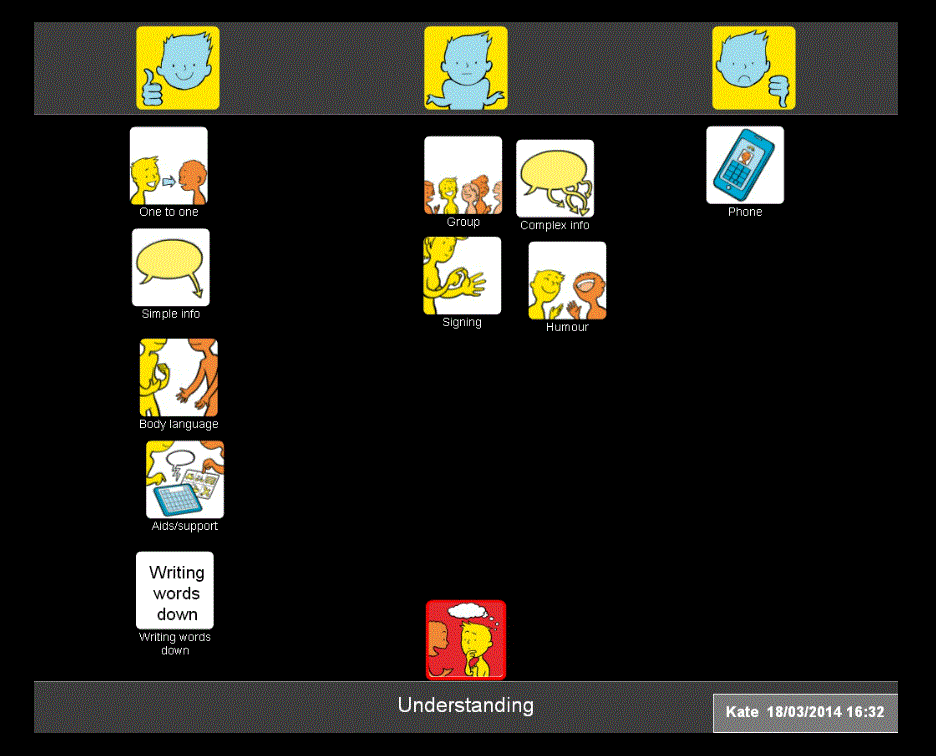
I then explored how Kate felt about understanding what people were saying to her. Kate was able to tell me that she found it easier to understand people on a one to one basis rather than in a group setting. She indicated that it really helped her if people used gestures or wrote things down. Her main difficulty was understanding people on the phone, and in fact she had stopped answering the phone altogether (see mat below).
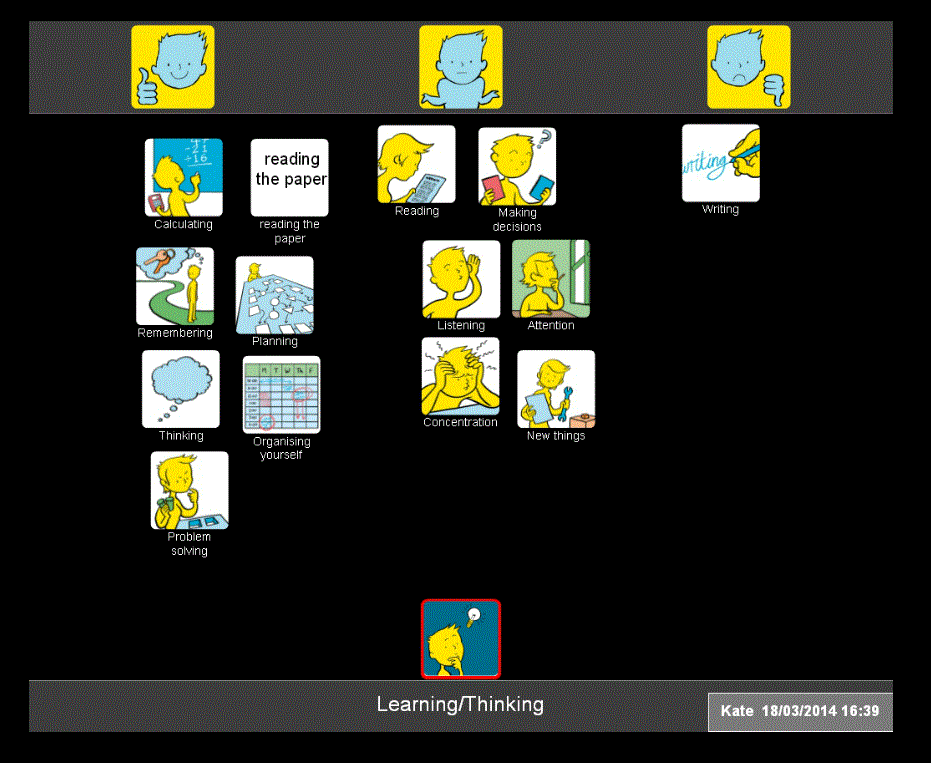
We went on to do a mat about Kate’s learning and thinking. In this set, there are symbols which cover higher level language activities such as reading, problem solving and organisation. When we talked about these areas, Kate was able to tell me about the things she was finding most problematic, but could also identify some things that she felt she could still manage (such as calculations and reading newspapers).
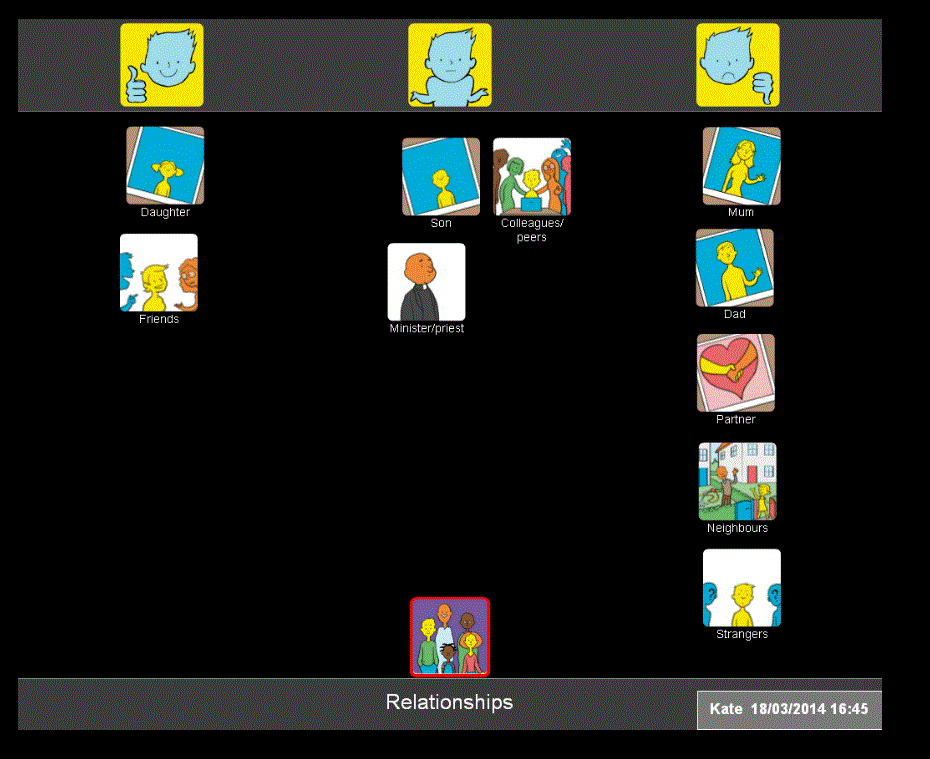
I then asked Kate how she felt about communicating with different people in her life. This mat shows that Kate found talking to her husband and her parents (who lived quite far away) particularly difficult.
As a result of doing these mats, we were able to target the things that mattered most to Kate in relation to her communication, and came up with the following actions:
1. Kate felt that her husband needed support and information, so we spent time working with him, showing him the best ways to support Kate’s communication.
2. Because Kate’s parents lived quite far away, she could only contact them using the phone, which was very difficult. We worked on getting Skype set up so that Kate could communicate with her family using all the modes available to her.
By splitting communication into different sub mats, Kate was able to think about different aspects of her communication and identify the things that she found most challenging. Together we began to work out some ways to help her overcome her difficulties.
Use the communication symbols to find out what people want to work on and use a collaborative approach to establish some goals to work on in therapy. I used the original Talking Mats when I explored Kate’s communication with her, but you could do the same with Digital Talking Mats. Find out more about it here.
Within the Health and Well-being resource there are four symbol sets (health, looking after yourself, communication and leisure & environment). Within the ‘health’ set, there are three topics which can be used to help people express their views about different aspects of their health:
• Health
• Coping
• Mobility
I worked with Pete who had severe aphasia. Pete had a range of health problems, including epilepsy and high blood pressure. Pete found it very difficult to communicate with his GP, and usually relied on his wife to translate. This meant that not all of Pete’s health problems were addressed or discussed when he went to the doctor, and he often felt excluded from conversations at these appointments. Prior to one of Pete’s GP appointments, I used Talking Mats with Pete to find out how he felt about his health. During our discussions, Pete was able to tell me that he was worried about a number of issues, but he especially wanted to talk to his GP about his ears, as he was having a lot of pain and also had a ringing sensation in his ears which meant that he found it very difficult to concentrate, particularly when watching TV.
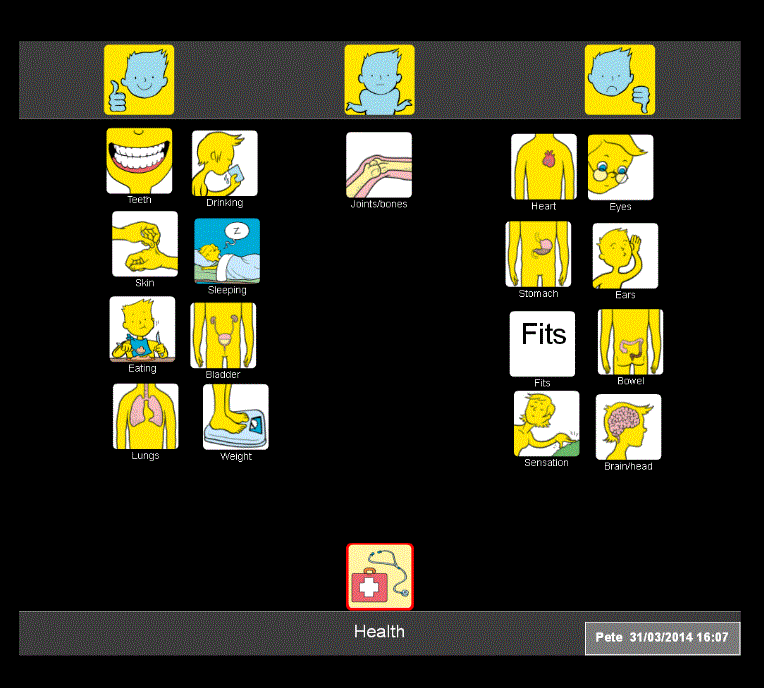
Pete took the photo of his completed mat with him to his next GP appointment and his GP used this as a focus for discussions. As a result, Pete was referred to an audiologist for assessment. His GP also spent time discussing Pete’s epilepsy with him and referred him back to the epilepsy specialist nurse who worked with Pete and his wife to improve their understanding and management of it.
Using Talking Mats helped Pete prepare for his GP appointment and also ensured that his GP focused on what was important to him. As a result, time was spent more effectively by all and Pete felt listened to and really participated in his GP consultation.
Use the Talking Mats ‘health’ symbols from the health and well-being resource to help people prepare for appointments with health professionals and manage their health more effectively.