Online training login

Communication Tools and Resources for Children and Young People in Education Settings
Talking Mats offers an approach which can be used by professionals working in Education, Health, Social Care and Third Sector settings, including childcare and respite, to support holistic and person-led planning and practice. Our approach is used widely across a range of Education settings, from Early Years through to College.

Supporting Children’s Voices in Schools and Education Settings
In schools and other educational settings, many children and young people, particularly those with SEND (Special Educational Needs and Disabilities), communication difficulties, or additional support needs, often struggle to express their views, feelings, and wishes in ways that adults can fully understand and act on. This doesn’t just matter for individual wellbeing, but it also matters for rights based practice.
At Talking Mats, our framework is commonly used in a range of settings, including:
- Early years and nurseries
- Primary schools
- Secondary schools
- SEND schools
- Colleges
- Childcare and respite settings
What Are Communication Tools and Why Do Children in Education Need Them?
The Talking Mats approach is based on a visual framework. Visual supports can be particularly helpful for children with communication difficulties. They support memory, sequencing, and decision-making, provide structure for concepts like feelings and preferences, and help children reflect rather than react.
Who Can Benefit from Talking Mats in Education?
Talking Mats is not diagnosis-led, but needs-led, meaning it supports any child who would benefit from structured, visual conversation support. This includes:
- Children and young people who are neurodivergent – Talking Mats helps structure conversations, supports processing time, and reduces overload.
- Children and young people with learning disabilities – our framework makes abstract topics involving feelings and choices more accessible, and encourages participation in decision-making.
- Children with speech, language and communication needs (SLCN) – Talking Mats helps children with SLCN reduce the reliance on verbal output alone.
- Children with social, emotional and mental health (SEMH) needs – Talking Mats supports safe exploration of feelings without pressure, in order to identify triggers and support needs.
- Children in early years and nursery settings – Talking Mats supports communication and play-based expression, working alongside non-verbal cues.
- Young people in further education and college – our framework supports the transition to adulthood conversations which can be helpful for independence and wellbeing
What impact can Talking Mats have in Education settings?
EHCP and SEND Planning
Children and Young People are able to explore and express their feelings, views, and aspirations, and helps gather structured pupil views for EHCP needs and assessments. Talking Mats reduces the reliance on adult interpretation.
Pupil Voice and Annual Reviews
Children and Young People have their voices heard, and their voices have a meaningful impact. Talking Mats supports reflection on school experience, helping to capture what is and isn’t working.
Transitions and Change
Support preparation for, and monitoring the impact of, transitions, including moving between year groups, schools, key stages, and post-16 pathways. This helps to reduce anxiety by structuring the unknown into manageable choices.
Pastoral Support and Wellbeing
Talking Mats helps to explore emotional wellbeing in a calm, non-threatening structure. It can help identify concerns around friendships, learning pressures, and home issues early.
Safeguarding Conversations
Talking Mats can improve communication and investigation of potentially sensitive or difficult issues, such as safeguarding.
Early Years and Play-Based Settings
Practitioners can use Talking Mats to integrate with play, visuals, and routine-based communication to help interpret preferences and feelings in children with communication difficulties.
Why Choose Talking Mats as a Communication Tool in Education?
Legislative and policy frameworks such as “Getting it Right for Every Child” (GIRFEC) in Scotland, and the SEND reforms in England, require practitioners to create a plan focused on the outcomes the child or young person wants to achieve, and to set out how services will work together to support these outcomes.
Talking Mats training supports practitioners across sectors to adapt their communication style and practice to facilitate child-led practice, in line with legislative and policy frameworks, as well as UNCRC (United Nations Convention on the Rights of the Child) Article 12. ‘One of the single strongest arguments for complying with Article 12 is that it is not just a right in itself, but a means of realising all other human rights for children’ Professor Laura Lundy, Why we must really listen to children in education (2026) a report by Children and Young People’s Commissioner Scotland.
Every child has the right to express their views, feelings and wishes in all matters affecting them, and to have their views considered and taken seriously.
UNCRC Article 12 https://www.unicef.org.uk/what-we-do/un-convention-child-rights/
Developed and Tested Through Rigorous Research
Talking Mats was developed at the University of Stirling and has been independently researched and evaluated across a wide range of education settings. With published studies relating to its use with children and young people, this is an evidence-based tool that benefits any education setting.
A Ready-Made Resource Designed for Education Conversations
Talking Mats is a resource of purpose-built frameworks for education contexts. It helps children explore and articulate their feelings, views, and wishes about their lives, learning, and support. It’s designed to be used across a wide range of settings, from early years through to further education.
Training for Every Practitioner Working with Children
We offer Foundation Training, which is designed for the full range of education practitioners, such as teachers, teaching assistants, SENCOs, SLTs, early years workers, and college support staff – not just communication specialists.
Our training equips practitioners to structure a Talking Mats conversation, adapt their communication style to be more child-led, and use the framework confidently. We offer both in-person and online training. Contact us today to arrange your comprehensive Talking Mats training.
Frequently asked questions
Talking Mats resources which could support your conversations
Consulting Children and Young People
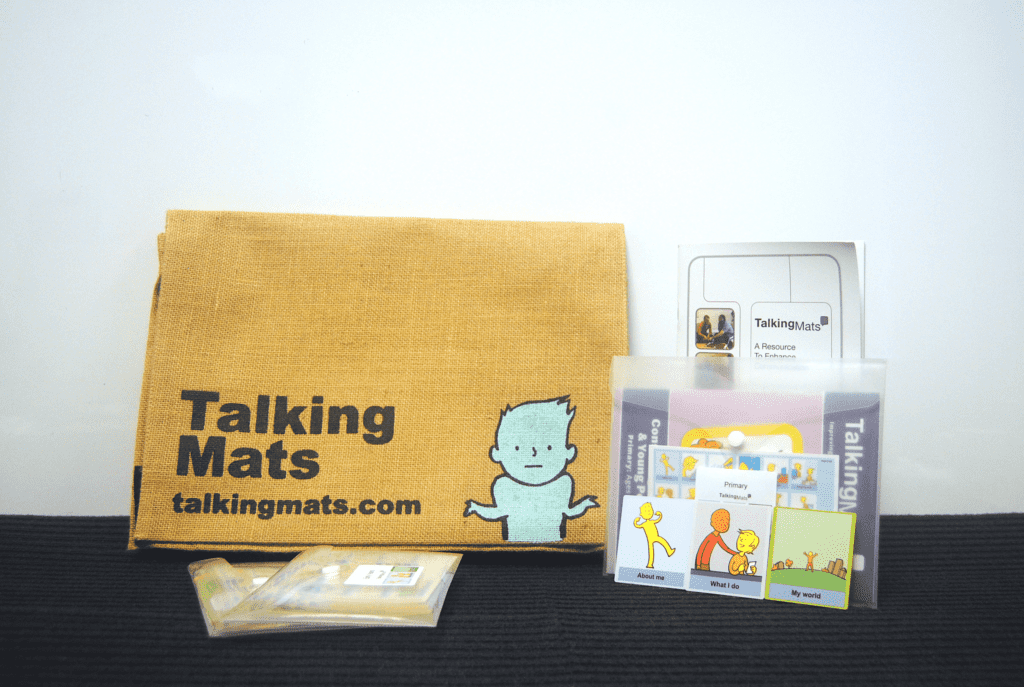
We recommend that professionals using our resources complete the Talking Mats Foundation course to ensure consistency of use, and to enable you to get the most out of them. Find out how to access our Talking Mats Foundation course here.