Online training login

Talking Mats is at its heart a Person Centred approach and makes this abstract concept real for practitioners and accessible to more people.
The skills we teach in our training are core to its values:
- Being explicit about the purpose of the conversation
- Using open questions
- Affirmation
- Active Listening
- Personalising
- Summarising
- Clarification
- Acknowledging that this is the persons view today and it is likely to change with time
‘ To improve the lives of people with communication difficulties by increasing their capacity to communicate effectively about the things that matter to them’
Our vision statement matches what is quoted in the introduction of the new Core Skills framework ‘Person-Centred Approaches’ produced by NHS Health Education England, Skills for Health and Skills for Care http://www.skillsforhealth.org.uk/news/latest-news/item/576-new-framework-to-promote-person-centred-approaches-in-healthcare
Talking Mats foundation training gives practitioners a tool to turn the values expressed in this powerful document into practice Read how one health authority made this a priority http ://www.talkingmats.com/person-centred-approach-to-health-planning
To support your organisation evidence they are using a Person Centred Approach look at our website www.talkingmats.com or contact info@talkingmats.com
Talking Mats and Autism- Have you sometimes tried it and it didn’t work?
There is a growing interest in teaching TM to people with ASD. We know that some important adaptations might be required to make this a meaningful experience, and are keen to share our learning so far.
Being asked for thoughts or views can be difficult for some people with communication difficulties. In particular, there is a group of people with autism where some of the core principles of Talking Mats have to be taught in stages. Some thinkers will just ‘get it’ and find it a valuable tool for sharing their thoughts and for supporting decision making. For others there may have to be adaptations and /or specific teaching e.g. the vocabulary of the top scale. We heard recently of a student in a specialist centre who couldn’t use Talking Mats. However the staff would include him in groups where it was used and make sure he was around others doing Mats. After a few years, he did learn the principles and go on to use it effectively.
We have gathered ideas and knowledge from practitioners working in the field of autism and included these on our web-site under Free Stuff on Communication Disability. ASD guidelines It’s important that these guidelines grow and adapt as we learn more about using TM with an even wider range of people.
We’ve arranged a twilight session here at Stirling on the 1st of February 2018 to bring together practitioners working in the field of autism to extend our knowledge and encourage a staged approach to effective use of Talking Mats.
We’re delighted that Ruth Chalmers, Principal Teacher for Autism Spectrum Info and Support Team (ASIST) in Fife will be joining us to talk about developing social communication skills using Talking Mats. There will be time for small group chat so bring along a case you want to discuss.
Please share the attached flier 201802 AsD seminar with your network and we hope you can join us
Please come along and If you are interested in attending this twilight session 4.00pm to 6.00 pm (cost £20.00), please notify us at info@talkingmats.com
Thanks to the Action Group in Edinburgh for their great blog about their co-trainer Lynnette Linton .
In 2016, a number of people with learning disabilities attended a Talking Mats training designed to build their communication skills and confidence so they could use to interview others about their community participation, in regard to Charter for Involvement goals. One of those trained was Lynnette Linton, the National Involvement Network Chairperson, and a Service User of The Action Group in Edinburgh.
Lynnette interviewed several fellow service users using Talking Mats, and was supporting in the role of ‘Listener’ by Liz Taylor, an Action Group Training Officer, who as a consequence of this work requested to become an Accredited TM Trainer. The Charter highlights that support organisations should involve Service Users in training their staff, so it then seemed natural for Liz and Lynnette to deliver TM training to Action Group staff together, with Lynnette in the role of volunteer co-trainer.
Lynnette has since been a core part of training over 50 employees (including those at Senior levels) in Foundation Talking Mats training with the Keeping Safe add-on. Liz says, it helps that Lynnette is “naturally gifted at speaking to people, and ably demonstrates the significance of TM as a means of having your say on the service you wish to receive”.
Lynnette and Liz do a demonstration Mat together, and then when trainees are doing their own Mat or showing their videos, Lynnette points out where they are applying the key TM principles (Lynnette enjoys issuing certificates to those who successfully complete the course). She also shares anonymised stories from her experience of interviewing ‘Thinkers’, which help get across what Action Group Users “want to change and improve about their service”.
Liz says, “Our first experience of demonstrating a Mat together didn’t quite go to plan, as Lynnette became unexpectedly upset when discussing her views of a football team, when she was reminded of a close friend who had died who had been a fan”. As difficult as this was for both Lynnette and Liz at the time, it was a powerful example of how TM helps us express emotions we may not even have been ourselves aware are ‘under the surface’, and sparked real interest in TM as a communicative tool.
The Action Group started gathering feedback specifically for Lynnette in her role as co-trainer, as part of the training evaluation and trainees have said that “she is exceptionally welcoming and puts everyone at ease; her passion for the topic is very evident, and it is very beneficial to hear real life examples, and how TM helps in her own life”. This includes how Lynnette benefits from the Keeping Safe pack, as a means of raising more ‘difficult’ issues.
Lynnette says, “As a service user, I also now see myself as an important, valued co-trainer. [Training] is something I see myself doing more of in the future. My confidence has shot right up. It makes me feel proud, and my parents get to hear about it at my Review”.
Staff also see the real importance of acting on the actions from each person’s Mat. Lynnette acknowledges that co-delivering has sometimes “been difficult, because I know some of the people we’re training. But I’ve been able to speak up about what I want from my support, my environment.” Recently she trained her own Service Development Manager and Team Manager, and although she felt it was harder to be honest, she had a captive audience, and her Managers then followed through on actions from her demonstration mats: “It’s made a difference to me, after doing a Mat with my DM about my home. I put ‘safety’ in the ‘Thumbs Down’, because I get frightened, and now I’ve got a security chain and a peephole on the door”.
“I never thought I would be training the staff. Now we’re booked up!”
Click for information about the Accredited training and or the Keeping Safe resource mentioned in the blog
Huge thanks to all the practitioners who have sent us guest blogs. We selected our 10 favourite guest blogs…in no particular order!
- Talking Mats to support children who stammer Kirsten Taylor, Speech and Language Therapist tells a moving story about how finding out what was upsetting a boy with a stammer helped to implement change.
- Hearing the voice of the child Emma Atkiss, Senior Educational Psychologist, shares her findings from the Wigan Pathfinder project reporting that using a Talking Mat helps to meet the 5 criteria of Shier’s model of participation.
- Talking Mats for capacity assessments in people with ASD/LD Ruth Spilman, Senior SLT from The Cambian Group, shares practical tips on assessing capacity.
- Castle hill school supports pupil voice Jenna McCammon, SLT and Rebecca Highton, SLT Assistant, tell 3 inspiring stories using TMs in: selective mutism; safeguarding and motivational interviewing.
- Supporting Looked After Children to have their say Karen Wilson, Principal Teacher for children with additional support needs in a mainstream secondary school shares her experience of using TMs to give young people a stronger voice in making decisions affecting them.
- Hearing the voices of Looked After Children Rachel Clemow, Head Teacher and Donna Wood, Education Support Worker, report that Talking Mats has enabled children to express their thoughts and views in a safe, neutral environment.
- Talking Mats and Mental Health Carla Innes, Clinical Psychologist for learning disability from Healthy Young minds Stockport talks about the impact of TM training on the whole team.
- Mummy I don’t want to go to nursery today read about how using a Talking Mat might shed some light on why a 4 year old was upset at the thought of going to nursery.
- How do you feel about starting school? The story of 4 year old twins and their thoughts about starting school.
- Sibling Attitudes Prof Juan Bornman from Pretoria in South Africa publishes a report on a study carried out with 27 typically developing children who have a younger sibling with a severe speech and language disability.
If you have been inspired and are not yet trained to use Talking Mats – come along to one of our training courses.
Involving people with a learning disability in service evaluation is both essential and challenging.
Maria Lavery speech and language therapist, and her colleagues in North and South Lanarkshire are using Talking Mats to get feedback about the service they deliver for people with a learning disability . They want to find out about what people feel they do well, and what could be done differently. In addition they have placed a suggestion box at the entrance to their building, but want to involve everyone who is connected with their service – clients, family, carers various multi-agency colleagues and are carrying the review out over a 6 month period.
The analysis and learning will be used to inform the Speech & Language Therapy work plan and support the future direction of the service.
Talking Mats has been used successfully to evaluate Augmentative and Alternative Communication services and the resource for this is available on our website http://www.talkingmats.com/wp-content/uploads/2013/09/AAC-service-Evaluation-script-and-symbols.pdf
We are currently working to develop a Talking Mats resource to support conversations relating to Advance Care Planning (ACP) with staff and patients from Strathcarron Hospice. People who use hospices often have specific difficulties communicating their thoughts and feelings because of advanced illness and emotional factors.
Sixteen staff from the multidisciplinary team at Strathcarron Hospice were trained to use Talking Mats by Sally Boa who is Head of Education, Research and Practice Development at Strathcarron Hospice and also one of our accredited trainers.The staff trained used it successfully with patients in the hospice and found that they could use it with a range of patients for a variety of purposes: getting to know someone; identifying goals; discharge planning.
A sub-group of staff attended a workshop with members of the Talking Mats team to discuss the potential use of Talking Mats to support conversations relating to ACP. Topics and options were agreed. These were then presented to a wider forum of staff from Highland Hospice for validation and checking. Three main topics to support ACP conversations were identified: Affairs; Care and Personal Values. New symbols are being developed and the resource will be trialled with a range of patients in the hospice setting.
Our hope is that Talking Mats can be used by trained staff in a hospice setting to support people to express their views and help them plan for the end of life and that it will also be helpful for many other people to consider future options in their lives.
We will write an update once the new resource has been completed.
Laura Holmes was pleased to meet up with Rachel Clemow, Head Teacher and Donna Wood, Education Support Worker who work for the Virtual Schools Team in Wigan to find out about the impact of Talking Mats training.
Donna accessed a Talking Mats Training last year delivered by a Talking Mats accredited Trainer in Wigan Educational Psychology service and quickly put her training into practice with the children that she works with, using the Consulting Children and Young People – Primary resource pack. Other members of the team soon recognised the potential benefits of introducing this approach themselves, and so, in April 2017, a further 15 members of the Virtual Schools Team received Talking Mats training.
Looked After Children can often struggle to express their thoughts and feelings, often as a result of their situation/ circumstances. This can be further compounded if they also present with speech, language and communication difficulties. There is a higher risk of such difficulties within the LAC population (Cross 1999 ).
Often there are many professionals involved with a Looked After Child, all asking a wide variety of questions, some of which can be highly personal and/or emotive in nature. The team have observed that children will sometimes end up giving answers which they think the listener wants to hear, rather than answers which reflect their true feelings/views – or the child may withdraw from the process entirely. Consequently, it can be very difficult to ensure that the true ‘voice of the child’ is being heard. Sometimes the children themselves struggle to understand what their own feelings are – often the topics and questions can be complex and involve abstract concepts.
Rachel and Donna report that the Talking Mats approach has had a big impact on their communication style when working with the children on their caseloads, and has enabled children to express their thoughts and views in a safe, neutral environment. Some of the comments they made about Talking Mats were that it:
– Enables the listener to get to know a child quicker and more easily as there is no pressure/expectation of the ‘thinker’ – it is a child/’thinker’ led approach.
– Provides way of supporting the child to open up to express their views and feelings, even if they have previously been hard to engage – and for the child to develop better insight into their own feelings.
– Helps to avoid the possibility of adult/listener misinterpretation of what the child is trying to communicate.
– Enables the child to focus on pictures – which appears to result in the child being more comfortable in expressing their own views and feelings – as opposed to what the child thinks the listener wants to hear.
– Provides a holistic view of the child – which can support target setting and planning at key stages for that child, for example, transition to High School.
– Gives the child something they can be successful at – there are no ‘wrong’ answers.
Donna shared a great example of how Talking Mats helped a young girl to describe an issue at home which she had not shared with any carers or school staff previously. The child placed the ‘home’ option symbol on the ‘not happy’ section of the mat then began to whisper to Donna explaining the reason why. This resulted in Donna being able to share the information with school staff and social care, consequently, the issue was resolved.
Services, organisations and schools in Wigan are already using the Talking Mats approach as a result of widespread training delivered by our Accredited trainers in the Educational Psychology Team. This provides a great example of how using Talking Mats across agencies can really help a whole area to become more child/ young person led.
The Virtual Schools team are now recommending the Talking Mats approach to other agencies working with the Looked After Children on their caseloads, such as adoption and fostering services.
If want to access the training then there are Talking Mats foundation courses run regularly in London, Stirling , Manchester and Newcastle . Once you have attended a foundation training and gained experience you can apply to become an accredited trainer .
 This is a fabulous film that really shows Talking Mats in action and how it supports and promotes involvement on so many levels.
Talking Mats and the National Involvement Network (NIN) have been working together for the past year to enable the NIN members to develop a Talking Mat and to use that Mat to listen to the experiences of people with learning disabilities . It has been a great project and we wrote up the experience of running the training in two earlier blogs.
The first blog described how we worked with the group to develop a Talking Mat to link with the NIN’s charter for involvement . The second how we developed and delivered a Talking Mats training course to meet the needs of the NIN members all of whom have learning disabilities
The group then set off to carry out their Talking Mats conversations supported by staff from their respective organisations and or ARC Scotland. The group decided they wanted to make a film about their experiences of using Talking Mats and ARC Scotland supported them to do this . Rhona and I were delighted when we got this link to the film all about their experiences of using Talking Mats. We really enjoyed watching it and we are sure you will to. https://www.youtube.com/watch?v=0BTlYuqLBXs
Five short stories from our recent accredited training course in Stirling.
- A looked after child was unhappy but no one knew specifically why. Using the Talking Mats, she indicated that she was upset by the weekly phone call with her mother because it always happened when it was her playing time. The time of the call was moved to just before her bedtime but this resulted in bad dreams. The time of the call was finally moved to Saturday afternoon which helped her settle and reduced her distress.
- Talking Mats was used with an Iraqi boy who had come to England via Libya, Italy and the jungle camp at Calais. When he picked the symbol of a waiting room he indicated that despite all she had been through he really liked this because it reminded him of all the children in his family and made him happy.
- A 76-year-old man with a learning disability disclosed that he had been attacked and suffocated by his upstairs neighbour one week previously. It was only when he used the Talking Mats that he disclosed to anyone what had happened.
- A lecturer usually used quantifying measuring with her students to find out how they were managing their studies. Instead she used Talking Mats to find out how they were coping with their work life balance. One student told her that she was managing fine except that her pet rabbits always escape under the bed and it takes her a long time to get them back out so she does not let them out very often!
- Talking Mats was used with a man who had had a stroke and had to go into residential care because his family could no longer look after him. They were very worried that he was unhappy with the new care set up. He was able to show with the Talking Mats that he was happy about everything except that he was not given enough time when he went to the toilet. Once the staff realised this they then gave him more time which resolved the situation and reassured his family.
Please send us your Talking Mats stories – we love hearing them.
We are now half way through our project, funded by The Health and Social Care ALLIANCE Scotland, whose overall aim is to empower people with a range of long term conditions, with and without additional communication difficulties, to self-manage their own health and well-being by using Digital Talking Mats.
Participants

We have carried out all the initial visits and 16 follow-up visits and participants are sending in their completed mats, choosing whichever topics they want from the digital Health and Well-being resource. At the time of writing this blog we have received 137 completed mats.
We have received very positive feedback with many examples of how people are using the Digital Talking Mats to self-manage.
Here are 3 examples:
One participant with learning disability has diabetes. Through using the Digital Talking Mats she has stopped buying takeaways every night and is now buying M&S ‘Balanced for You’ meals. This is a huge step forward for her as she refused to discuss healthier eating before.
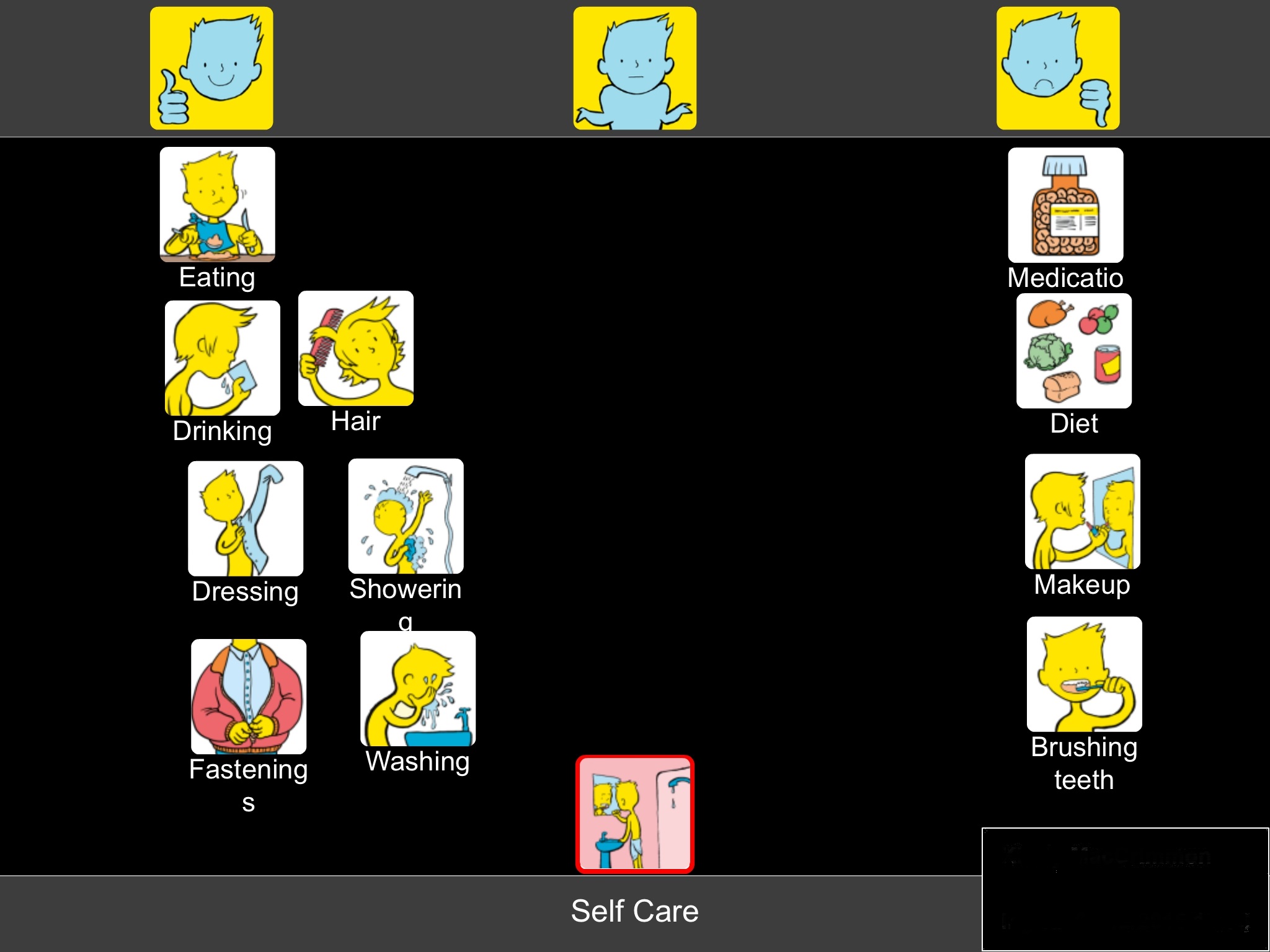
A man with early onset dementia has identified that he used to enjoy singing and has decided for the first time in his life to join a choir. This is not something that had come up in conversation before. Despite the diagnosis of dementia he has realised that he is still keen to try new things.
The wife of a man with severe aphasia said ‘This (Leisure away) has highlighted how few things he can do away from home. We discussed this but can’t see how we can change the situation.’ However at the second visit he used the same mat and indicated that he had been thinking about his mobility and was about to start swimming and a fitness class.
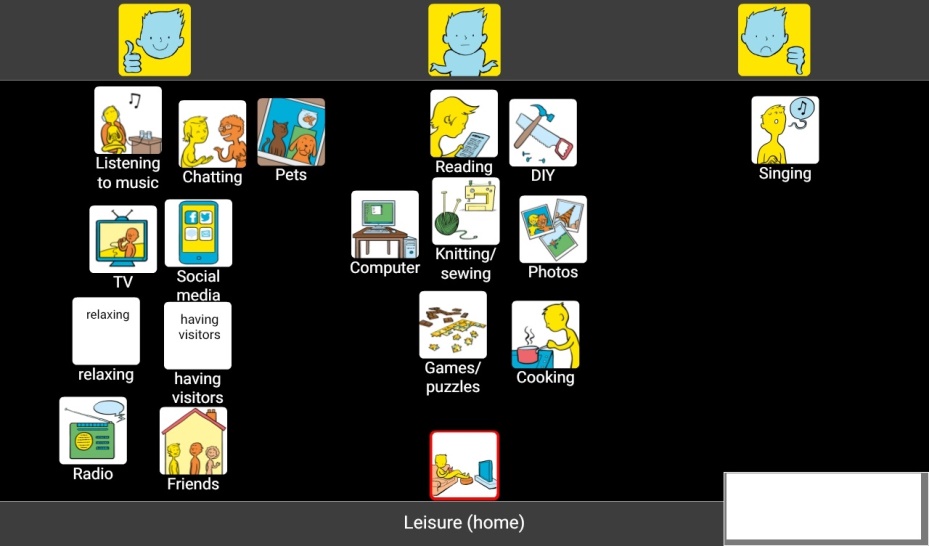
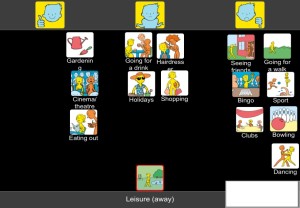
We already have an increased awareness of the meaning of self-management as we observe how participants are using the Digital Talking Mats to think about their situation, state their own views and share them with carers/support workers. We are also noticing that there is a shift in some relationships as the carers/support workers realise that the person with the long term conditions can make decisions and express their own views rather than having decisions made for them.