Online training login

This blog describes the foundation Talking Mats course we ran for members of the National Involvement Network. Following the seminars and the work to design a Charter for Involvement ‘Taking Part Talking Mat’ described in a previous blog , 16 people attended our course run over three days with about a month between each session. The participants were 8 NIN members who all had a worker to support them as a learning partner. Their role was to assist with embedding the knowledge gained, and the implementation of the pilot ‘Taking Part Talking Mat’. The learning partners were equal course participants, and expected to complete all course activities e.g. make a video of themselves carrying out a Talking Mat
In adapting the foundation Talking Mats course we learnt lots! Here is a summary of key learning.
- That we had a great group of people who were keen to learn and develop their communication practice to become Talking Mats interviewers, or as we call them in Talking Mats ‘the listener’ ( as they are listening to someone’s views). They appeared to really enjoy the learning experience and were enthusiastic, embracing all tasks including making a video of themselves using Talking Mats with someone in their organisation. In Talking Mats we call the person doing the mat ‘the thinker’.
- That it was really important for us as trainers to focus on key information, not all information so as not to overload
- That movement helped learning. It was good to design activities with some potential for movement so that people were not sitting too long and that they could get up and stretch.
 For example, on the Talking Mats foundation course there is an activity that thinks about abstract and concrete language. We adapted this by using cut out coloured circles and got participants to think about the language load of a particular concept and place the symbol concept in the relevant circle.
 - Teaching the principles of Talking Mats and getting the participants to follow the rules e.g asking open questions, introducing blanks, the check and change stage was relatively easy. What was more problematic was supporting a listener to be flexible and person centred in the way they introduced an concept . Often it is important to give a relevant example to support a thinker’s understanding and our listeners struggled with that. To overcome this, we wrote specific examples on the back of the cards and designed some activities to give time to practice. Repetition of learning was important
- A detailed script helped, including what to say to introduce the Talking Mat
- That you needed to pay particular attention to the quieter members of the group –coffee breaks proved to be a useful time to catch up on their thoughts and feelings
- The role of the learning partner is critical. We were very fortunate in our partners. They were natural enablers and it showed. We relied on partners sharing a set of values, and believing that people with learning disabilities could learn and be a key member of the pilot project.. One person did not complete the project maybe because she felt uncomfortable. It made us realise if we were to do this again we should be explicit about values and the roles of the learning partner from the outset
- That the recording of interviews needs support, and it was key that there were was both a NIN member and a learning partner to enable that to happen
- That our partnership with ARC Scotland was key as they provided individual follow up advice to each of the organisations involved and provided a source of learning reinforcement , observation and support to each of the NIN members and their learning partner. They were also able to feedback to the course organisers about any areas of difficulty that needed further attention and input
- That Talking Mats empowers both the thinker and the listener. It gives a structure to make a conversation flow. The training itself not only gave the NIN members who attended a tool to communicate with others about how they feel, but also seems to have had a positive knock on effect on their confidence and we hope that continues.
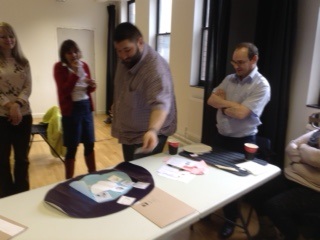
We are incredibly proud of our cohort of trained Talking Mats listeners. As part of the project they have been interviewing other service users in their organisations about 2 aspects of the Charter for Involvement –‘independence’ and ‘being involved in their community’ – ( 2 abstract concepts, as the NIN listeners will tell you). Not only has this included more people in service evaluation but has led to making changes that are improving lives.
For example
One woman was no longer being taken to church and she is now going and starting to be part of a local church community
One man who everyone thought was doing really well living on his own expressed a view that he was feeling lonely, He is now being supported to identify if there are enough people interested to start a local group.
Two videos were made by the group the first shows what they found out using their Talking Mats tool
Over the past 9 months Rhona and I have been delighted and privileged to work on the Charter for Involvement with members of The National Involvement Network (NIN) . The NIN is a Scottish wide group of people with learning disabilities who want to have more say over the services they use
They have developed the Charter for Involvement. This Charter has 12 clear statements that set out how people want to be involved in their own lives, their services and their communities. For example
- Statement 2- We have the right to be live our lives independently
- Statement 3 –We must be involved in our communities.
Organisations from a wide range of settings sign up to the Charter and commit to ensure their services put the statements into practice, as they are relevant to people everywhere. ARC Scotland is the organisation that supports the work of the NIN.
Partnership working
At a Scottish Government Keys to Life event at the Scottish Parliament James Fletcher Director of ARC Scotland and Lois got talking about how we could help services reflect on the extent they were meeting the Charter aims from the perspective of people who need extra support with communication, and the seeds of this project were sown. Feedback was it can be difficult for organisations to support the people who use their services to become truly connected and involved in the local community . In addition there can be a tension about supporting people to be more independent and autonomous when we live in a risk averse service culture.
Could we develop a Talking mat that would allow members of the NIN to explore statements 2 and 3 of the Charter . What aspects of living independently and being involved in their community were going well for them and what aspects were not going so well? Keys to Life was recognising the importance of social connectedness and the subsequent ARC application for money to do this in partnership with Talking Mats was successful .
Developing the Talking Mat
The first task in creating a Talking Mats is to unpick the meaning in this case the meaning of the two statements . What do we mean when we say we are involved or that we are independent? What does successful involvement or independence look like? To explore this we held three seminars with NIN members in Edinburgh , Glasgow and then Dundee . The groups initially started with a blank sheet of paper on which we would mind map their thoughts and ideas.As the seminar progressed we would bring in ideas from the earlier groups and after much debate reached a consensus. It was recognised there were too many items for one Talking Mat. It was decided to create two Mats, one that would deal with words and symbols that were easier to understand and more likely to be in people’s lived experience
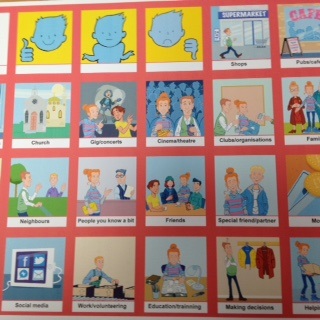
It included options such as Leisure centre, Neighbours ,Work/ volunteering. The other Talking Mat would contain the more abstract words and symbols . e.g Being accepted , Taking risks
It was recognised from the outset that there would be some people with a learning disability who would not be able to respond to the more abstract Talking Mat.
Design style
The Charter for Involvement has its own design and style and therefore it was agreed that The Talking Mat would fit into its brand and that we would work with their artist. The Talking Mats are called Taking Part (1 for the more concrete mat ) and Taking Part (2 for the more abstract) Once the Mat was created the training with Nin Members could commence but that is for another blog!
Exploring sibling attitudes towards participation when the younger sibling has a severe speech and language disability
We were delighted to receive this publication from a friend and colleague, Prof Juan Bornman from Pretoria in South Africa. It reports on a study carried out with 27 typically developing children who have a younger sibling with a severe speech and language disability. Juan and her colleagues used Talking Mats to carried out an adapted structured interview to find out the views of these children on four everyday life situations identified by the WHO-ICF-CY (World Health Organisation’s International Classification of Functioning, Disability and Health, Children and Youth Version).
The four topics were:
Communication
Domestic life
Interpersonal interaction and relationships
Major life areas.
The findings showed that the children were ‘most positive towards participation in play activities with their sibling with a disability. They were also positive towards participation in household tasks. They were less positive towards communication participation and least positive about participation in interpersonal relationships’.
The following example is taken from Juan’s publication.
 The overall findings suggest that the attitudes of the young children in the study towards participation with their younger siblings with severe speech and language disabilities were generally positive.
The article’s reference is:
Exploring sibling attitudes towards participation when the younger sibling has a severe speech and language disability. M Hansen, M Harty, J Bornman South African Journal of Child Health 2016 Vol. 10 No. 1
To read the full publication with details of the methods used and the results click here sibling-attitudes-2016
Delighted to introduce you to ‘The Communication Game’ : a board game for staff to improve their communication skills.
How we listen, talk and engage with people is fundamental to the quality and effectiveness of health and social care services. Although communication underpins everything we do in a work context, it can be a difficult topic for staff to talk easily about. Add to that the possibility of service users having an additional communication support need, through reasons like stroke, learning disability or dementia, then there is much potential for things to go awry and unfortunately, they often do. ‘Poor communication’ is cited as the most common cause of frustration in complaints about services.
The Communication Game was developed by Focus Games, NHS Education for Scotland (NES) and Talking Mats. It is a learning tool to help staff working in the health & social care sector increase their knowledge and skills around communication. The Communication Game is fun and easy to play. It can be played with or without a facilitator, and allows staff groups to have discussions and reflect on their communication skills. It allows them the chance to learn from each other. It will improve knowledge, but more importantly enable them to think about the small steps they can make to improve their interactions.
The project grew out of two previous projects funded by NES: Making Communication Even Better and Through a Different Door. In these projects, it was recognised that the experience of services for people with a communication support need is something of a lottery. For them, there was a considerable difference in the experience of interacting with a staff member who was empathetic and able adapt to their communication, to interacting with a member of staff who was struggling and unable to adapt their interaction. Training and understanding of inclusive communication practice is key. It has been a great privilege for Talking Mats to continue to support the work of the previous 2 projects and work with Focus Games Ltd to develop The Communication Game. Support during the development process from the Stroke Association Scotland, Capability Scotland, RCSLT, Scottish Care, Communication Forum, Queen Margaret University and NHS Ayrshire & Arran SLT Department have been invaluable, and we are very grateful; also to NHS Education for Scotland for their continued input and funding.
If you are working with staff in the health and social care sector, then this will be a great resource for you. You can get The Communication Game from the Focus Games online shop. It is guaranteed to promote laughter learning, and a touch of competitive team spirit. Most importantly, it will be a catalyst to help develop staff communication, making interactions better for people with communication support needs.
You can find out more about the game at www.communicationgame.co.uk
, and follow the game on Twitter on @Comm_Game.
Get your copy at www.focusgames.com.
Many thanks to Ruth Spilman, Senior Speech and Language Therapist, for this great blog about how she uses Talking Mats for Capacity Assessments with People with ASD/LD
I am a speech and language therapist (SLT) working in a residential provision for young people with autism spectrum disorder, learning disabilities and other co-occurring difficulties. We support young people from 7 up to the age of 20. Many of the young people are in a ‘grey area’ with a view to capacity assessments, including those aged 16-18. We support many capacity assessments, including deputy-ship for finances and care, health and welfare, as well as more individualised capacity assessments around restrictions in the environment, consent to medical interventions and making decisions about the future.
A large part of the way we support these capacity assessments is by using Talking Mats, which support people with autism who generally prefer to think about things visually. The young people are encouraged to use Talking Mats in their everyday communication, such as evaluating activities, lessons and therapy sessions to develop their skills, as well as during direct Speech and Language Therapy work. If a young person has proven their competence using a Talking Mat, we can then move on to supporting capacity assessments. As part of the process, the SLT would break down the concepts needed to be understood to identify if the individual has capacity or not. For example with finances, do they know what money is? can they organise things that are expensive and cheap? can they put items in a scale of least to most expensive? This would all be done using a Talking Mat, then followed up if they achieved this task with a range of further activities. A Talking Mat can then support activities to evidence their understanding or lack of, while also giving a young person all practicable help to communicate.
See below two examples of a young person thinking about 1) money to support their finances, and 2) things that are healthy or not.

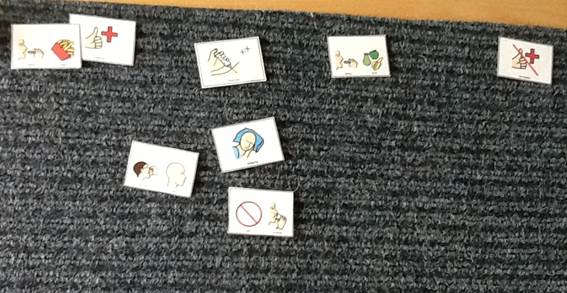
Talking mats are used for a range of different skills and assessments in the provision I work in, but their use for capacity assessment gives the young people the most practicable support with communication and allows for clear evidence of the person’s understanding of the concepts involved. In addition to the range of items mentioned above, we have have also discussed tattoos, physical intervention and behaviour support strategies, having a lock on an individual’s bedroom door, and understanding of fantasy and reality.
Talking Mats has proved to be a truly simple but brilliant and useful tool.
Ruth Spilman, Senior Speech and Language Therapist, Specialist services in education
The Cambian Group, Dorset, BH19 1PR www.cambiangroup.com
We are very grateful to Lauren Pettit and her colleagues from Pretoria, South Africa for sending us their published paper on a recent research project which used Talking Mats as a research method.
The study’s aim was to describe and compare the views of adults with aphasia, their significant others and their speech and language pathologists regarding the importance of nine life areas for the rehabilitation of adults with aphasia.
They used Talking Mats to support 15 adults with expressive aphasia to rate 9 life areas in terms of importance to them. The 9 life areas they included were Domestic Life, Relationships, Work and Education, Leisure, Self-care, Learning and Thinking, Coping, Communication and Mobility. These are taken from the World Health Organisation International Classification of Functioning Disability and Health (WHO-ICF). The researchers also obtained the ratings of 15 significant others and the 15 speech and language pathologists treating them.
They found that most life areas were rated as important to work on in rehabilitation by most participants. However, there were some discrepancies between the views of the adults with aphasia and the other 2 groups in the study and significant discrepancies were noted for 3 of the 9 life areas.
The graphs below show the comparisons of the 3 groups of participants. Click on graphs to enlarge
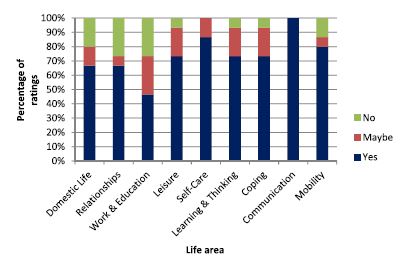 Fig1. People with aphasia
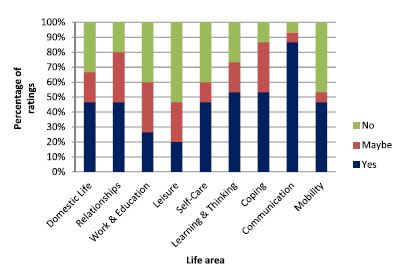 Fig2. Significant others
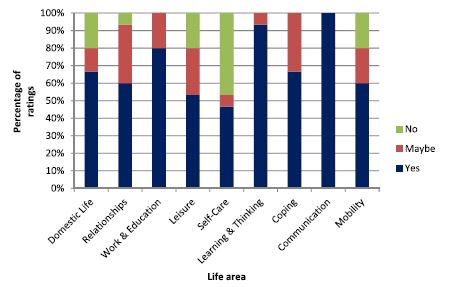 Fig3. Speech and language pathologists
The researchers suggest that ‘These life areas can provide the ‘common language’ for team members to engage in dialogue and identify problem areas related to the daily life functioning of people with expressive aphasia. By simplifying some of the labels of the activities and participation dimensions of the WHO-ICF and pairing these labels with pictures and the interactive Talking Mats interview procedure, adults with expressive aphasia (who often have difficulty participating in the selection of rehabilitation priorities) were able to express their own views. This may be a first step in assisting the adult with aphasia to advocate for themselves and to exercise their right to identify the activities and participation opportunities which they would like to access, and to set rehabilitation priorities based on their choice. While the overlap in priorities among the three groups as found in this study is encouraging, the presence of some significant differences underlines the importance of the voice of adults with aphasia themselves. This ensures truly client-centred rehabilitation that underscores the principles of human rights and a focus on competence rather than deficits’.
To link to the full article: http://dx.doi.org/10.1080/10749357.2016.1207148aphasia
Please contact info@talkingmats if you would like to discuss using Talking Mats in research
This blog summarises a project we have completed providing Talking Mats training for families living with dementia. A key aspect of the work done by Talking Mats is to find ways to improve communication for families living with long term conditions. In particular dementia is a long term condition where deterioration in communication will eventually affect everyone. This makes it increasingly difficult to ensure that the person with dementia continues to be involved in decisions about their life.
We have completed a project funded by Health and Social Care ALLIANCE Scotland. Training in the use of Talking Mats was given to families living with dementia and staff who worked with these families. The Alliance Family Training final report highlights how this training helped people with dementia to communicate their views and be more involved in making decisions about their lives.
Families identified issues relating to self-management that they had not previously been aware of and new insights emerged as the following comments illustrate.(click on box to enlarge)
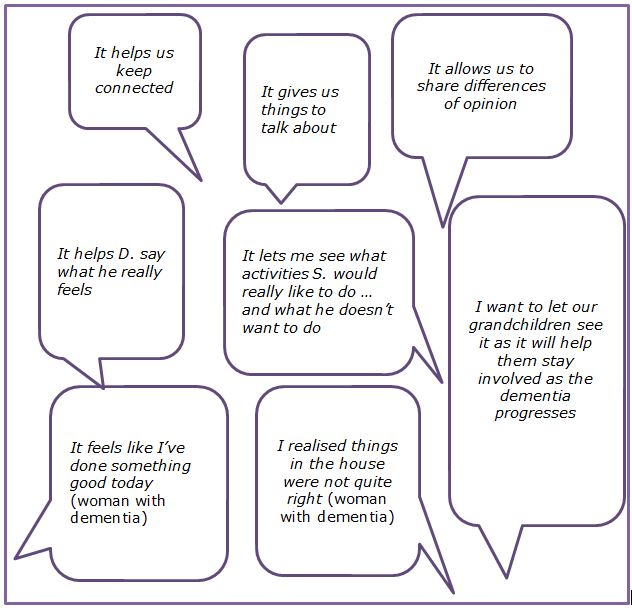
For some family members an important outcome was that Talking Mats helped them see that their spouse was satisfied with many aspects of his/her life. They found this very reassuring as many assumed that the person with dementia was frustrated and discontented.
The following is an example of how using Talking Mats helped with self-management.
When using Talking Mats on the topic of Where you live, G explained that he found it difficult to find his way to the toilet in the night. As a result his wife bought special senior night lights to help him which solved their problem. As a result, night times improved for both of them.
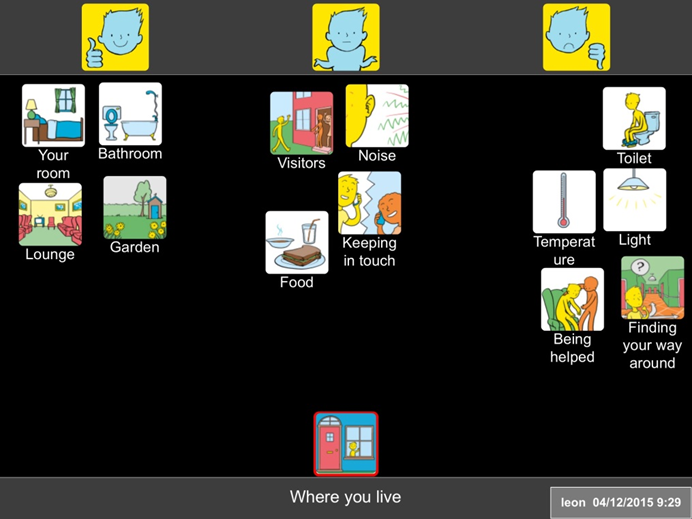
For further examples and information read the full report here Alliance Family Training final report and for further information about Talking Mats Family training please contact info@talkingmats.com
Thanks to Laura Holmes for telling us more about the innovative work in Stockport.
As part of an ongoing project, we at NHS Stockport Children’s Speech and Language Therapy Service are introducing the Talking Mats approach to support the children we work with to contribute to their own EHC Planning, enabling them to make their voices heard.
For example, I have used the ‘Consulting Children and Young People – My Body and Skills’ (Primary) digital resource to help identify and plan target areas for an 6 year old child with a diagnosis of Autism. I selected a top scale of ‘happy/unsure/not happy’ and chose a variety of options symbols from the resource. The child (R) was then able to drag and drop each option symbol to the area she felt it belonged in, producing the following talking mat:
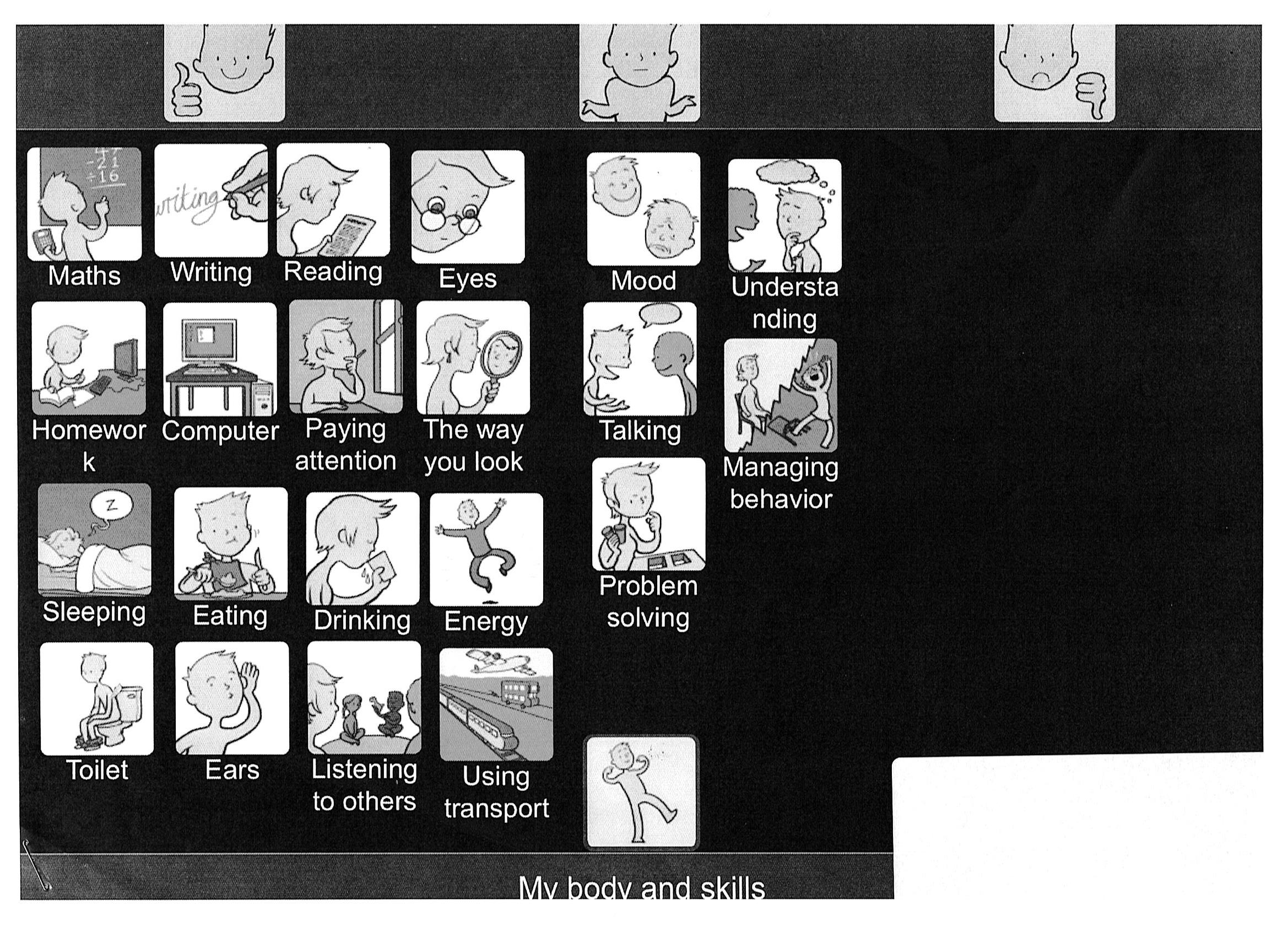
Whilst completing the mat the child volunteered further information about particular options – in general I find I get to know the children I work with much quicker using this approach!
Once complete, we agreed that we would sub-mat the option ‘talking’ (which had been placed under ‘unsure’) and explore that option as a topic in our next therapy session.
I then thought about all the possible options I wanted to explore in this submat, and created symbols using Boardmaker. I was able to add these symbols as options for the digital mat by taking photos using my Ipad and selecting them from my camera roll.
R completed the submat as follows:
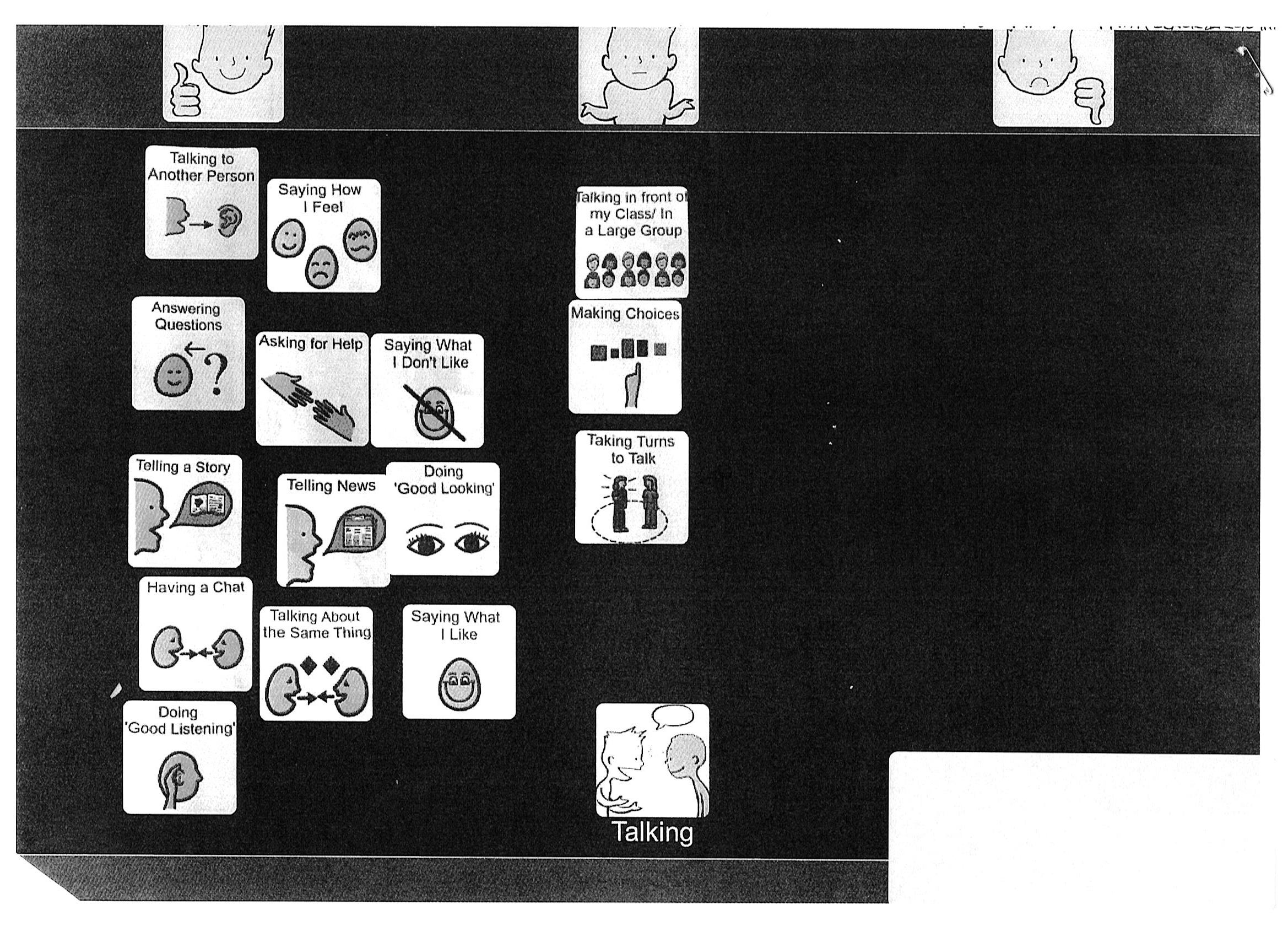
The mat enabled R to pinpoint the areas of talking she feels unsure about – i.e. ‘talking in front of my class/ in a large group’; ‘making choices’; ‘taking turns to talk’. I was then able to include this information in my review report, attaching the pictures of the mats as evidence of consultation. My review report included details of specific targets and recommendations to support R to work on the areas she had identified, which are designed to be incorporated into her EHC Plan.
We know from our own network that many practitioners are looking for training and tools to help implement the SEND reforms. Talking Mats are running a free seminar in Stockport to let practitioners see how Talking Mats can be used. The morning session is FULL but we have added an afternoon session. Book your place now as it is first come first served and places are filling up fast. Free Stockport afternoon seminar
Talking Mats considers both health and social aspects when it is used to include people in their care planning. Lots of interesting comments are made by course participants on the forum in our online training course. Annemarie, who works as an agency carer visiting clients in their own homes posted her thoughts about the social model of disability
Remembering the person behind the condition
In my experience, society is fixated on the medical model, the ‘what’s wrong’ approach. Whilst the medical model is clearly a valuable and required tool, it often leads to labels that individuals are then lumbered with, such as, ‘she has dementia’, ‘she is visually impaired’, ‘he’s deaf’ or has a ‘leaning disability’. Taking this approach overlooks the person behind the ‘condition’ and so can restrict inclusion. One example could be an individual with dementia being unable to make everyday choices about seemingly mundane issues such as what to wear that day. Using a medical model, a carer may be aware of the clients difficulties and make choices for them, whereas using the social model approach enables the carer to see beyond the condition and fully include the client, allowing them to be part of the decision making process for themselves. A second example could be a person with a communication disorder such as Asperger’s Syndrome. Access to work could be severely restricted using a medical model as the pragmatic manifestation of this condition may well exclude a person from seeking certain types of employment. Promoting the use of a social model would ensure work colleagues understood the possible limitations of the condition and ensure adequate support networks were in place. The social model attempts to embrace a person’s difference and raises awareness within society of individual needs that will facilitate inclusion into all aspects of life.
The WHO ICF -World Health Organisation International Classification Framework of Functioning, Disability and Health (2001, 2007b) aims to merge the medical and social model, encouraging professionals to think not only of the persons health condition and resulting impairment, but the impact this has on the persons participation and activities. It captures the full complexity of people’s lives, including environmental and social factors and can be applied over different cultures
The Talking Mats Health and Well- being resource is based on the WHO ICF and supports a person to reflect and express their view on various aspects of their lives. Using the Health and Well being resource supports workers to remember the person behind the condition.
We are delighted to have received funding from Life Changes Trust to work with Patient Opinion to help improve the access to their website by developing a Talking Mats to enable people to tell their stories.

Like Talking Mats, Patient Opinion is a Social Enterprise and has an excellent independent website https://www.patientopinion.org.uk/ that enables people to share their experiences of UK health services, good or bad. They then pass the stories to the right people so that they can learn from them.
The project we are working on is focusing on people with dementia but in the long run we hope that lots of people will benefit. It will bring our two innovative technologies together marrying the expertise of the Patient Opinion website with that of the Digital Talking Mats.
Our aim is that people affected by dementia can use their own voice to share their experiences and make real differences to relationships, services and culture, just as many others are already doing across health and care. We also hope that this work will empower others with communication or cognitive difficulties to share their experiences and be heard in an open and transparent way.
This ground breaking work is being funded and supported by Life Changes Trust, People Affected by Dementia programme. The Big Lottery funded programme is committed to working with people living with dementia and those who care for them, investing resources so that individuals are more able to face the challenges before them, and can exercise more choice and control in their own lives.
We expect the project to take 18 months to complete and have already run focus groups with people with dementia, family members and expert practitioners to plan the new symbols. We are now working with the technical experts to create the website interface which we will then pilot with people with dementia.
Watch this space for more updates…..