Online training login

After many years as a Licenced Trainer we are delighted that Claire has joined the Talking Mats team as a Consultant. In this blog Claire gives us an insight into her other passion and reflects on similarities between her yoga practise and Talking Mats.
A Tale of Two Mats: Synergy and learning from the yoga mat to a Talking Mat.

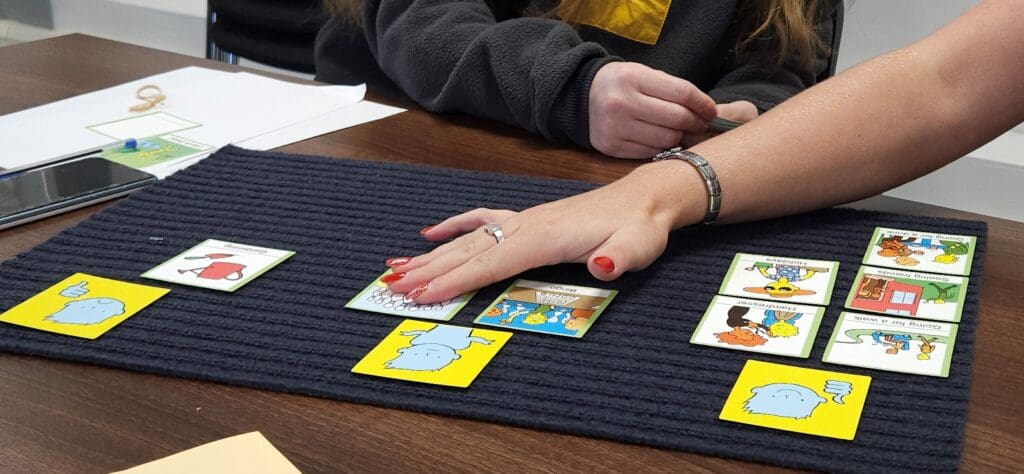
What can the philosophy and practice of yoga teach us about our approach to carrying out a Talking Mat? Claire delves deeper into the key learnings from yoga and how the yoga mat can inspire our approach to Talking Mats.
Until last year, I was the AAC Lead in an NHS Children’s Service, leading service developments and supporting colleagues with AAC, alongside a caseload of children and young people who need AAC to communicate. Part of my role involved delivering Talking Mats Foundation training to Speech and Language Therapists, other health professionals and education partners in the local area.
Now a Consultant and Associate Tutor for Talking Mats alongside independent SALT practice, I also qualified as a yoga teacher in June. One unexpected benefit of this fantastic opportunity for further study and reflection on yoga philosophy and physiology, is the profound influence it is having on my approach to Talking Mats.

Regulation
The definition of yoga according to Patanjali, is ‘the stilling of the mind.’* In yoga, it is this stilling of the mind that enables us to focus on combining our breath with our movement. How could this concept of stilling the mind benefit our Talking Mats practice? Can we put aside external pressures of our busy caseloads to give our full attention to the Thinker as an active Listener?
In yoga, we are guiding people to move away from the ‘fight or flight’ response of the sympathetic nervous system, to activate their parasympathetic nervous system, which puts us in a ‘rest and digest’ state. By tuning into ourselves during a Talking Mat, we can benefit the Thinker by modelling a calm and well-regulated state, assuring the Thinker that they have our full attention and empathy.
Furthermore, our Thinkers may well be in a dysregulated state when carrying out a Talking Mat and we will need to carefully consider the optimum time to work with them to be flexible and responsive to their needs. By ensuring that we are in a well-regulated state ourselves, we can fire copycat neurons known as ‘mirror neurones’ in the Thinker, helping them to co-regulate and engage more fully in the Talking Mats approach.
Put simply, by showing up in a calm state, we have the power to greatly influence the positive outcome of the Talking Mat for our Thinkers who will naturally absorb our emotional and regulatory state and subconsciously regulate their own responses accordingly. We are conveying to them that the Talking Mat is a safe space for communicating and for thinking, and that we are a safe person to guide and support them.
How can we regulate our own nervous system in this way? We could start by slowing down our pace and bringing awareness to our own breathing patterns before and during a Talking Mat. We could remind ourselves to breathe gently through the nose, and to engage the muscles of the diaphragm when breathing. Being an active Listener and holding space and silence for someone involves great concentration, known in yoga as ‘dharana*’ where we focus our attention on one thing. For a Talking Mat, the focus of our attention is the Thinker; and we can bring our attention not only to our Thinker’s words (either verbal or using other means of communication) but also to what our Thinker’s non-verbal communication may be conveying, from their posture and movement to their facial expressions and gestures.

Addressing the Power Balance
By focusing on regulation, we are working towards shifting the power balance away from the Listener towards the Thinker. But there are further ways in which we can ensure that the balance of power in a Talking Mat remains in the Thinker’s favour. Yoga philosophy teaches us to consider our limiting beliefs or limiting patterns, known as Samskaras*. Similarly with a Talking Mat, do we have preconceptions about how a Thinker might respond or are there others present who may unwittingly have expectations or influence how the Thinker will respond? One deeply impactful concept from yoga philosophy is the theme of non attachment* whereby we can be truly free in life by not attaching ourselves to a desired outcome.
Can we engage in a Talking Mat by practising non attachment in the same way? Can we respond to someone’s views and opinions with neutrality, with no expectation or anticipation of a desired response? By moving towards non attachment, can we practise cultivating our desire to facilitate, to listen, to hear and to act upon another person’s opinions, even if these differ from our own?
Conclusion
Like the Listener in a Talking Mat, a yoga teacher is there to guide and support people, rather than to direct or to push someone towards a particular pose or a particular outcome. Although we only touch on some of the underpinnings of yoga philosophy here, there is much to suggest that yoga philosophy shares many of the core values of Talking Mats, and that by looking inwards, we can find increased connection and understanding with our Thinkers. I am reminded here of Mahatma Ghandi’s observation that, “if we could change ourselves, the tendencies in the world would also change.”
Claire trained with Yoga Hero, Leeds @beayogahero as a 200h Vinyasa Yoga Teacher (Yoga Alliance Professionals accredited)
Notes
* Patanjali’s Sutras are foundational texts in yoga philosophy, believed to have been written anytime between 5,000BC to 300AD.
*Dharana is the Sanskrit term meaning ‘concentration’ and is the sixth of the eight limbs of yoga in the Ashtanga yoga system
*Samskara is a Sanskrit term, one meaning of which is our limiting beliefs or limiting patterns that mean we act in a way that we have already acted
*non attachment is a key theme of the Bhagavad Gita, a Hindu scripture that teaches about yoga philosophy
References
- Caird, J. Summer 2024. RCSLT Bulletin ‘Presence of mind.’
- Vyasa (2007). The Bhagavad Gita. Translated by Eknath Easwaran.Tomales, CA: Nilgiri Press.
- Sri Swami Satchidananda (2012) .Yoga Sutras of Patanjali: New Edition. Virginia, USA: Integral Yoga Publications.
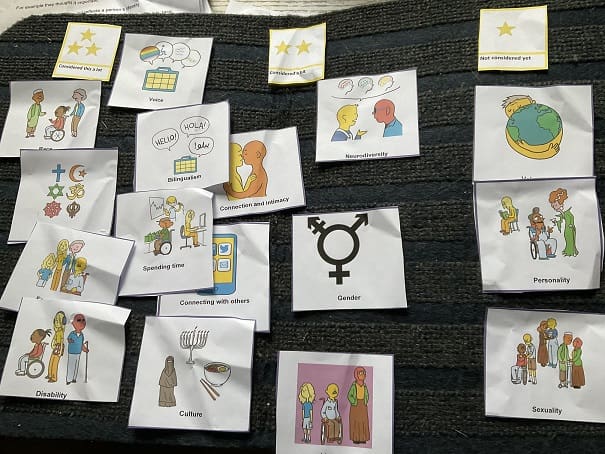
The previous blog (read here) described the development of a set of symbols to prompt discussions around identity. In this blog, the authors illustrate how the symbols can be used to support practitioners to consider their own ideas about identity and how this may influence the clinical relationship.
The completed resource was trialled with practitioners working in a variety of settings.
Feedback
‘It help me understand and reflect on my own biases and how I am slowly working to be more aware of them and ask the right questions’
‘This Talking Mat was an eye opener about my worries and anxieties around saying the wrong thing’
Overall practitioners reported that using the resource helped;
• understanding and reflection on own biases and challenge default assumptions
• consideration of wider aspects of identity that were not routinely thought about
• holistic thinking by encouraging seeing clients in a wider context
• stimulate ideas about different questions to ask
• provide a safe platform for staff to open up
• address your own anxieties as a professional about getting it wrong and fear of ”putting your foot in it”.
It was also agreed that the resource could be used in diverse settings and not only within AAC.
Next steps
At the start of the process we were not sure where the discussions with the original project group would lead but the results of the pilot have shown that this Talking Mats identity resource is helpful for practitioners to mindfully reflect on their practice, allow unconscious bias to rise to the surface, consider all aspects of their clients’ identity to develop their practice, contribute to reducing inequalities and improving the responsiveness of services.
Many thanks to Peter Just, Head of External Affairs, RCSLT and Padraigin O’Flynn, External Affairs Assistant, RCSLT for this blog describing the newly launched UK-wide RCSLT Survey, which includes free Talking Mats resources to support those with communication difficulties to have their voices heard.
Like many of you, the Royal College of Speech and Language Therapists (RCSLT) has been worried about the impact of COVID-19 on people with communication and swallowing needs. Based on what we’ve heard from our members, service user organisations and service users themselves we’ve been very concerned about how the UK-wide lockdown (March-June 2020) affected people’s access to the speech and language therapy they and their families and carers need.
To help us understand the issue better and to inform our response, we’ve just launched a UK-wide survey. Following consultation with service user organisations, the three key questions we’re asking are:
- How did lockdown affect your speech and language therapy?
- What impact did this have on you?
- What are your thoughts about the future?
From the start, we were clear: we wanted the survey to be as accessible as possible to as many people as possible, no matter how they communicate and no matter what their communication preference is. Over the past couple of months, we’ve worked with members to produce the survey in a range of accessible formats.
We’re particularly delighted that one of those formats is Talking Mats – and we’re very grateful to Lois and Laura for all their advice and support . As you will know better than anyone, the mats will enable people to give us their views and tell us how they’ve felt and are feeling. We are delighted the mats will provide people with the means to self-advocate – this will add a richness to the survey findings that they might otherwise lack.
We’ll be working with service user organisations to promote the survey to their networks. But we’d also really like your help too. Please share the survey and encourage as many people as possible to fill it out. The more voices we hear, the more stories we collect and the more responses we receive, the greater the impact of the survey findings will be.
Those findings, which we hope to publish early in the New Year, will be used to influence Governments, Parliaments and Assemblies across the United Kingdom. The case that will be making to ministers, officials and parliamentarians – that people must have access to the speech and language therapy they need – will be all the stronger for it being based on service users’ lived experiences. The very powerful testimony that the mats will provide will strengthen that case even further.
The survey is open until 5pm on Friday, 8th January 2021 and you can find more information about it here:
https://www.rcslt.org/learning/has-coronavirus-affected-your-access-to-speech-and-language-therapy
We hope you find the mats useful and if you had any queries or wanted any more information, please let us know. We look forward to working with you to help make a difference to the lives of people with communication and swallowing needs.
Peter Just, Head of External Affairs, RCSLT
Padraigin O’Flynn External Affairs Assistant, RCSLT
We are really looking forward to our first ever Talking Mats Twitter Chat on Thursday 01.10.20 from 7.30 – 8.30pm!
It will be a great opportunity to share experiences and ideas – here are the questions we will be asking:


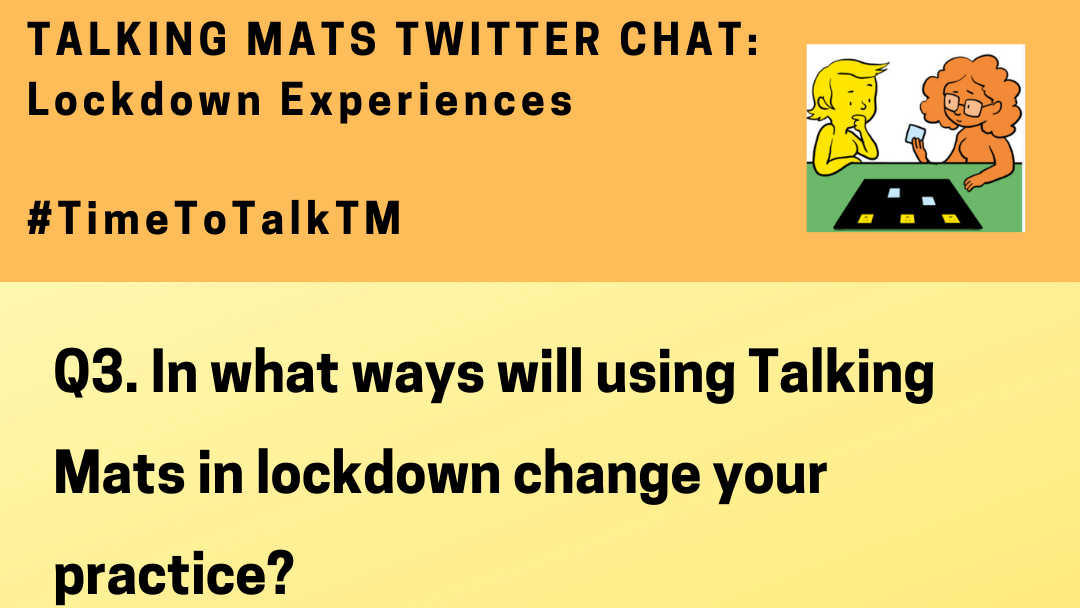
This will be followed by a brief summary of the key learning points from the discussion. Join in and remember to use #TimeToTalkTM in all your comments – we look forward to chatting with you all!
We are delighted that we now have around 20 members of our Talking Mats (TM) research group. Members come from a variety of countries including the United Kingdom, Denmark, Cyprus, Germany, Sweden, Australia and Japan! We are a mix of academics and practitioners, with many combining both roles. So far we have spent time getting to know one another via video sessions and thinking about how the group might work.
We have decided our initial focus will be thinking about ways of analysing the data that is generated from conversations that are supported by TMs. This idea was suggested by Nikita Hayden. Nikita is a PhD student at the University of Warwick exploring the outcomes of siblings of children and adults with learning (intellectual) and developmental disabilities. Part of her research has used TMs with children with severe learning disabilities and their siblings to further understand their sibling relationships.
The types of data generated have been rich, vast and varied, leading to an overhaul of Nikita’s initial plan to analyse her TM data. This has raised questions about how TMs are interpreted and analysed in a research context, and what scope there is for our group to explore and synthesise the analysis potential of TMs. This is a question that the TM team is often asked and so having some information on the different options would be useful.
TM discussions generate various types of data, including:
- The photograph of the mat (which symbols are placed under the various columns);
- The conversation generated during the discussion;
- The body language and facial expression of the ‘thinker’;
- The speed of placement of symbols;
- The symbols that are moved following feedback etc.
We would like to review existing publications that have used TMs as research data and think about possible methods of analysis. This may include consideration of both within and between group research analysis techniques. It may also involve exploring the potential of both traditionally qualitative and quantitative analysis techniques, such as thematic or conversation analysis, or by drawing on data from the symbol placements to provide pre-post evaluation data.
We hope to generate a list of guidelines about what you might need to take into account when considering how to analyse these data. A challenge when analysing TMs data, is how to handle the variation in the types of data collected between participants. For example, some participants may place a large number of symbols, whereas other participants may have placed relatively few. This raises questions about how we deal with ‘missing data’. In small samples, how can we conduct a pre-post evaluation where some symbols are missing for some participants? If some participants use a five-point scale, and some use a two-point scale, what numerical analysis potential is there, if any? How can we appropriately derive qualitative themes from across our sample if some of our participants were minimally verbal? What sorts of non-verbal cues have been analysed in research using TMs?
Please do share any ideas or questions you have with Jill Bradshaw, our Talking Mats Research Associate – J.Bradshaw@kent.ac.uk
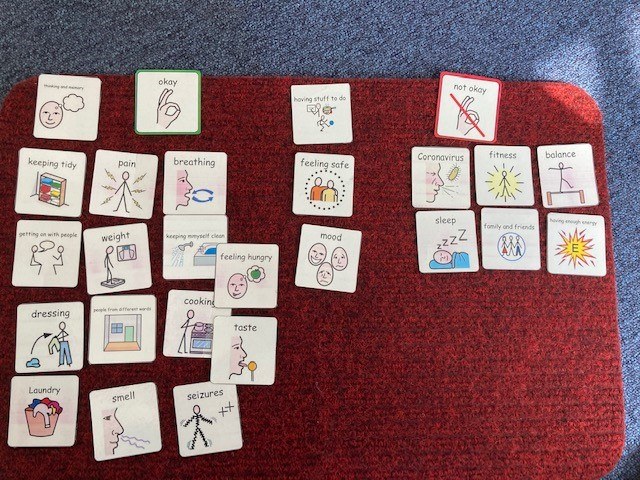
As a group of Allied Health Professionals (AHPs) working in a secure hospital we recently embarked on a mini project using Talking Mats to check in with our service users with learning disabilities during Covid-19. We collated the evidence from our respective professional bodies (Royal College of Occupational Therapy, Royal College of Speech and Language Therapy, Chartered Society of Physiotherapists and British Dietetic Association) in terms of changes that people might experience if they’d had Covid-19 and produced a talking mat around these.
It quickly dawned on us that we might be on to something here, and that creating an opportunity to ‘check in’ more broadly with our service users would serve a useful purpose, so we added some additional categories around changes to routine, psychological wellbeing and feeling safe.
This was my colleagues’ first experience of using talking mats, and their faces when I turned up clutching my 99p actual doormat were a picture! I introduced them to the theory behind the mat and its presentation and harped on about the benefits in terms of attention, comprehension, non-threatening interaction, initiation and structuring narrative; they nodded supportively.
We set off across our learning disability wards in multi-disciplinary pairs and all but a few of the service users agreed to have a chat with us. My colleagues commented that they were pleasantly surprised by the engagement and the amount and novelty of the information gained; we identified things that the service users hadn’t told anyone because they hadn’t been asked that question!
In talking to others we were asked why weren’t rolling this out in a partner secure hospital for people with mental health conditions? ‘no reason really, we just haven’t got there yet’ we answered. Then came the…. but we can just do it like a questionnaire with them. This question wasn’t, and in my experience isn’t ever ill meant. It comes from a place of naivety in relation to the presence of communication difficulties in people with mental health conditions and because of that, lack of exposure to different professional groups such as Speech and Language Therapy and the skills and approaches we have to offer. Skills in gaining and holding someone’s attention. Skills in decreasing pressure in communication situations. Skills in enabling time, space and ways in which people can initiate their thoughts.
The Multi-Disciplinary Team (MDT) working around the project has enabled me to show others how talking mats can support their practice. It has enabled them to see how a very simple and non-threatening visual tool can open up conversations and lead to information that the service users hadn’t shared before, in a way that a face to face conversation doesn’t.
Thanks to Jo Brackley, Clinical Lead, Speech and Language Therapy Secure Services at Cumbria, Northumberland Tyne and Wear NHS Foundation Trust for this inspiring blog – which demonstrates when we shift the way we listen and gather information from patients we get a different result and improve the quality of information and communication . If you or your team want to consider Talking Mats training then we can provide this for organisations . At the moment we can take a cohort through our online course together and then arrange a zoom call to discuss application to your work setting – email info@talkingmats.com for more information.
In our latest blog, Rachel Woolcomb, Talking Mats OT Associate, discusses how Talking Mats can support Reflective Practice for Occupational Therapists.
Taking time out to stop and reflect on our practice can be a challenge. We convince ourselves there are more important things to do, people to see, targets to meet, and therefore we just don’t have the time.
However, I suggest, that with this mind set we are doing ourselves, and the people to whom we provide support and care, a disservice.
Clinical supervision has always been embedded in the culture of occupational therapy and at its best should create a safe and supportive environment in which reflective practice can take place.
Unfortunately, in practice, the reality can look different.
The more I have used Talking Mats to enable my clients to think and express their opinions, the more I have been convinced, that there is also great benefit to them being used within the clinical supervision process.
I want to thank the occupational therapists who agreed to explore this further with me. They used Talking Mats to think about their coping skills at work, or reflected on how their ability to learn and think, impacted their job role.
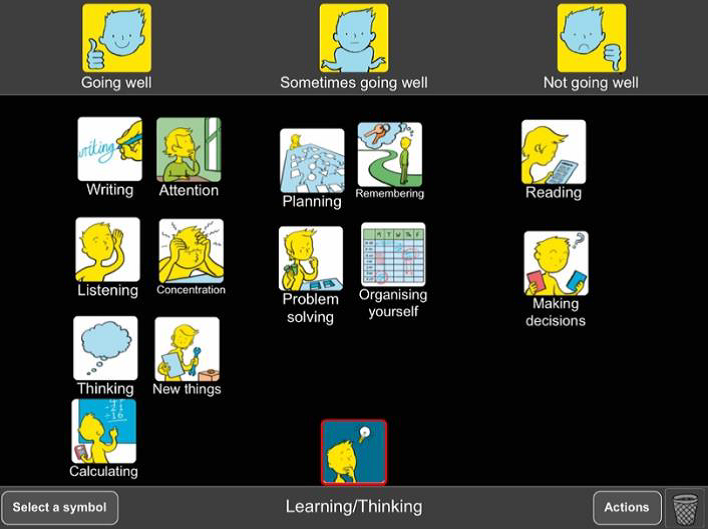
They were surprised how easy they found it to think about the full breadth of their working life and the impact this had on their wellbeing. As clinicians, we are great at looking after other people and ensuring that their health and wellbeing needs are met, however, we are not so great at caring for ourselves.
The latest TMOT resource provides more information about why and how, Talking Mats can be an effective tool in enabling a reflective thinking space for clinicians. Check it out here: TMOT3 Reflective practice
Give it a go… You are worth it!
To find out more about our Talking Mats resources, check out this link:
https://www.talkingmats.com/shop/