Online training login

The Effectiveness Framework of Functional Communication (EFFC) has been a vital tool for Talking Mats (TM) practitioners and researchers for over two decades. We are now inviting you to contribute your expertise to a crucial update!
Our Goal
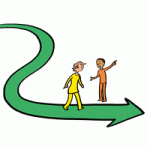
Our aim is to revise and refine the indicators and definitions within the EFFC. We need your practical knowledge and experience using TM in clinical, non-clinical, and/or research contexts to ensure the updated framework is relevant and robust.

About the Study
We will conduct this revision by involving a series of structured rounds to gather and synthesize your opinions as TM practitioners and researchers. You will be expected to participate remotely in each of the structured rounds via Qualtrics.

Who should Participate?
Please consider joining our expert panel if you meet the following criteria:
(a) You have received at least the TM Foundation Training.
(b) You are actively experienced in the use of TM in your everyday practice (clinical or non-clinical) or research contexts.

Why Participate?
Your participation and feedback are invaluable! By joining this study, you will help us make the necessary amendments to the EFFC, ensuring it is widely available and effective for use in various settings where individuals benefit from TM.
Contributing to this study can be considered as part of your ongoing CPD required for your annual registration.
Next Steps & Contact Information
Ready to contribute your expertise? Here are the contact details for the research team if you have any questions:
Dr. Şevket Özdemir
Mugla Sitki Kocman University (Turkey)
sevketozdemir@mu.edu.tr
sevketozde@gmail.com
Prof. Jill Bradshaw
University of Birmingham & Talking Mats (UK)
j.bradshaw.2@bham.ac.uk Jill@talkingmats.com
Cathy Darwell, MSc.
Hertfordshire Partnership University NHS Trust (UK)
cathy.darwell@nhs.net
Lois Cameron, BSc.
Talking Mats (UK)
Lois@talkingmats.com
Use these links to access the study’s link
Thank you to Julie King for this blog to mark Human Rights Day 2025.
When we use tools like Talking Mats, we create space for honest conversations, meaningful choices, and genuine inclusion. Having a voice and being part of decisions that shape our lives, is a human right, not a privilege.

What Is Supported Decision-Making?
Supported decision-making is about walking alongside people as they explore their options, understand what matters to them, and take part in decisions that shape their lives. Although this approach is highlighted in the UN Convention on the Rights of Persons with Disabilities (UNCRPD), its values reach far beyond it. Anyone who needs support to be involved in decisions has the right to receive that support.
It’s a compassionate, rights-based view of autonomy and inclusion—recognising that people may make decisions independently, with support, or somewhere in between, depending on what they need.
Human Rights and Ethical Practice
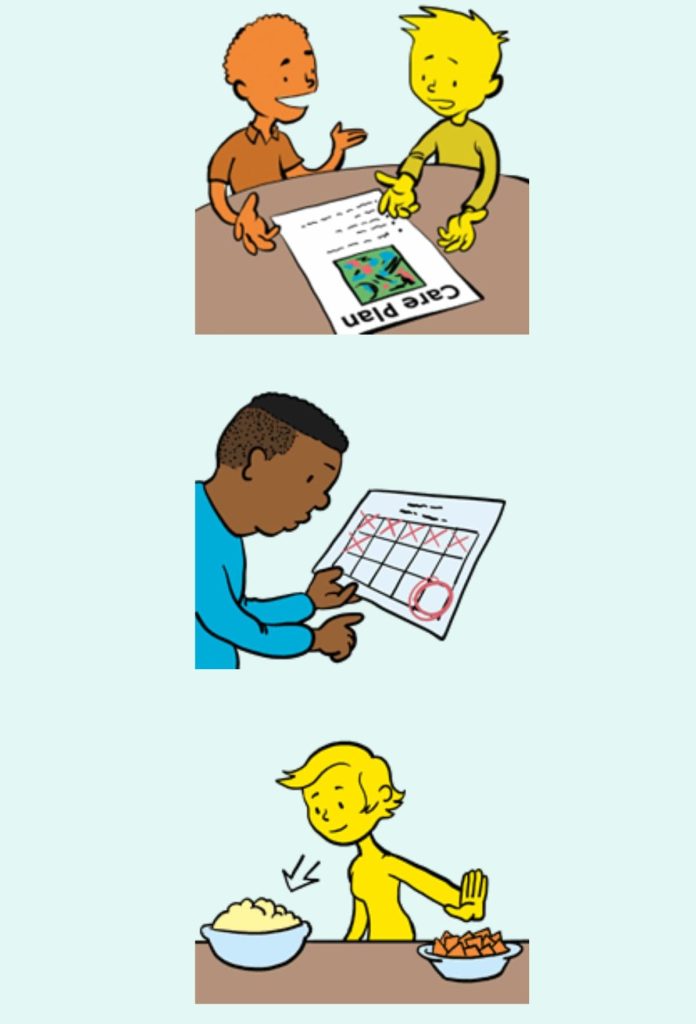
Human rights are not determined by someone’s capacity. A person’s capacity can vary and depends on the decision at hand, but their right to be included in decisions about their life never changes. Tools like Talking Mats help create ethical, rights-based practice by:
• Reducing power imbalances
• Challenging assumptions about ability
• Ensuring decisions reflect the person’s own views
These principles are closely aligned with human rights law and best-practice guidance on supporting capacity and consent.
How Talking Mats Helps
Talking Mats is an evidence-based communication tool that utilises symbols and a visual scale to help individuals think about topics that matter to them in a structured manner. It can be used across various areas of life, from everyday choices about personal care and routines, to decisions about where and with whom someone lives, health and wellbeing, representation and advocacy, and planning for the future.
This year we launched Capacity; enabling supported decision making and we have 2 new opportunities for practitioners to develop their skills in this area.
1. Advanced Webinar: Supporting Capacity Decisions
Feb 24th 9.30am – 12.30pm
For practitioners who have already completed the foundation Talking Mats training. This session will focus specifically on supporting capacity decisions, providing practical strategies and enhanced skills to apply in your daily practice.
Cost £95 including the Capacity Resource
2. Combined Foundation Training: Capacity Assessment and Supported Decision-Making
For organisations who want their staff to develop skills in Talking Mats, we are introducing a trial Capacity and Talking Mats foundation course integrating the core Talking Mats framework with a particular emphasis on capacity assessment and supported decision-making. We are offering this at an introductory rate for the first two organizations to book before the end of March 2026. This training is for up to 16 people and includes 4 copies of the new Talking Mats , Capacity; Enabling supported decision making resource If this is of interest to your organisation ask info@talkingmats.com to send further details.
On Human Rights Day, let’s reaffirm our commitment to honouring each person’s choice, dignity, and autonomy. Supporting someone’s communication isn’t just helpful—it’s a vital part of respecting their human rights.
Thank you to Gerard Wainwright – Clinical Educator at St Anne’s Charity in the North East of England and Talking Mats Licenced Trainer– for this personal blog where he reflects on Talking Mats and his autism.

Retaining Information
My Talking Mats journey started when I completed the Foundation Training last year. That day left me feeling enthused about the potential of using Talking Mats in my work but also led me to reflect more deeply on my own communication and the impact of adopting a Talking Mats approach in terms of my autism.
In a situation where there is a lot to process, I often find it difficult to accurately recall the details. For many autistic people, their ability to retain information is affected when under pressure – we can experience delays in retrieving knowledge, or lose the ability to retain it altogether, because of stress, sensory overload or emotional intensity. This is a natural part of the way an autistic brain processes information. Both socially and professionally this can make situations in which neurotypical people often thrive, difficult for an autistic person to negotiate. For me, that’s been a lifelong challenge, particularly relating to many things I do in my work, such as giving a presentation, providing feedback in a group, or chairing a meeting.
On the Foundation Training I was asked if I’d take the role of the Thinker with the trainer acting as Listener to demonstrate how a Talking Mat works. We then discussed the process as a group; the trainer identified the importance of the Listener passing the Option card to the Thinker to place in their chosen column on the mat. Afterwards, I had no recollection of doing this. I was surprised, however, to realise that I’d not retained something so important when I thought I was focusing on the task. This incident acted as a moment of clarity in terms of understanding the impact my autism has and a valuable learning opportunity.

Active Listening
One of the biggest lessons I took from that day was the importance of listening to understand rather than listening to respond. Being autistic, one of my communication strategies is to concentrate on my response. When I’m speaking to someone, I often have a lot to deal with. This includes navigating the sensory aspects of my surroundings, coping with the expectation to make eye-contact, background noise, distracting visuals, and maintaining personal space, all of which make the concept of listening to understand a significant challenge. Prior to the Foundation Training I considered myself a good listener, but that day led me to review this assumption and consider more closely the obstacles I face in being an active listener.

A Visual Framework
What Talking Mats provides me with as a Listener is a framework and an aid to memory. We know that the brain processes visual information more quickly than spoken words. Whilst words are ephemeral, to me at least, the picture remains on the mat as a constant reminder during the Talking Mat conversation. I naturally feel more comfortable with formality than informality. Clearly identified rules provide a structure and sense of permanence that I understand and can anticipate. It reduces spontaneity and the unexpected. Significantly, it decreases anxiety, which is at the heart of my inability to retain information in certain circumstances. I realise that to many neurotypical people this may sound unnatural – I’d argue that’s an assumption based on a neuro-normative viewpoint. Personally, it’s a lifeline and can support me to be a much more effective communicator and listener.

Preparation and Predictability
Autistic neurology often thrives on preparation and predictability. Talking Mats provides the structure, tools and format to support this. Training to become a Licenced Talking Mats practitioner has provided me with an approach and resource to support people with learning disabilities to be heard and have their opinions valued, to make more nuanced decisions, and achieve greater self-determination. It’s also provided me with a means to communicate in a way which supports and affirms my autism, the way I think and process information. It helps me to communicate more effectively, and crucially to feel safer within a predictable and comforting framework in which I can draw on my strengths, develop my listening skills and be my authentic self.

Reasonable Adjustments
Monotropic brains often focus deeply on one thing at a time. This is an aspect of being autistic I really value, because it allows me to be highly effective in certain situations, complete projects on time, work autonomously, develop detailed knowledge, and bring a strong sense of passion to the things that are important to me – it’s a defining characteristic and forms a strong part of my identity and sense of self. However, this can also make shifting attention challenging, which I mitigate by creating time between assignments, tasks or even transitioning from work to home. Time alone, even for a short period, helps if I’ve been around people for a significant time. I recognise the need to set boundaries and resist systems that weren’t built with autistic people in mind. I find that being clear with people often helps. If I’m given an opportunity to show the value I can bring, people are usually more accepting of any adjustments I may need. Being part of the Talking Mats community has created such an environment, as was demonstrated on the recent licensed training I undertook with the team at Stirling University.

Empowerment
Talking Mats has, unexpectedly, provided me with a format and framework that enables me to develop and thrive as an autistic person. It helps me to anchor my communication, to self-regulate and reduce the cognitive load, to minimise potential anxiety, and creates a safe space which is ultimately empowering. It supports my strong belief in giving opportunities to people with learning disabilities to have a voice, to be seen, heard and valued, to make decisions and have agency.
If you are trained in Talking Mats and would like to become a Licenced Trainer in 2026 you can
More information on Foundation Training can be found here
“It’s the power of simply being heard“
At Talking Mats, we’re passionate about supporting mental well-being through better communication. Over the years, we’ve explored a wide range of mental health topics—sharing insights, resources, and real-world experiences to help individuals, families, and professionals navigate emotional well-being more effectively.
To mark World Mental Health Day (or just to celebrate the power of thoughtful conversation), we’ve curated a list of our Top 10 Mental Health Blogs. These posts reflect the heart of what we do: listening with empathy, empowering choice, and giving people the tools to express how they truly feel.
We hope this collection inspires reflection, understanding, and meaningful dialogue around mental health.


You can also access the blogs listed above by clicking the following links:
We’re excited to invite you to take part in piloting the new Talking Mats Spirituality Resource.
This new resource has been developed by The Centre for Autism and Theology at Aberdeen University in partnership with Talking Mats. It grew out of:
- The research of Leon Van Ommen, who has used Talking Mats in his academic work.
- A workshop in Aberdeen (April 2025) attended by representatives from Muslim, Sikh, Buddhist, Pagan, and Christian communities.
- Ongoing contributions—including from a representative of the Jewish faith—through emails, online meetings, and collaboration with the Talking Mats artist.
Our aim has been to create a resource that opens conversations about spirituality in a way that is broad, accessible, and inclusive.
What’s in the Spirituality Resource?
The resource covers four key topics:

Your faith community
Focus: people, relationships, activities, and important life events.

Your place of worship – accessibility and sensory
Focus: sensory experiences, accessibility, and safety.

Spiritual practice
Focus: creativity, contemplation & stillness, and action. This topic can be used with people with no faith community

Beliefs
Focus: exploring specific religious beliefs in a short, focused way.
If you are Talking Mats foundation trained, then please consider volunteering.. We are looking for twenty volunteers. If you are interested please email paula@talkingmats.com giving her details of
- your foundation training,
- why testing this resource would be useful to you
- the faith background of those you will test it with – that includes those with no religious beliefs for Mat 3
We will send you the pilot resource as a PDF ( you will need to cut it up!) in return we will ask you
✅ To use the resource with at least one person (more is even better).
✅ For each person, fill in the feedback form we’ll send you the link .
✅ Share what worked, what didn’t, and your suggestions for improvement.
Deadline
Please return all comments and feedback by 10th October 2025.
Thank you to Lois Cameron and Nikky Steiner for this tribute to their friend and co-author.
We are extremely sad to hear about the death of Lucia Tullio and extend our deepest condolences to her family.
Lucia became involved in Talking Mats during the pandemic when the Central London community health trust gave a small grant to develop a resource to explore identity, diversity and equality in AAC practice. Lucia who, used AAC, became a core and active member of the group. The group met regularly on zoom and spent considerable time unpicking the components of our lives that contribute to our identity. After those components had been identified the group spent time thinking about how these could be represented in symbol form. This was not an easy topic but Lucia loved the challenge. Articulating her thoughts and ideas through her AAC often took a long time but the wait was always worth it as the Lucia’s contributions were helpful and wise.
Lucia stayed on working on the second part of the project which was to create a resource that clinicians could use as a reflective tool. It was a privilege to work with Lucia and it was wonderful to be able to present with her in person at the Communication Matters conference in 2023. One of the things that Lucia was passionate about was challenging the assumptions that people made about the intelligence of people who used AAC. Her thoughtful and perceptive contribution to developing the Equality, Diversity, and Inclusion Talking Mats springboard challenges the assumptions that people might make and is a legacy and tribute to her.
The resource and the video to demonstrate its use are available here for anyone to download.
The article, Equality, Diversity and Inclusion: A Resource to Support the Exploration of Identity within Practice by Lois, Nikky and Lucia can be found in Communication Matters (2023), Volume 38 number 2
Thank you to Meredith Smith for this follow up to her 2024 blog. In it she described the development of a Talking Mats Resource that allowed young people with Cerebral Palsy to monitor and report on their pain. In this blog Meredith shares what was learnt and the next steps for making the tools freely available.
Why we did this work?
Chronic pain management services are underutilised by children and young people with Cerebral Palsy (CP). Traditional pain assessment tools are filled out with pen and paper, but this can be difficult for many children with CP, especially if they have communication difficulties. Often an adult fills out the form for them, which means we don’t get a true sense of the young person’s perspective.
We worked with Talking Mats to create two different ways to use two pain assessments; the modified Brief Pain Inventory (mBPI) and the Fear of Pain Questionnaire (FOPQ). One approach still used pen and paper and the other used Talking Mats .
Figure 1: Fear of Pain Questionnaire – adapted for CP, pen and paper version

Figure 2: FOPQ; Talking Mats version

How we made sure the tools were valid.
We wanted to make sure these tools measured what they were supposed to measure, and that they made sense to the people using them. This is known as ‘content validity’ (1), and is considered the most important property of any assessment tool. We used a three step process to achieve this, and published three peer-reviewed papers with the findings:
- We asked people with CP, their families, and clinicians how the tools could be improved, and gathered their feedback suggestions.(2)
- We ran an online survey to see which suggestions from step 1 people agreed should be used to improve the tools.(3)
- We tested the new tools in one-on-one interviews with children and young people with CP, including those with a range of communication and thinking abilities, to see whether they understood the tools and if the tools were practical to use in real-life settings.(4)
The third step, when we worked directly with kids and young people to test the assessment tools, was the most fun! We found that most children and young people with CP were able to tell us about their pain using the adapted tools. This included those who used AAC (augmentative and alternative communication) and those with mild to moderate cognitive impairment.
The Talking Mats version was generally preferred by younger children (under 8 years), kids with cognitive difficulties, and AAC users. The symbols were easily understood by almost everyone. For most children and young people, it took about 4 minutes to complete the FOPQ and 6 minutes for the mBPI. For people using AAC, it sometimes took longer, up to 20 minutes,as they needed extra time to process questions and answer using their devices.
What we’ve done since
We then ran a larger study across three locations in Australia, using the CP-adapted tools with 128 children and young people as part of their usual care. We wanted to make sure the changes we made didn’t affect how the tools worked statistically (like how well the questions fit together), and to find out how many children and young people with CP could self-report on the impact of pain using the adapted tools.
This paper is currently under review with a journal, but the early results are really encouraging: up to 80% of children and young people with CP were able to give reliable answers about their pain using the adapted tools.
This is a big step forward. It means more children with CP can tell use directly how pain is affecting them, so we can better support and improve their access to pain management.
Want a copy?
We’re looking forward to making the tools freely available once our final paper is published. In the meantime, if you’re interested in getting a copy, please email Meredith.smith@adelaide.edu.au – we are very happy to share!
Use this link to access the questionnaires.
Please note: Talking Mats Foundation Training is required if you’d like to use the Talking Mats versions.
References:
- Terwee CB, Prinsen CAC, Chiarotto A, Westerman MJ, Patrick DL, Alonso J, et al. COSMIN methodology for evaluating the content validity of patient-reported outcome measures: a Delphi study. Quality of Life Research. 2018;27(5):1159-70. https://doi.org/10.1007/s11136-018-1829-0
- Smith MG, Gibson RJ, Russo RN, Karanicolas S, Harvey AR. Examining tools for assessing the impact of chronic pain on emotional functioning in children and young people with cerebral palsy: stakeholder preference and recommendations for modification. Quality of life research : an international journal of quality of life aspects of treatment, care and rehabilitation. 2024;33(8):2247-59. https://doi.org/10.1007/s11136-024-03693-1
- Smith MG, Gibson RJ, Russo RN, Harvey AR. Adapting two pain assessment tools for young people with cerebral palsy: a multi-stakeholder consensus study. Pain Rep. 2025:accepted for publication – in press
- Smith MG, Gibson RJ, Schibani M, Russo RN, Thirumanickam A, Harvey AR. The comprehensibility and feasibility of the modified brief pain inventory and fear of pain questionnaire adapted for children and young people with cerebral palsy. Quality of Life Research. 2025. https://doi.org/10.1007/s11136-025-03981-4
If you would like more information on becoming Talking Mats trained
Using Talking Mats within a creative participatory research framework with parents and Speech and Language Therapists (SLTs) to explore collaborative practice in Augmentative and Alternative Communication (AAC).
The mission statement of Talking Mats is to improve the lives of people with communication difficulties by increasing their capacity to think about, and communicate effectively about, things that matter to them. A few of us in the Talking Mats Research Network are interested in exploring whether the use of Talking Mats can enhance the capacity of different participant groups to articulate their thoughts on a topic of interest to those with communication difficulties. In the research discussed here, the participants were caregivers and professionals rather than individuals with disclosed communication difficulties.
Workshops
Talking Mats were used throughout a set of workshops conducted using Participatory Action Research (PAR) methods. PAR is a co-learning research process between communities and researchers which involves problem identification, action and reflection, leading to further inquiry and action for change (Chambers 1994; Kindon et al. 2007; Chevalier and Buckles 2013). The workshops were carried out as part of my PhD project, which aims to develop resources to improve collaboration between SLTs and caregivers of children who may benefit from AAC. Ten workshops took place across England; six with SLTs facilitated by me and two art student research assistants, and four parent workshops facilitated in a co-research partnership between myself and Joanna Holmes, a parent of an AAC user. These workshops involved a total of 20 SLTs and 25 parents.
Creative methods
We used a variety of creative methods such as clay modelling and drawing in this research. Art can be used as a tool for encouraging engagement in a research topic, promoting freedom of expression, reducing language barriers within multicultural communities and supporting those with literacy challenges. Art can also stimulate new thought about a topic of interest and help to articulate ideas in a fresh way. The use of Talking Mats as a visual framework to enhance thinking and communication integrated well with these creative methods.
The Talking Mat
A large group Talking Mat was used to visualise and discuss the ideas shared by our groups of participants. Traditional Talking Mats elements included the identification of the topic for discussion (collaborative relationships) and the use of a Top Scale, in this case, what improves the collaborative relationship (working well), what makes things worse (not working well) or is neutral. We used a set of shared pictures that were selected from printed and online resources ahead of the main set of workshops by a group of SLTs and parents. All participants were encouraged to engage with the set of shared pictures as per the photo response research method. Unlike a traditional Talking Mat, these pictures were not labelled to represent concepts or activities, instead participants could provide their own labels to indicate what each image meant to them. In addition to the shared pictures, participants produced their own drawings, clay models and post-it notes to represent their own ideas about collaboration. These were also added to the Talking Mat. This echoes the traditional part of the Talking Mat process where the Thinker is asked whether they have ‘anything else’ to add. At the end of the workshops, the pictures, drawings and models were placed onto the large group Talking Mat. Discussions about the meaning and the placement of the created items took place between participants and researchers. Objects and pictures could be moved within the Mat in response to discussion. Photographs of each Mat and audio recordings of the workshops were taken as a record for analysis.
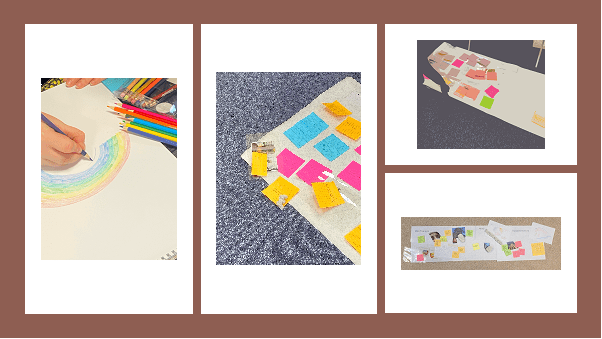
Within the Talking Mats Research Network, some discussion has taken place about how to analyse the data developed from these non-typical uses of Talking Mats, such as the group method presented here. Our group Talking Mats were analysed qualitatively to identify themes relating to collaboration as presented by the participants.
Sarah Hayward
Acknowledgments: Joanna Holmes
This research was carried out as part of Sarah Hayward’s PhD supported by a studentship from The University College London, Bloomsbury and East London Doctoral Training Partnership (Ubel-dtp), an ESRC funded organisation ES/P000592/1.
Sarah’s PhD is supervised by Professor Steven Bloch, Dr Daniel Hayes & Dr Michael Clarke.
Online Advanced Training, May 7th 2025
Thank you to Lois Cameron for this blog about our 2025 revised Thinking Ahead Resource
Why have Advance Care Planning conversations?
It is very important to involve people in Advance Care Planning, in Scotland this is called Future Care Planning. Evidence shows that people who are forward thinking and express their views, are more likely to receive the care they want. It results in less invasive treatment and provides comfort and reassurance. Having these conversations can also reduce the burden on relatives, friends and carers as they don’t have to work out what an individual wants.
The Thinking Ahead Talking Mats Resource
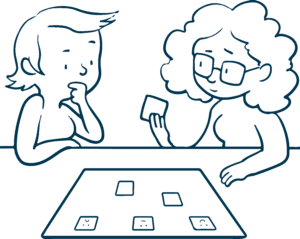
The Thinking Ahead Talking Mats Resource was developed in partnership with Strathcarron Hospice. Funding from Neurological Care and Support in Scotland allowed us to map the existing resource against other resources in this field and test it out more widely, particularly with people living with neurological conditions. Following this, we have made a few changes to the original Talking Mats Thinking Ahead resource and are now launching version 2
Why use Talking Mats ?
- Talking Mats provides a neutral space for people to reflect on what they are thinking.
- The Thinking Ahead Resource allows people to think about what they have organised, or want to organize, consider different options, and develop a plan to fulfil their wishes.
- It provides staff with a structured supportive way to have these conversations, supports them to really listen and have an easy way of sharing their patients’ views with others.
The feedback from our latest project shows what a helpful tool the Talking Mats thinking ahead resource is;
“They originally thought they had everything planned for the future but there were a few areas they had not considered and said they found it very helpful and plan to talk to their son” (participant 1)
“This was a positive but emotional conversation. My thinker shared a lot of her plans for leaving memories ……. I was a bit anxious about raising some of the topics with her as she has always been very reserved and hasn’t wanted to talk very much about the future, however following the mat she opened up in a way that she hasn’t before” (participant 8)
Thinking Ahead: Advanced Online Training

We learned a lot from the participants from our latest project and will share this learning through an advanced training session on the 7th May 9.30- 12.30. Each participant will receive their own copy of the Resource before the training session.
Delivered jointly by Talking Mats and Strathcarron Hospice the session will;
- explore how to introduce the Resource to support helpful conversation
- explore ways to personalise and make the Resource relevant to an individual’s specific situation
- discuss how to hold the emotion that can be generated
- discuss using with people with significant communication disabilities
- support you to think about using the Resource in your work setting and plan next steps
Learning will be through short talks, interactive activities, watching and reflecting on videos and small group discussion. There will be a mid-morning screen break.
To join this Thinking Ahead advanced training you need to;
- have completed the Talking Mats Foundation training.
- attend with a system that will allow you to join in the Teams chat during the session and go into small breakout rooms.
- book onto our Advanced training via the website shop before 7th of March.
The cost is £95 and this covers the resource and the training. Places are limited to make sure to book on soon. Resources will be posted out the week before training. Bookings close on the 25th of April.
If you’d like to become Foundation Trained there are lots of ways. Click on the button to find out more

I am sad to inform the Talking Mats world of the death of Professor Ivana Marková on 1 December 2024.
Ivana was Professor Emerita of the University of Stirling, Visiting Professor at the London School of Economics (UK), Senior Member of Wolfson College Cambridge, Fellow of The British Psychological Society, Fellow of the Royal Society of Edinburgh, and Fellow of the British Academy.
Born in Czechoslovakia in 1938, Ivana experienced first-hand the impact of WWII in Europe and the historical events that were to have a profound impact on her outlook and life. Assigned by the communist party to work as a technician in a chemical plant and not allowed to study full-time, she became an external student at Charles University in Prague, earning her doctorate in 1964. Following the Soviet Invasion of Czechoslovakia in 1968, she was forced to relocate her young family to England. After postdoctoral positions at the University of Cambridge and the University of London, she was appointed lecturer and then professor at the University of Stirling. From there she went on to become a leading voice in linguistics and psychological science, producing influential work on the epistemology of psychology, social and cultural psychology, dialogicality and linguistics.
I first met Ivana in the 1980s when I was a speech therapist working with adults with learning disabilities in Stirling with whom she was carrying out research. What an inspiration she was – gradually encouraging me to do my own research. Her intellect and analytic mind taught so much to my practical therapeutic one. She changed my life.
She was also just a wonderful person – kind, humble, generous and with a gentle sense of humour. We had many laughs over the years in Stirling and I will never forget her un-filing system! She has given an enormous amount to the world of communication and will continue to be an inspiration to many.
Joan Murphy