Online training login

The Children and Families Act 2014 makes clear that local authorities in England must have regard to the views, wishes and feelings of the young person and the parents. How do you ensure children and Young People are fully involved in decisions about their support and what they want to achieve? This blog describes how Talking Mats can be used to support the Education and Health Care Plans (EHCP).
A question like ‘What do you want to be able to do in the next 12 months, that you can’t do now ?’ is difficult for us all. For children and young people who struggle with communication, this is even more of a challenge.Talking Mats is an ideal tool to support the young person to consider this big question because it breaks down the dialogue into bite-size chunks, makes abstract concepts more concrete, and creates a visual record of the discussion.
The top scale can change depending on the topic and what the interviewer wants to find out. It can vary from
- things I like/ don’t like/ unsure
- things that are important to me / not important/ not sure,
- things I want to try/ don’t want to try/ not sure .
We have two resources that can be used to support conversations about planning :
- Health and Well being – this resource is based on the WHO ICF framework and allows you to have a topic focused conversation on the various aspects that make up well being
- Consulting Children and Young People this resource gives a much more holistic overview of how the young person or child is feeling about their lives
- Example from Health and Well being resource
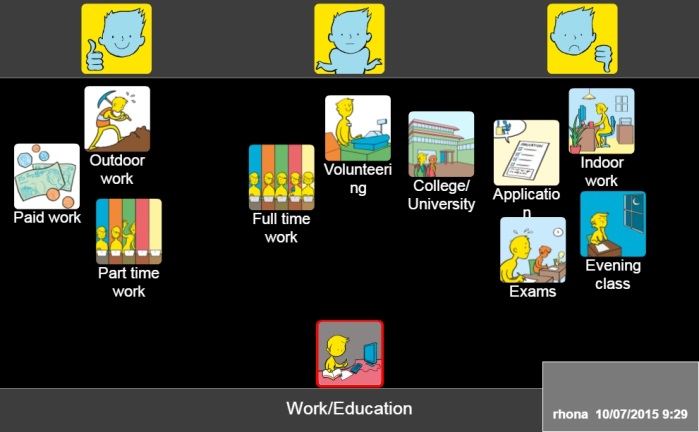
Using the work/education topic from the Looking after yourself set in the Health and Well –being resource, this pupil is able to express what his aspirations are post school. Click on picture to enlarge.
- Example from Consulting Children and Young People resource
This example came from a primary teacher and demonstrates how the process of using Talking Mats can help a young person reflect on their lives and in this case make positive change . The teacher told us about a pupil aged 8 who placed the symbol for ‘being listened to’ in the position for something he liked, and the symbol for ‘listening to others’ in the position for something he didn’t like. ‘That’s not right’, he exclaimed.
There was no miracle cure she said. ‘But it was like a light bulb going on!’ He began to engage with work on his interaction and listening skills and ended up a playground champion.
Free Seminar
We are holding a free half day seminar in London on the 20th October. The seminar is an introduction to how you can use Talking Mats to support pupil participation in planning . If you wish to attend please let us know by responding to our invite. We would love to see you. London Seminar Invite
Background
Social workers are required to complete a detailed assessment of their client’s needs. It is recognised that it can be a challenge to ensure clients fully participate in the process if they have cognitive or communication difficulties. The City of Edinburgh Council were keen to explore if we could adapt their standardized assessment tool and make it into a Talking Mat framework. Several staff in the council are already skilled practitioners in Talking Mats so are familiar with the framework and use Talking Mats in their practice. They are enthusiastic about the benefits of using Talking Mats both in terms of how it increases participation of service users but also because in their view it makes interviews easier for staff to undertake.
Structuring Talking Mats assessment framework
In order to develop the bespoke Talking Mat we held a seminar to discuss the social work assessment tool and approach used. Six key staff attended the seminar, facilitated by two Talking Mats associates. The discussion at the seminar identified a structure that would enable us to construct a coherent visual conversation that would cover the issues required to complete the assessment, using mind mapping to support this process. It is also important to identify a top scale that matches the question you are asking and make sure the options you are including are neutral and not leading.
The structure that emerged from this discussion is a Talking Mat that enables people to explore their views on 3 topics
- their home
- their health and well being
- their community involvement
Trialling the Talking Mats framework
Talking Mats then took the mind maps and developed these into symbol sets that were piloted by social work staff. At the end of the pilot a review was held and changes made which included alterations to
- the language used
- the symbols used
- the topic an option was included under
- making it clearer to staff when options were more abstract and required further explanation and or personalisation
Nicki Ewing from Edinburgh City Council who leads on the project says ‘ I am very excited that staff have a tool that can make assessment more meaningful for service users to participate in and makes it easier for staff to get good quality information’.
Next steps
We are thinking of holding a focus group for others that might be interested in using the framework for their practice if, you are interested please contact Lois via the info@talkingmats.com email – call your email ‘social work focus group’.
Thanks to Karen Wilson, a specialist teacher and one of our accredited trainers, who describes how Talking Mats can help in supporting Looked After Children in having their say.
‘I work as Principal Teacher for children with additional support needs in a mainstream secondary school. In supporting a wide range of children and young people, I am frequently involved in Looked After Children reviews. These reviews can be quite daunting for an adult, as all agencies involved with the young person are represented, along with their carers and their support agencies. I can’t imagine what it must feel like as the child.
Many of these young people find it difficult to express their views, partly because of the circumstances they find themselves in and partly because many of them have communication difficulties linked to their early experiences. I have been struck by how little information is often contained in their Having Your Say form. This should be one of the key ways for young people to express their views and is completed in advance of the review.
I recently used a Talking Mat to help a young person complete her ‘Having Your Say’ form. The young person reported that it was much easier to engage in the process and told me that she had enjoyed doing it. She normally does not like filling in the form. All of those involved in the review expressed surprise and delight at how much more information it was possible to get using a Talking Mat.
I am now working with Talking Mats to explore how this idea can be developed to give more of our Looked After young people a stronger voice in decisions which directly affect them.’
Have a look at the following blogs for further information on theTalking Mats GIRFEC resource and how it is being used
As part of the Right to Speak initiative Talking Mats was funded to develop ‘Promoting Inclusion and Participation’: an online learning resource for staff working with children and young people who use Alternative Augmentative Communication (AAC). We have been delighted to work with NHS Education Scotland on developing this free resource and also have really enjoyed working in partnership with the learning and development consultancy: Forum Interactive.
The complexity of care for children and young people who use Alternative and Augmentative Communication (AAC) is multifaceted. Ensuring that goals are centred on the young person and family’s needs is a constant challenge to practitioners. There are several resources that focus on developing the technical skills of developing AAC but there is a scarcity of resources that focus on the impact of AAC on the child’s day to day life.
Promoting Inclusion and Participation is based on an earlier project which determined the key indicators of a quality AAC service from the perspective of AAC users and their families.
Promoting Inclusion and Participation uses the following frameworks to help practitioners structure their decision making:
- International Classification of Functioning, Disability and Health – Children and Young People (ICF-CY)
- Janice Light’s Communicative Competencies (2014)
- GIRFEC (Getting It Right For Every Child) wellbeing indicators
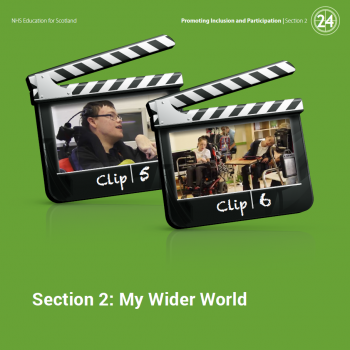 These are brought to life in a series of DVD vignettes which tell the stories from the perspective of the child, their families and schools. It poses the practitioners’ questions that allow them to reflect on the impact of AAC on the child’s day to day life. The resource is designed to be used for group discussion. The feedback from the expert practitioners that reviewed the material suggest that the DVD and resulting questions can enable AAC practitioners to have a rich discussion about best practice and how to time educational and therapeutic input to achieve holistic outcomes.
This on-line resource will help practitioners:
- Understand the role that collaboration and involvement play in delivering wellbeing outcomes for children who use AAC.
- Apply a holistic approach and outcomes focused approach to assessment, implementation and review which places the child at the centre.
- Recognise that as the child develops and changes, so the level of different team member’s involvement will ebb and flow.
Download the resource here. It takes a little time to download so be patient !
We would be delighted to receive feedback of how it is being used.
Ref
Light J , Mcnaughton D, Communicative Competence for Individuals who require Augmentative and Alternative Communication: A New Definition for a New Era of Communication? Augmentative and Alternative Communication, 2014; 30(1): 1–18
The inability to make a decision could be because of a learning disability, mental health problems, brain injury, dementia, alcohol or drug misuse, side effects of medical treatment or any other illness or disability. Click here for further information.
Both the Mental Capacity Act (2005) in England and Wales and the Adults with Incapacity Scotland Act (2000) identify the following components which determine whether or not someone has capacity to make their own decisions.
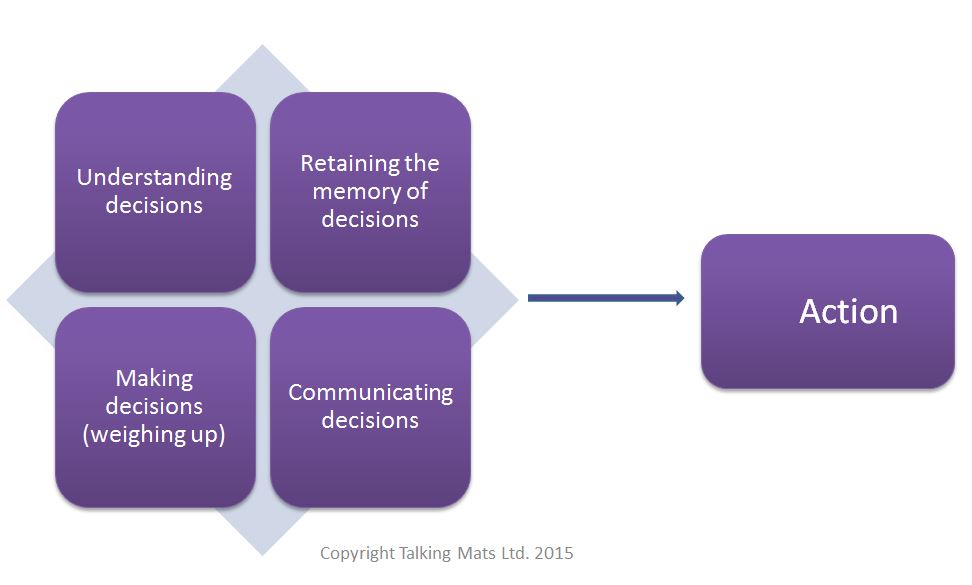
There are a number of additional assumptions that are central to determining whether or not someone has the capacity to make their own decisions:
• Every adult has the right to make decisions unless proved otherwise
• Everyone should be supported to make their own decisions
• People should be given the support they need
• People are entitled to make their decision – good or bad
• Each individual has a different capacity to make decisions about different aspects of their life.
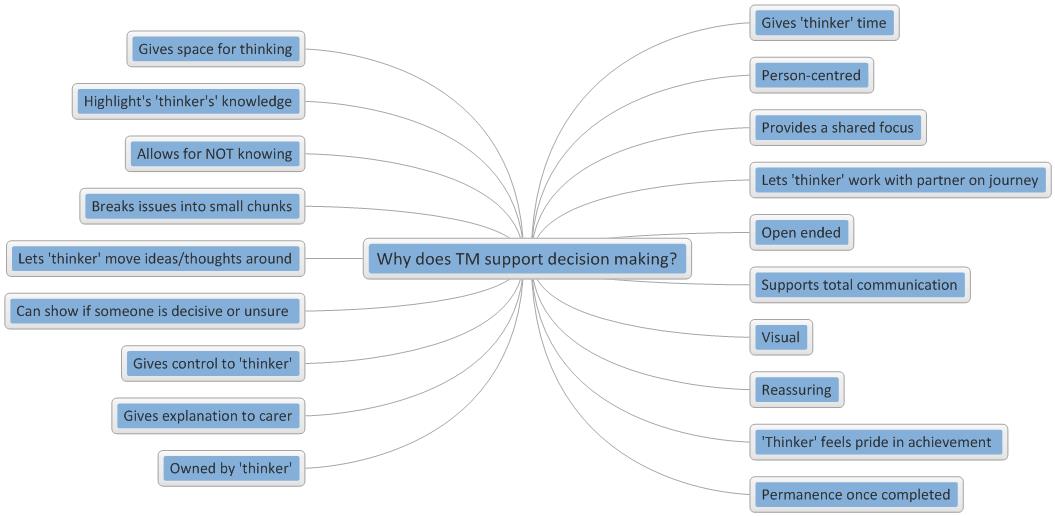
We have been running seminars on how Talking Mats can be used to support a person’s capacity to make decisions.The diagram below illustrates some of the comments we received form participants at a recent seminar about the benefits of using Talking Mats to support decision making.
Click on the diagram to enlarge.
The process of completing a Talking Mat helps people retain their view and if they have memory problems the picture of the mat is a good prompt to enable recall.
Its worth noting that our brain processes visual images 60,000 faster than text!
Getting feedback on AAC services is particularly challenging because of the communication support needs of this group of people. It is therefore really important for AAC users to have the chance to say how they feel about the services they receive. Services need to make sure that this group of people have a voice and that there is a mechanism for their views to be taken into account in monitoring the quality of services and service planning.
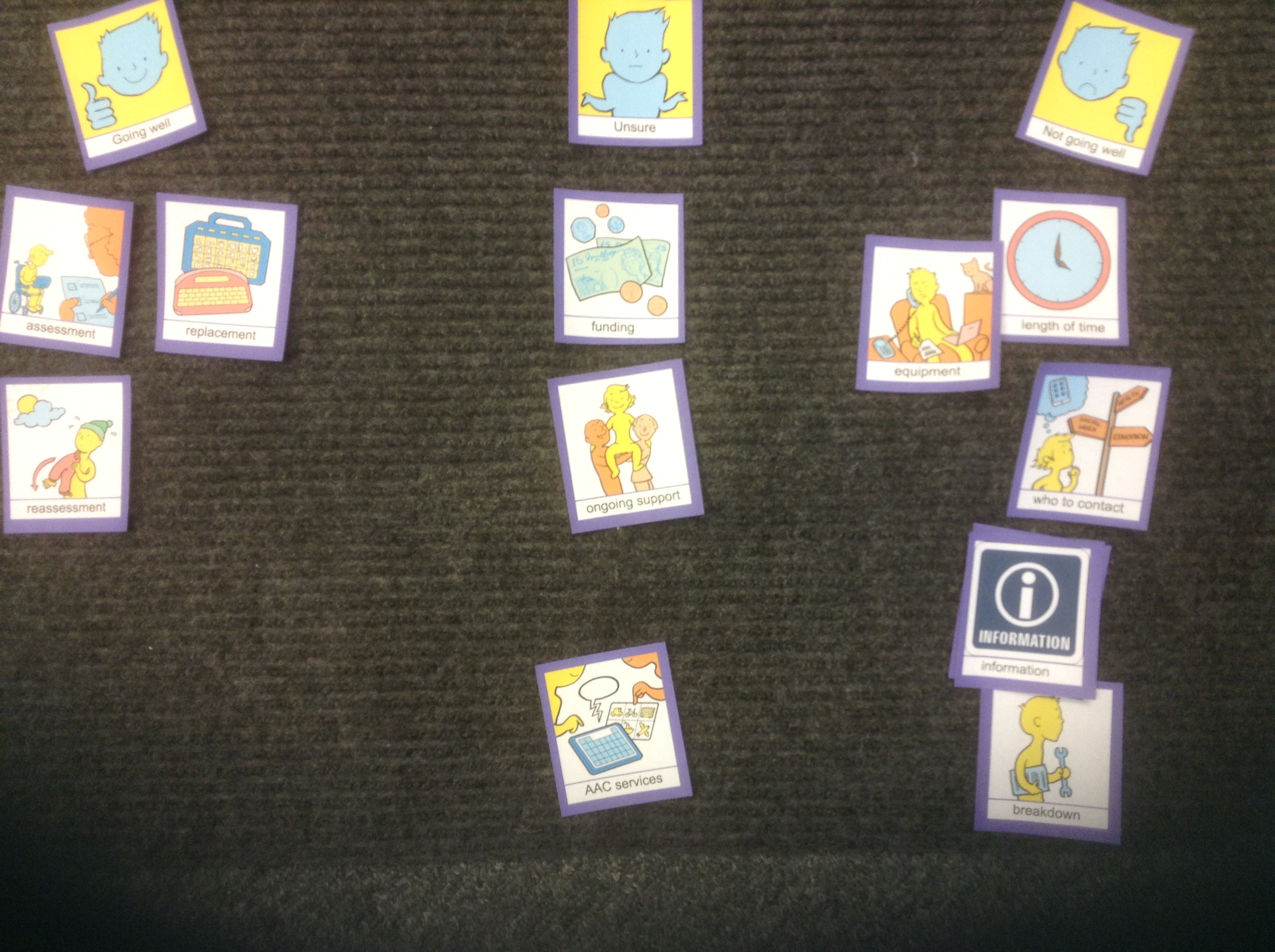
NES has funded the opportunity for professionals to attend a seminar and go away with a resource to support them to get feedback from AAC users about their service. The Talking Mats resource was trialled and developed with Forth Valley AAC partnership and is based on AAC quality indicators (NES 2013).
This opportunity is free of charge to people in AAC partnerships in Scotland. You will attend a half day specialist seminar and go away with a free resource to use in practice.
The resource will help people find out how AAC users feel about:
- People who work with them
- How AAC services are delivered
It provides a model of good practice which could be extended to evaluate other services.
4 dates and locations are available.
Edinburgh- Tuesday 17th March 1.45 -4-.30pm
Dundee – Wednesday 18th March 1.45 -4.30pm
Glasgow Thursday 19th March – 1.45 -4.30pm
Inverness Friday 20th March 1.45 -4.30 pm
If you are trained in Talking Mats and wish to take up this great opportunity, please book your place as soon as possible.
sally@talkingmats.com or rhona@talkingmats.com
We are grateful to Nicola King SLT, who describes how she and colleagues use Talking Mats not only to gain feedback from parents about the therapy process, but also about the parent’s understanding of the child’s diagnosis and its impact.
The options to start the discussion are included in the mind map below. Click on image to enlarge.
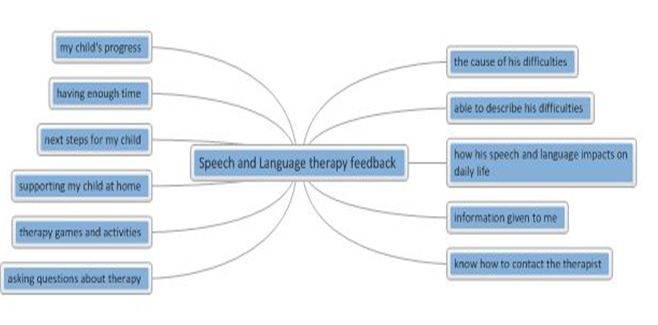
Issues raised by one parent were
1) Information given to me –unsure . The mum went on to say ‘I’m worried/ frightened. I don’t want to ask too much as I’m frightened as to t he answers
2) My child’s progress –unsure. The mum offered ‘I’m inpatient’
Nicola commented –‘These were huge issues and each response gave me a chance to explore what she was thinking and meaning. For the first time this mum offered her fears about ASD and ADHD. She enjoyed the Talking Mats process and after the interaction agreed for the first time to an onward referral which ensured support was in place for her son starting school.
The Talking Mats format was a brilliant way to have that ‘difficult conversation’ ‘
The intention at the core of the Scottish Strategy Getting it Right For Every Child (GIRFEC) is to keep the child at the heart of the planning process. Helping the child to set personal outcomes based on what is important to them, should be the starting point. In practice, this can be difficult as many of the well-being indicators are difficult for children and parents to grasp. A primary headteacher highlighted the limitations, explaining that she was trying to find out about how safe one of her pupils felt. When the pupil asked her to explain what she meant, she replied “Well, do you feel safe in my office or do you think one of the books might fall off the shelf onto your head?”
The Consulting Children and young people resource allows you to reorganise the symbol sets to reflect on each of the specific well being Indicators. If we take the example of safety, we can make the concept more accessible to the child by providing concrete examples. This may include: asking for help if needed, feeling listened to, as well as, safety in specific settings for example at home; in school; with friends or using social media. The CCYP resource helps the interviewer to think about the child’s age and stage of development and uses examples that are meaningful.
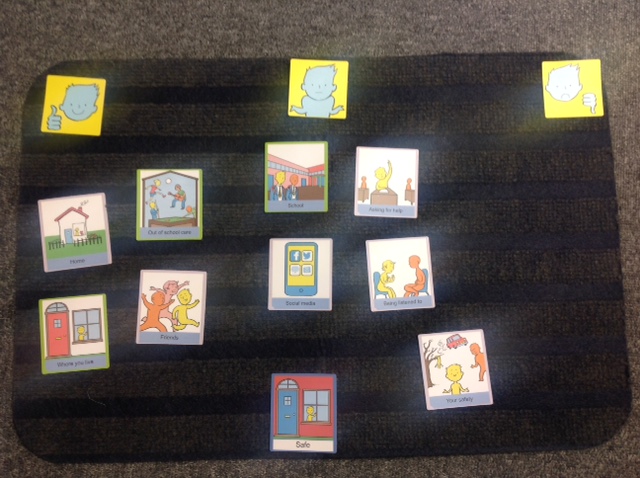
The visual framework means that their is a clear record of the shared understanding between the child and the interviewer of the concept of safety.
We are planning to run specialist sessions on using Talking Mats with the SHANARRI indicators in order to ensure that the child’s view is at the heart of the planning process. If you are interested please let us know what would work best for you.
Email us at info@talking mats and tell us if you would prefer a Saturday session, a Twilight session or a half day session and state your preference for morning or afternoon.
It is recognised that it is difficult for people with communication disability to give feedback to health service staff. The group that developed the Making communication even better resource decided that mystery shopping would be a good way to find out whether health staff were supporting their communication and enabling them to access the services that they require and are entitled to. Funding was sought and gained from NHS Education Scotland for a small mystery shopping project.
20 people with communication disability were involved in the project which was coordinated by Talking Mats Limited and the Stroke Association Scotland. There were different aspects of the project – making phone calls, face to face visits and recounting personal experience . It covered the 14 Health boards in Scotland. The project report was named ‘Through a Different Door’ as this reflected the overall findings that people had highly varied experiences of interactions with health service staff ranging from the excellent and supportive to poor which had the further risk of endangering patient safety . Click here to read the final reports
Whilst developing the eating and drinking resource, we tried it out with people with a range of eating and drinking difficulties. I talked to Ellie, who had swallowing difficulties following a stroke. She found it really helpful to use the mats to think about different aspects of meals (mealtimes, where you eat and the process of eating). Ellie had very good insight into her eating and drinking difficulties and had developed clear strategies to help manage them. She found breakfast and snacks the most difficult meals to manage. She was also very clear that pureed and soft moist foods were the safest and easiest for her. After we had done the mat, Ellie reflected on her eating and drinking, saying that it was limiting but that she could see that things had improved. One of the most difficult things for her was the impact of her swallowing difficulties on some of the social aspects of eating. She really misses going out for a meal with family and friends, something that we often take for granted.
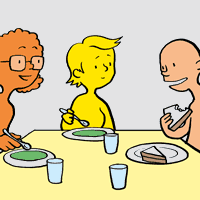
Doing the ‘meals’ mat helped Ellie to see that although she still has many difficulties, mealtimes have become less stressful. For example, although eating and drinking is still a long, slow process, Ellie and her family have adapted to this and now manage ok, especially if they plan ahead. Some useful action points were also identified for the professionals working with Ellie – it would be good for her to have suggestions about a greater range of breakfast options as well as a variety of snacks which she could eat between meals.
Using the mats really helped to clarify the progress that Ellie has made with her eating and drinking since her stroke.