Online training login

I like my iPad and I LOVE the new Talking Mats app.
My 89 year old mum lives on her own about 2 hours from where I live and enjoys looking at photos on my iPad Mum has ‘all her marbles’, as the saying goes, and freely expresses her extreme views on current affairs, politics and photographs in Hello magazine! More difficult however, is discussing her failing energy levels and physical strength. She has till now resisted all suggestions of moving house to somewhere with more support.
I knew she would be interested in the Talking Mats app and a demonstration one afternoon flowed naturally into the Domestic topic of the Health and Well Being section. Suddenly we were in the middle of that difficult conversation we’d both been avoiding. Mum fully engaged with the app and changed the position of some items after consideration
The reality is she isn’t managing, she’s struggling. For the first time using the Talking Mats app she confessed to all domestic tasks being difficult even with the bits and pieces of help going in regularly.
The app made that bit easy. Making a decision about the next step will be more difficult.
Rhona Matthews
The final part of my keynote talk at the AAC Conference in Helsinki last month focused on what we mean by communication effectiveness.
It is important to be able to determine the effectiveness / success of an interaction between two people, whether they are politicians, parent and child, husband and wife….. people using AAC systems or people using their own speech.
When I carried out a literature search of peer reviewed journals for my PhD in 2009 I could find no clear definition of communication effectiveness. Some people thought that effectiveness was synonymous with ‘word intelligibility’ or ‘correct syntax’. Others defined effectiveness in terms of the number of words produced on an AAC device. One publication even suggested that effectiveness was demonstrated by someone taking responsibility for charging their AAC device!
The main focus of all the papers I found, which mentioned communication effectiveness, was on needs and wants and only 3 papers cited social closeness as important (click here to read previous blog).
However, some publications did give useful pointers. Light (1988) emphasised that effective communication depends on 2 way interaction and that the partner is a major factor in the success or failure of communicative interactions. Lund (2006) described adequacy, relevance, promptness and communication sharing as key indicators. Ho et al (2005) highlighted satisfaction – partners’ feeling of how well they communicated during the conversation. Locke (1998) stressed that determining the success of any communication is a subjective undertaking as ‘Communication is not a mathematical formula of phonemes, morphemes and syntax, but rather includes casual conversation such as gossip’.
The Talking Mats team has tried to capture what we believe are the essential factors in determining communication effectiveness. We have produced a simple tool – the Effectiveness Framework of Functional Communication (EFFC) which can be used to chart key factors in an interaction on a 5 point scale and give an overall indication of whether the conversation is effective or not.
We have used the EFFC in several of our research projects and show participants how to use it during our training workshops. In Finland I tried it out with the audience of 200 AAC professionals using 3 video examples of different AAC conversations. The resulting scores were amazingly in agreement suggesting that this is a reliable tool.
For a free download please click here EFFC 2014
We would welcome any comments or questions.
In my last blog I wrote about the purposes of human communication and suggested that social closeness is essential for effective communication. Janice Light, in her 1988 model, described social etiquette as the ability to conform to social conventions of politeness and one of the key purposes of communication.
I believe that social etiquette has been overlooked when working with people with communication difficulties. Social etiquette may be seen as ‘the cherry on the cake’ and not really necessary, when getting a basic message across is so difficult for someone with a communication disability. However, the way in which someone greets you when they meet you, how they show interest in what you are saying or how they say goodbye, all effect how you respond to them and can influence your subsequent interactions with them.
Moreover social etiquette can often be done non-verbally – a smile to show you are pleased to see someone, a nod of agreement to show you are following what they say, a handshake or ‘thanks for coming’/’good to talk to you’ when you say goodbye. These are all basic and almost universal communication symbols.

Social etiquette is not just a communication add-on that can be missed out because it’s too much effort. It can be crucial in developing and maintaining relationships.
Not many people enjoy going to the dentist but it can be a real problem for people with communication disabilities.
Recently I wrote about using Talking Mats in a care home to find out the views of an elderly lady with communication difficulties and dementia who had lost her dentures. click here. Using the mats, she was able to tell us that she was unwilling to open her mouth but thought that if someone was with her she might manage better.
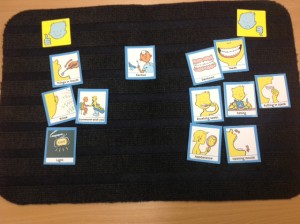
Following our Talking Mats conversation the Care Home arranged an appointment with the dentist for the following week. Her son went back over what we had talked about just before the visit. She managed fine, opened her mouth and her treatment was carried out successfully.
 Her new dentures are on the way!
Dentistry is a huge problem for many people, but the impact of not being able to cooperate can have serious implications for a person’s appearance, comfort, quality of life and health.
In preparing for a visit to the dentist it’s important that the person understands both what is going to happen and why its happening. Talking Mats is a visual tool that can help the person with communication difficulties both with understanding and also expressing their views. In this way the family and carers can find ways to reassure the person and support them to get the appropriate dental treatment.
Please let us know your thoughts on supporting people in similar situations.
“About half of all people with multiple sclerosis have some degree of problem at some time with aspects of thinking – memory, attention span or concentration. …. Many people may not recognise cognitive symptoms as an aspect of their MS and they can arise early in the course of the condition although the greater the disease duration and severity the more likely problems are to occur”. MS Trust
Talking Mats is one tool which can help people recognise any problems they may be having. It also provides a sensitive way for people to discuss these issues and plan ways to manage their situation.
We have developed a range of topics which encompass virtually all aspects of a person’s life
Insert mind map
The Learning and Thinking topic is particularly relevant. The following is an example of a Talking Mat done with Stella who has MS and lives at home with her husband and 3 children.
Top Scale Used: Managing: Need some help: Not managing

Stella began by putting most of the option symbols between the Managing and Need some help columns. However as more symbols were presented, she took time and thought about each symbol more carefully and changed her mind about many of them.
She said that using Talking Mats helped her realise that she was having some problems. On completion of the mat, she showed it to her husband and together they discussed practical ways of ways of managing her difficulties.
There are a further 12 topics in the Health and Well-being resource that can be helpful to people with MS. these are available either on our app or as Talking Mats original.
I undertook the ‘Talking Mats’ on-line course to acquire a new skill and a way to enhance my communication with people with dementia in practice. I have found the learning strategies used are varied and interactive – so there is not a sense of sameness, even though visually there is a consistent layout to the presentation of each module (this expedites navigation). This enhances engagement and my interest so that I am never reticent in logging on to complete the next module! In the beginning, I felt that I could move a lot quicker through the course if the modules were available once each part was completed, instead of having to wait for feedback on each assignment. However, nearing the end of the training course, the benefits of this approach are now clearer. Spaced learning and spaced practice allows for thinking time and internalisation of the module components. In this way, I have come to appreciate the part skills involved in the overall process and how they come together. I now find myself observing the skills involved and the reactions of all communicating as well as the surrounding environment, body language etc. I have also found myself looking back over the past module materials to ensure I am integrating as I go and to remind myself of the rationales for the actions that need to be taken, as well as ensuring that I am more and more familiar with the new terminology that I have been exposed too.
Little did I know when I signed up that the benefits of learning about and how to use ‘Talking Mats’ would stretch wider than what I initially anticipated or wanted! In completing the course, I am now much more aware of my communication practice in general, and the part-skills involved. I can also now see the wide applicability of ‘Talking Mats’ to different populations, age groups and conditions. Communication is everywhere but it needs to be efficient and effective – I am now more confident that my communication practice will improve as a result of this course. For me this is the best outcome possible.
Please click here to find out how to book on the next course
When I went back to the Care Home where I was piloting our new Social Care symbols the staff told me this story about Ann (see previous blog). Apparently she usually is very quiet and never joins in with activities or with other residents. However when we used Talking Mats with the Activitiies symbols, she told me that she really likes singing and had started singing to me. Later that day, one of the care staff had suggested that she sing again and Ann started a song with him. Gradually other residents joined in and they had a lovely sing-song with Ann leading it!
On another day I used the Social Care symbols with Dorothy who tends to go off track and repeat stories over and over. She was quite sure about what she liked and didn’t like about the Care Home and using Talking Mats was a gentle and easy way to bring her back on topic.
I recently used the ‘Talking Mats Social Care’ pack in a Care Home with 3 residents, Ann, Barbara and Colin, who all have dementia. Neither Ann nor Barbara were wearing their glasses but all three were able to see and recognise the symbols and use Talking Mats to express their views. All three conversations took place in the lounge where the TV was on, staff were moving around and and where other residents were chatting.
Ann, whose mat is at the top of this blog, used the ‘Activities’ set and very quickly understood what to do although at times she needed to be reminded what the top scale meant. She said she was a very happy person and didn’t think I would find anything that she didn’t like but as we went through the symbols she became more thoughtful and said that she did not like DIY, exercise or knitting and sewing. She used the mid-point to indicate the things she used to enjoy but does not do now. She was delighted when she saw how positive her overall mat was.
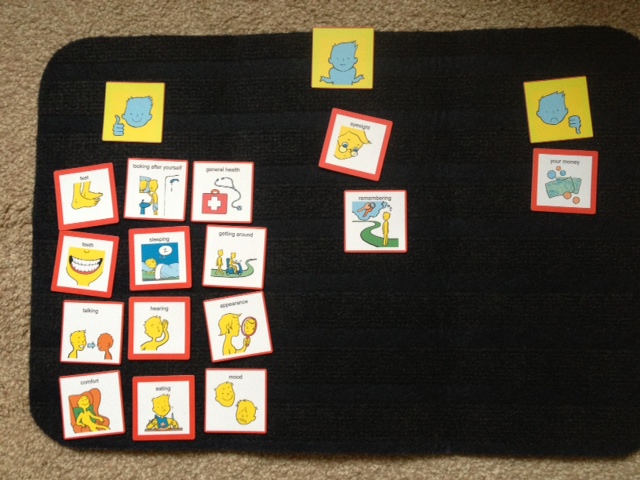
Barbara used the ‘You’ set to tell me how she felt about herself. Although she could have placed the symbols, she preferred to sit back, tell me what she thought and let me place them for her. She felt fairly positive about most things although she was aware that her eyesight and her memory were not as good as they used to be. She also joked that she never had enough money.

Colin has dementia and is also profoundly deaf. He has only recently moved into the care home so we used the ‘Where you live’ set of symbols. Colin said several times that he didn’t think there was any point in having a conversation as he can’t hear. However after writing down the reason for doing it, he gradually realised that he could use the symbols to understand what I was asking and then express himself. He said he was generally happy with the Care Home although he missed his garden and found it hard to make friends now as he cannot hear what the other residents are saying. He also felt there are not enough activities that he can take part in. He mentioned that he has a pet dog but doesn’t know what has happened to it since he moved. One of the staff said he would try to find out. He seemed satisfied with the final mat and staff felt it would be useful to use Talking Mats more with him to reduce his isolation.
During the final stages of developing Digital Talking Mats, we invited some people with aphasia and their partners to come and try it out for us. I spent some time talking to Matthew, who has severe global aphasia and dyspraxia. Matthew loves having a chat, but relaxed conversation can be a challenge because Matthew finds it difficult to generate language and sometimes his yes/no responses get mixed up. I used the ‘activities’ topic with Matthew to have a chat about the things he likes (and doesn’t like) doing. Matthew found the Digital Talking Mats easy to use and quickly gave me his views about activities. Using the i-pad made the conversation feel very natural, and Matthew was able to convey his sense of humour – when I asked him about Church; Matthew started to sing the Funeral March! We had quite a laugh about this, and it turned out that at the moment, Matthew really only goes to Church when there is a funeral. Matthew was also able to tell me about things that he finds difficult since his stroke, such as reading and doing DIY. During our conversation, I was struck by how equal the conversation felt. Matthew was able to express his views without feeling pressurised to think of words. I was able to ask Matthew open questions without worrying that I might not understand his responses. Using Talking Mats on the i-pad was easy and relaxed. I could imagine using it with Matthew to have a chat over coffee or at the pub. Perhaps we should think of some conversational symbol sets?
To see Matthew using the app, click here
We wanted to develop a tool that would give a holistic picture of how a child or young person feels about their lives at home at school and in their communities. We took into account the significant developmental changes that occur from 3 to 17 years and the influence of environmental and personal factors surrounding the child or young person.
We asked our artist to reflect the age and stage of the child in developing a symbol set for:
- Early years
- Primary and
- Secondary
The symbols are organised into three topics:
My Body and Skills: In this section you explore how the child is growing and developing by focussing on the functions of the body as well as skills that are emerging. You can gain an impression of how the child feels he or she is progressing physically, socially, cognitively and behaviourally.
What I do and my support: In this section you look at the child’s lived experience by asking about the activities they participate in, as well as how they feel about the support they receive.
My Wider world: The communities in which children grow up have a significant impact on the well-being of both children and families. In this section you look at the child’s wider world by exploring the impact of nursery or school as well as the support system available to them.
Talking Mats prompts you to cover the relevant topics for each age group you’re working with. You can help children and young people to see their personal strengths and abilities and take time to consider what their problem areas are.
The mind map below shows what is included in the Primary pack – What I do and my support.
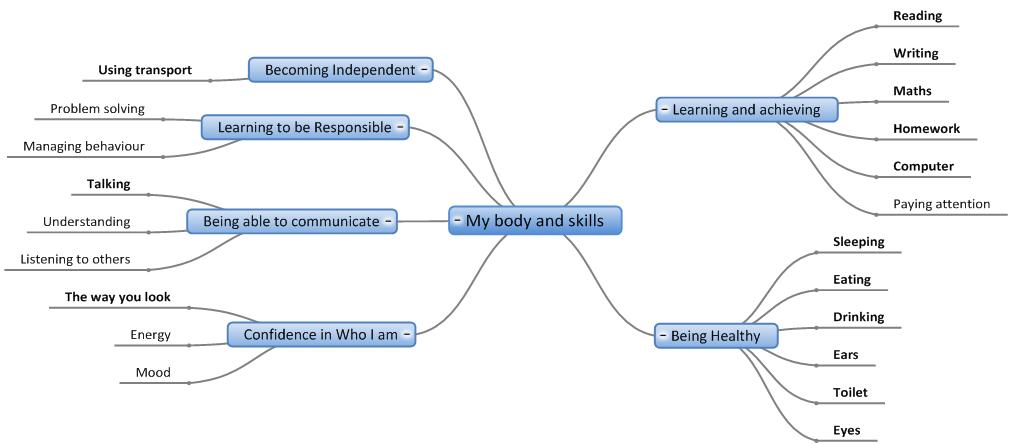
If you want to read about how Talking Mats were used to help young people think about targets for their IEP read the 2012 research report.
If you would like the complete Consulting children and young people pack, covering Early years, Primary and Secondary then buy the silver resource which can be purchased either as an original or through a digital subscription.