Online training login

Thanks to Alison Matthews for a great guest blog on Talking Mats supporting people with learning disability to have a political voice In the photo from left to right Alison Matthews, John Hendrickson ( chair of NW LDA) , Shahnaz Ashraf, Rosemary Trustam, Darren Heywood (vice chair)
The North West Learning Disability Alliance (LDA) is a campaign group focussing on the rights of people with learning disabilities. The NW regional self -advocates forum met twice to identify their priority concerns which were due to be discussed at the regional conference in Blackpool. Members of the NW LDA attended a conference planning event and we discussed ways in which people could be supported to voice their views on services. It was agreed that given the need for local and national politicians representing their citizens to hear the views of people with learning disabilities, the conference would be a way to develop this with the help of social media. The NW LDA was then invited to have a stand at the conference in Blackpool.
Talking Mats seemed the obvious approach to support discussions around the concerns as it provided a structured means of people expressing their views and provided potential objectivity in that people could also praise services, as well as voice concerns, which in fact some did! We wanted to take photographs of people with their mats as we felt it would bring the concerns or issues to life, it certainly seemed a more powerful way of enabling people to speak out. Our idea then was to e mail relevant local councillor or MP and to support people to get their voices heard wherever possible.
Some of the challenge was in planning the vocabulary needed and in finding the appropriate visual scale. The list of concerns created by the self- advocates provided an ideal starting point. The scale we opted for consisted of symbols which enabled people to say whether they were worried about the topic or happy/not concerned. The topic itself was ‘services’. Finding symbols was a real challenge so we opted for a mixture in the end, photos, symbols, photosymbols and our own line drawings.
We spent time with the self -advocates who produced a mat, first exploring their knowledge of social media, in particular Twitter and Facebook. Many already had accounts and e mail addresses, some people came ready with topics they wanted to get off their chests or people they wanted to praise. Everyone said whether or not they wanted to e mail their MP or local councillor with a photo of them and their mat and whether they wanted us to post the photograph of them with a mat on social media. For Twitter we used the hashtag our voices matter (#ourvoicesmatter).
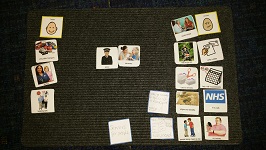
People raised concerns about a variety of issues to do with service cuts, from cuts to the NHS and the need for local pharmacies to stay open, to cuts to transport and the need for additional support with relationships. One person mentioned specifically that she wanted to feel safe at home and talked about crime directed towards people with learning disabilities. Most people were worried about benefit cuts
We had some positive responses, one person wanted to highlight how happy she feels in her new flat and one person specifically wanted to compliment his local councillor who he felt really listened to people with learning disabilities. Ivan Lewis MP tweeted his support for the campaign. In terms of learning for next year’s conference, we will develop the vocabulary and the process of collecting e mail addresses and twitter accounts for MP’s. One very valuable lesson we learned about the numbers engaged in the activity was to hold next year’s sessions before the party on the last night. It seems the participants at the self advocates conference work hard and play hard too!
Alison Matthews is a Speech & Language Therapist, Director of Total communication Services CIC and member of the North West Learning Disability Alliance
April 2016
Talking Mats was used as part of a Speech and Language therapy assessment for a boy with a stammer (dysfluent speech). He was very aware of his stammering and would change what he was going to say or avoid some situations because he anticipated that he would stammer. He had low self-esteem about his speech and felt that whenever anyone laughed in his class, it was to do with his stammer.
Talking Mats was used to gather information about which situations and people made speaking easier, and any situations and particular people which caused more of a challenge. The activity provided much more information than originally anticipated.
A starter mat was used to show how a Talking Mat worked, using pictures of food. He engaged well with this, and understood the process quickly. We then moved onto discussing his speech – we wrote names of people in his life and situations which involved speaking onto pieces of paper, and he placed these on the mat where he felt appropriate. We started with people and situations which appeared more positive, then gradually moved onto those it was anticipated would be more challenging.
His insight into his speech and what helped him or made speaking more difficult was impressive. We were able to use this information to compile a list of “Do’s and Don’t’s” for people he came into regular contact with. He agreed that this information could be shared with school to give them strategies to support him there.
The most powerful part of the Mat was him being able to say that he did not feel happy about talking with his big brother sometimes, because he could make fun of his speech, and this made him feel really upset. This was a powerful revelation for his Mum who had sat in on the session, as she had not realised he felt this way. After the session, the family had a chat around the table at tea-time about how his therapy session had gone that day – with Mum’s support he was able to say to his brother about how his teasing had made him feel. His older brother had thought it was all a bit of fun and hadn’t realised the impact it was having. They agreed the older brother wouldn’t tease him anymore.
When he came back for his next session, he commented on being much happier about his talking at home, and felt the activity had been really helpful. His Mum was very positive about it too, and proud of how he had managed to speak up for himself and be able to say how other people could help him with his talking.
Our thanks to Kirsten Taylor, Speech and Language therapist for sharing this powerful story
We are delighted to introduce Laura Holmes our first Regional Talking Mats Associate. She is joining the Talking Mats team and will be working in the North West of England. I will let Laura introduce herself:-
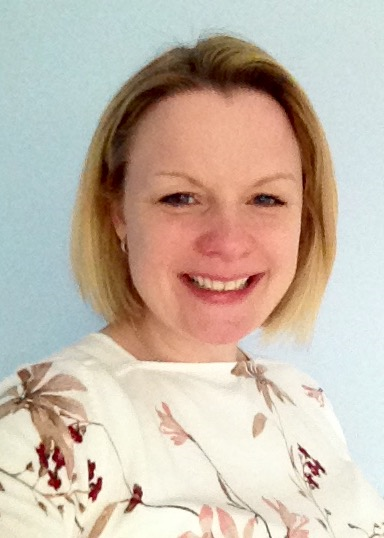
” Hi, I am a Speech and Language Therapist working in Stockport, Cheshire. I am delighted to be joining Talking Mats as the first Regional Associate, covering the North West of England. I work 1 day a week, term-time only for Talking Mats, as well as 3 days a week for the NHS. I am excited about developing awareness, understanding and use of Talking Mats across the area, within the context of the SEND reforms in particular, over the next few months. I feel Talking Mats is a very effective way of truly capturing the voices of the children and young people I work with. The Talking Mats approach also links well with the use of Therapy Outcome Measures, which I am currently trialling with my caseload. I am looking forward to sharing my knowledge and experiences to facilitate wider use of this versatile approach across the North West region.”
It is great to have Laura working with us to build on some of the excellent work being done already in the North West. Two examples of best practice are in Wigan where Talking Mats are used to increase child participation and more recently in Salford. Children’s services in Salford NHS foundation trust are committed to seeking the views of children and young people about how they feel about their health appointments. They have finished piloting their own Talking Mats set and the revised set has just been sent to the printers – it looks great.
We are running a training course in Liverpool on the 21st April and we would love to meet more of you from the North West.
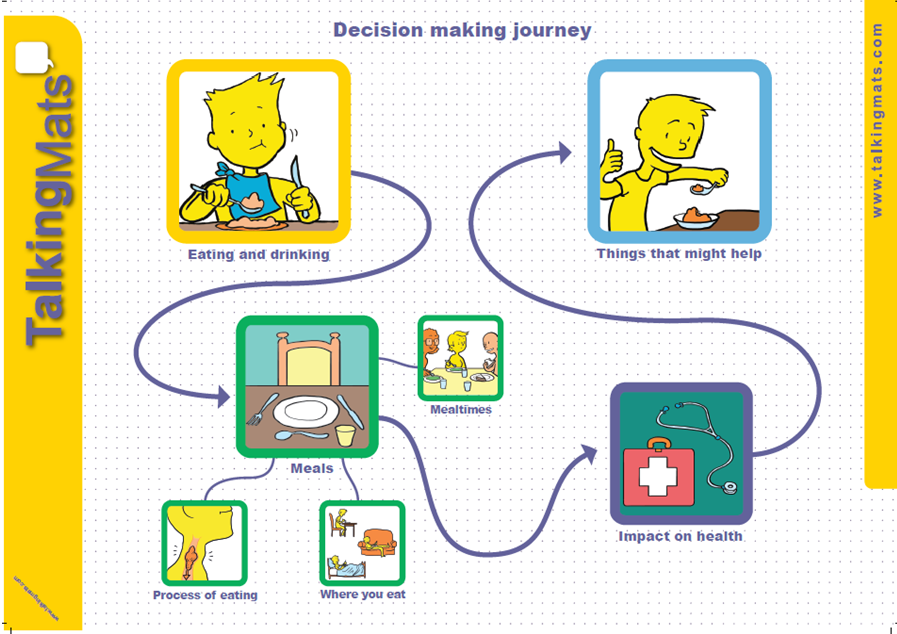
The Talking Mats Eating and Drinking resource provides insight into what service users perceive their difficulties to be and can help raise issues that care providers are unaware of.
Gillian Callander, speech and language therapist wrote the following review.
I have used this Talking Mats resource with adults with learning disability and it has been a valuable tool in discussing issues that they have with their eating and drinking and in providing a focus for discussion. It helps understanding of what can be an abstract and complex subject and can aid the planning of next steps.
There are 3 symbol sets included with the resource
- Meals
- Health
- Things that might help
I have also used this resource with additional personalised symbols to discuss potential specific changes to eating and drinking and to gather information about how the service user would feel about this. There were blank symbols included with the resource which can be used for this purpose.
The symbols in this pack provide a range of subjects to be discussed and are clearly categorised. I have found that for the service users I work with that the “meals” set and “things that might help” have been the most relevant and easiest for discussion and the symbol sets provided ably support this. The “health” category is a little bit more abstract and is harder to discuss with this client group, particularly if this issue is one that may occur but currently is not causing any difficulties. However, it does provide a basis and support for this discussion and helps to tackle issues that are more complex and abstract.
I have found that using this Talking Mats resource has provided increased clarity during discussions with service users about eating and drinking and it provides service users with a more consistent method to express feelings about eating and drinking and the impact of any difficulties. It also supports me by giving a way to convey the information about concerns or potential changes to eating and drinking using the same method of communication as the service users, thus providing a method to enhance two way communication and facilitate discussions. It helps to ensure, that as far as possible, service users are able to input into the discussion about their eating and drinking and to make their opinions known. Using the Talking Mats has helped to provide evidence that service users do/do not understand the information being presented and can help decide outcome with regard to capacity for decision making.
Based on my experience of using this resource, I would recommend this as a valuable addition to your eating and drinking assessment tools.
Gillian Callander
Following the success of previous seminars we are holding further specialist seminars in Stirling and London for anyone who has done the Talking Mats training. The topics will be:
- Talking Mats and the Eating and Drinking resource (morning)
- Talking Mats and Capacity (afternoon)
During the Eating and Drinking seminar, we provide background on how and why the resource was developed and showed some DVD examples of people using the resource. This really brings things to life and shows how important it is to give people (with and without speech) the opportunity to consider and talk about different aspects of eating and drinking. We also give people hands-on practice in using the symbols from each topic. Each participant will receive a copy of the full Eating and Drinking resource, including symbols, a mat, and explanatory booklet.
During the Capacity seminar we will discuss the fundamental principles of the Capacity Act and participants will have a chance to consider how Talking Mats can help people to:
- understand
- retain/remember
- weigh up information
- communicate their views/wishes and feelings.
They will also be given the opportunity to work through some practical examples and think about options to help people understand issues and make decisions.

If you have completed a Talking Mats training course and would like to attend either of specialist seminars, please click on the relevant course and fill in the registration form.
Stirling on Friday 29th April Stirling Seminars flier Apr 2016
London on Friday 10th June London Seminars flier June 2016
Registration form Seminar registration form 2016
This is the second of Kristine Pedersen’s projects using Talking Mats as a tool to support people with dementia.
Care workers at two residential care homes in Denmark were taught how to use the Talking Mats framework and how to incorporate the method into planning daily activities for people with dementia.
The care workers gave positive feedback in regard to using Talking Mats:
- Using the Talking Mat framework provides important knowledge about communicative difficulties of the person with dementia
- Talking Mats helps people to understand their options and thereby motivates to social activities, eating, physical exercise, etc.
- Talking Mats increases the possibility of active participation in caregiving plans
- Talking Mats enhances the joy of work, when I know how I can give the right care
- The Talking Mats conversations support a closer relation between elderly and care giver
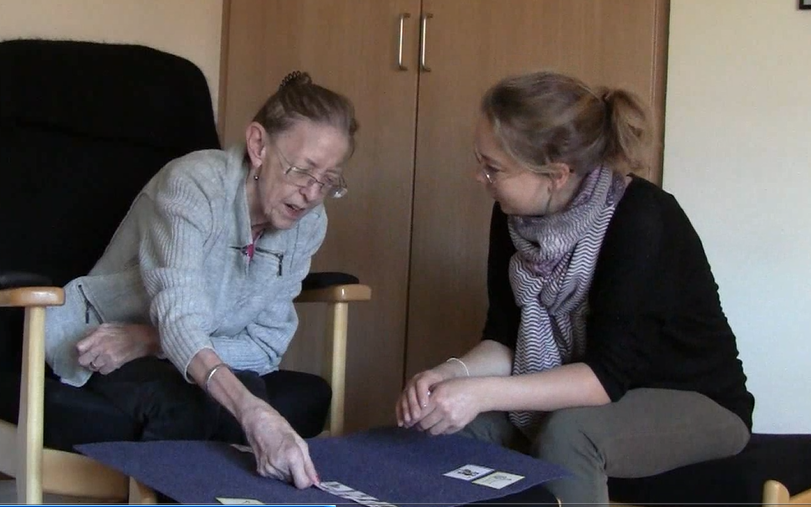
This project and the one described in the previous blog, gave the opportunity to explore the Talking Mat framework in use and how the framework can support the communication of people with dementia. Very importantly, due to the adoption of Talking Mats and its extension in Denmark, the projects gave a lot of Danish examples. The projects also gave important information about how to implement the tool in care homes for people with dementia within a Danish setting.
‘We are very grateful to the Directors, Dr Joan Murphy and Lois Cameron and everyone on the team at the Talking Mats Centre who developed the framework and who continue to increase knowledge of Talking Mats through research and education. It is a very helpful tool for many people and supports and enables more people to have their views seen and heard’
And we are grateful to Kristine for sharing her projects with us.
We are very grateful to Kristine Pedersen from Kommunikationscentret in Denmark for sharing the findings of 2 projects with us. The first project found Talking Mats was effective in supporting communication for people who have dementia when compared with both unstructured and structured conversations.
‘t is important to know how to give people with dementia the right support’
At Kommunikationscentret in Hillerød (Denmark), we have been using the Talking Mats framework since our first trainer was accredited at the Talking Mats Centre, University of Stirling in 2010. We have been using Talking Mats with both children and adults across a range of communication difficulties e.g. caused by Aphasia, Cerebral Palsy, Downs Syndrome, learning difficulties etc. Inspired by the important research project by Dr. Joan Murphy and others ‘Decision making with people with dementia’ (2010), our next step was to gain our own experience within the framework specifically aimed towards people with dementia.
As in the rest of the world, the number of people in Denmark with dementia is increasing. Symptoms of dementia vary from person to person but many of the symptoms are related to communication: Difficulties finding words, using familiar words repeatedly, losing track in conversation, difficulties in focusing and paying attention etc. The growing dependence of the person with dementia on a caregiver makes communication essential to express wishes and needs. Therefore, it makes sense to look at the consequences of the illness (dementia) within the perspective of communication and how family members and professionals around the person with dementia can support communication using AAC.
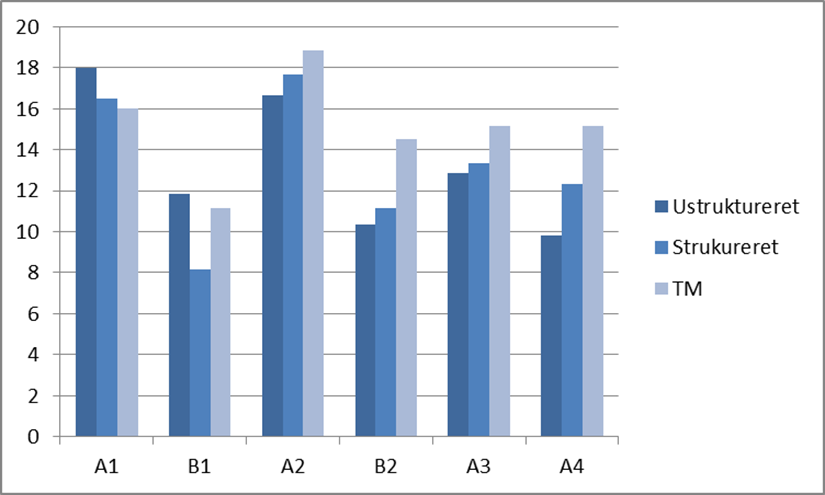
The purpose of the first project was to compare the communication in conversations about views on I) Daily activities and II) The importance of information, using three different communication methods. The methods were: 1) unstructured conversation 2) structured conversation 3) the Talking Mats framework. The project involved 6 participants having early to moderate stage dementia, all living in residential care homes.
Like the study ‘Decision making with people with dementia’ (2010), the report concludes that the Talking Mats method was associated with better communication for the majority of the participants. The Talking Mats framework was found especially helpful regarding the participant’s ability to understand subject and question of the conversation, the participant’s ability to reflect, and the participant’s ability to make themselves understood. The graph below shows that only one participant (A1) did not benefit from the visual method. She had poor eyesight, which strongly indicates that visual support compensates the difficulties that people with dementia have.
The report also concludes that the Talking Mats framework increases the interviewer’s ability to detect and compensate for some of the communication difficulties. Finally, it seemed that several of the participants have been able to learn how to use Talking Mats in the process.
The photo underneath shows a Talking Mat conversation from the project. This Talking Mat gives an insight into how this person feels about what information is important to her, and what isn’t. It is in some way a difficult and abstract question, but most of the participants managed to both understand, reflect and answer the question when we used the Talking Mats framework.
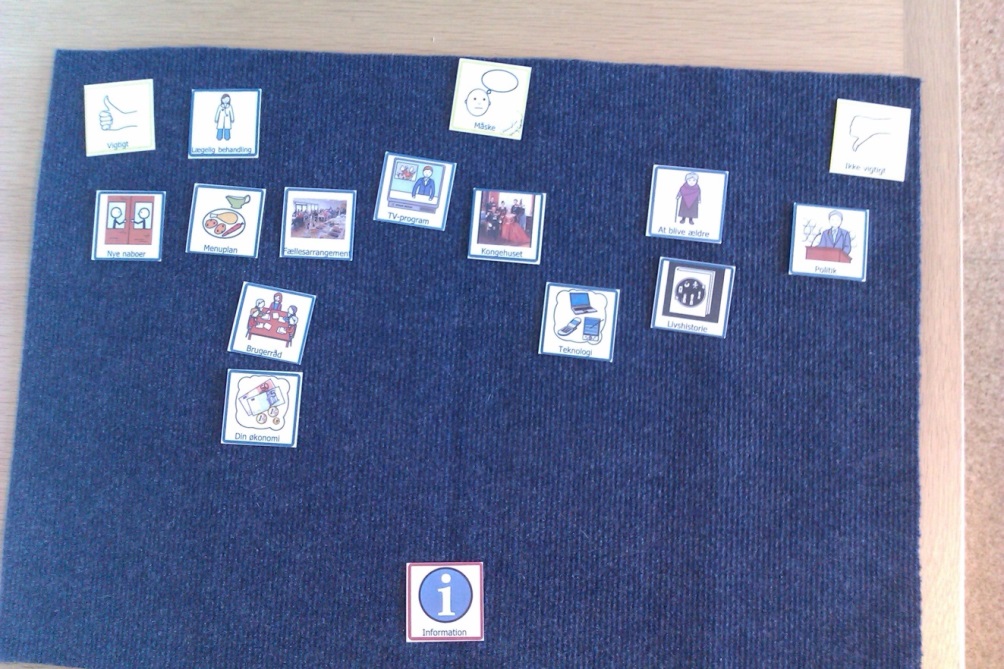
Important information to this participant is information about new neighbours, the menu at the residential care home, economy etc. Less important is news about the Danish royal family, technology, getting older etc. Politics is definitely not important to her.
One of the issues which has emerged from previous Talking Mats and dementia projects is that many people with dementia experience difficulties with mealtimes and that it can affect people at any stage of dementia.
Mealtimes involve two of our most fundamental human needs, the basic physiological requirements for food and drink and interpersonal involvement. Mealtimes are particularly important for people with dementia as they may develop difficulties both with eating as a source of nourishment and with the social aspects of mealtimes.
In 2015 Joan Murphy and James McKillop carried out a project, funded by the Miss EC Hendry Charitable Trust, to gather information from the first-hand experience of people with dementia about their views about mealtimes. We ran three focus groups and used the Talking Mats Eating and Drinking Resource to allow participants to reflect, express and share their views.
Findings:
The people who took part in this study felt that there were significant changes in their eating and drinking since their diagnosis of dementia. For some, their experience of mealtimes had changed and several said that they now skip breakfast and sometimes lunch. For some this seemed to be related to forgetting to eat and drink, for others it related to changes in taste whereas for others these meals seemed to be simply less important. Forgetting to eat was particularly noted by the participants with dementia and confirmed by their spouses.
The social aspect of eating and drinking also changed for many of the participants and, given the importance of social engagement for quality of life it is important to be aware of the effects of changes in eating and drinking on mealtime dynamics. For some it may be that they are now less interested in the social aspect of eating with others at home. Others found it hard to eat out because of distractions and lack of familiarity while some felt embarrassed about eating out in front of strangers. Others still really enjoyed going out for meals but added that they preferred to go somewhere well-known to them. The shared mealtime may be a particularly crucial opportunity for social engagement as it plays a central role in our daily lives. Social relationships are central for not only enhancing quality of life, but also for preventing ill health and decreasing mortality (Maher, 2013).
Almost all the participants talked about how their taste had changed both for food and drink which in turn affected their appetite. Some families had overcome the problem of lack of taste by going for more strongly flavoured food. When asked specifically about drinking, thirst was noted as a significant change since diagnosis
Their feelings about the texture of food did not appear to have changed significantly and was simply a matter of preference.
Three additional health issues which the participants felt were connected with eating and drinking were poorer energy levels than before their diagnosis, reduction in ability to concentrate and changes in sleep patterns.
For a copy of the full report please click here Dementia and Mealtimes – final report 2015
Get your New Year’s resolution Talking Mat here!
Talking Mats is a social enterprise whose vision is to improve the lives of people with communication difficulties. 2015 has been another exciting year for us. We have had great opportunities to work with a fantastic range of people and hear great stories: from wee ones in nurseries using Talking Mats to encourage active participation and decision making, to older people and their families through our dementia family training project. It is our core belief that good communication is fundamental to a quality service. Making sure there is space for active listening to views and concerns particularly, if individuals have difficulties communicating is central to effective interactions and individualised, person centered care. We are really grateful to all the people who have supported the work of Talking Mats; people with communication support needs, staff who work with them and organisations that we are privileged to work with on a consultancy basis.
It will not surprise you to know that as an organisation we like to set goals and then go for them so as our thank you to you all for your continued support , we have created our very own New Year’s resolution Talking Mats;
• What are you definitely going to go for ?
• What is in the maybe pile – or that could be for those things you are already doing and will continue
• What is not a goal for you in 2016 .
• Don’t forget to use the blanks to personalize it further!
• Plus take a photo so you can reflect back on where 2016 takes you and whether you achieved your goals .
So open and download it , cut it up and we hope you enjoy using the resolution Talking Mat with friends and family ! resolution pics
We wish you all every health and happiness from all in the Talking Mats team
Fika (coffee time) in the Talking Mats office is always interesting. Recently we got chatting about Christmas preparations and who had the longest ‘to do’ list. There was a definite variation in enthusiasm for all things Christmas. We needed to do a Talking Mat! This was done on our digital Talking Mats – it’s easy to import your own images now and make a digital Talking Mat about any topic.
Eating , drinking and games and puzzles got the thumbs up! (Lois is the games queen and was the most enthusiastic about that).
Holiday, partying and entertaining got consensus.
Extended family coming to stay? This moved around a bit, but was generally positive (say no more!)
Shopping was in the mid section-we all agreed. Perhaps by now it would be less positive with last minute mayhem.
Gifts was added as a blank (how could the interviewer forget that) and not everyone was comfortable about the commercialisation of Christmas.
‘How do you feel about Juggling demands?’ We all agreed -not sure. Again remember, Talking Mats is how a person feels at a certain point in time. Ask us again on Christmas Eve?!
Christmas cleaning? All agreed was a chore and some thought best not to get too bothered about it
Talking Mats supports a group conversation. We all got our say
Merry Christmas one and all