Online training login

The role of Talking Mats in supporting people to make decisions in a capacity context.
Context
At the heart of the different capacity legislation that covers England, Wales, Ireland and Scotland is a requirement to ensure that all practicable steps are taken to support the communication of an individual. Talking Mats is well suited to do this as, it supports people to understand, process and weigh up information and then helps them express their views.
Talking Mats has a research base that provides evidence that using this visual framework improves the quality and quantity of information people can give. This has been shown for people with learning disability, dementia and aphasia.
Capacity; enabling supported decision-making.
The Resource.
This resource has been developed with several teams working in different parts of UK. Capacity is decision specific and must be tailored to fit the requirements of the decision. In developing this resource we have focused on the most common decisions people face; what you do in your free time, where you live, your safety, and your support plan. This resource will not cover all capacity decisions but will be a helpful starting point to support you and your clients.
Why use Talking Mats to support decision making ?

- Decisions are broken down into manageable chunks that reduce cognitive load
- The use of visuals reduces the pressure on spoken language and assists the expression of views.
- It allows people time to reflect on their decisions and change their min
- It demonstrates areas that require more information and knowledge to help make a decision
The Advanced Online Course
This course has been jointly developed by practitioners from social work, occupational therapy and speech and language therapy. Course attendees will;

- Think about and extend their practice within the provisions of the Capacity Act relevant to them
- Think about how decisions are made and what affects the way they are made
- Learn how to extend the resource to cover specific decisions that are not covered
- Explore and reflect on their own use of Talking Mats in this context
- Share their experience and learn from others
Learning will be through short talks, interactive activities, case examples and small group discussion. There will be a mid- session screen break.
To join this Advanced Online Course you need to;
- Have completed the Talking Mats Foundation Training
- Attend with a system that allows you to join in the Teams chat during the session and go into small breakout rooms
- Book onto our Advanced Course via the website shop before the 7th of April
The cost is £95 and this covers the resource and the online session. Places are limited to make sure to book on soon. Resources will be posted out the week before training. Bookings close on the 7th of April.
Not yet Foundation Trained?
Our final resource in our January Sale, the Social Care Resource, in its original form was one of our first. It will be reduced by 30% for the whole of January 2025!
“ it’s an amazing thing; that something so simple could be so useful to people”
James, Talking Mats user

This resource can help build an understanding of who someone is and what is important to them.
It has 3 topics:
You – how is your general health, emotional well being, appetite going at the moment?
Activities – what interests do you have?
Where you live – what works well in your home / where you live and what doesn’t?
Margo MacKay, now our Managing Director, tells a story of her early days using the Social Care Resource in a care home for people with dementia:
When I went back to the Care Home where I was piloting our new Social Care symbols the staff told me this story about Ann. Apparently she usually is very quiet and never joins in with activities or with other residents. However when we used Talking Mats with the Activities symbols, she told me that she really likes singing and had started singing to me. Later that day, one of the care staff had suggested that she sing again and Ann started a song with him. Gradually other residents joined in and they had a lovely sing-song with Ann leading it!
Joan Murphy, Founder of Talking Mats, recently published a report; Reducing the Burden of Dementia by Using the Talking Mats Framework to Help People with Dementia and their Carers Communicate More Effectively. 1 One study described in the report looked at the use of Talking Mats to support people with dementia and their carers to make decisions together. Here are some quotes from people with dementia in the study:
I found it (Talking Mats) a big help, sometimes I get the words muddled and can’t get out what I am trying to say.
The mat shows that I am able to do much more than I thought. I didn’t realise how much she is doing in the house.

The Social Care resource is available to anyone already trained in Talking Mats and between the 1st and 31st of January it will be reduced by 30%.
If becoming trained in Talking Mats is something you’d like to achieve in 2025 find out more here.
References
- Reducing the Burden of Dementia by Using the Talking Mats Framework to Help People with Dementia and their Carers Communicate More Effectively.European Society of Medicine Medical Research Archives, [S.l.]. Vol 12 No 9.
Available at: https://esmed.org/MRA/mra/article/view/5716
Talking Mats don’t do Pink Friday, Black Friday or Cyber Monday but we can tell you about our January Sale.
Starting on the 1st of January 2025 and running until the 31st of January 2025 we are offering;
- 30% discount on our Health and Well Being Bundle
- 30% discount on our Social Care Resource *
- 50% discount on our Eating and Drinking Resource *
*available if Foundation Trained
These are popular resources and over the next couple of weeks I will signpost you to some of our top blogs that showcase how they can be used.
This week:
Health and Well Being Resource Bundle

This comprehensive resource can support conversations around general health, a person’s environment, ability to look after themselves and their communication across different areas. Find out more about it’s development and use.
Read about the development and background to the resource and its use with Duncan who had had a stroke.
Kate was a woman with severe communication difficulties following a stroke. This blog describes how using the 4 communication topics Kate and her therapist were able to identify specific challenges that could be worked on to help her overcome her difficulties.
The Health and Well Being Resource complete with bag and mat will be reduced by 30% from the 1st of January and will be available to buy in the website shop from that date.
When this blog from Janie Scott, a Talking Mats Licenced Trainer with Perth and Kinross Council came in I was a bit stumped. There was a lot that I wanted to highlight but I didn’t want to focus on one thing and detract from others:
- The importance of understanding and applying the Talking Mats framework allowing conversations on topics not covered by our resources.
- Demonstrating how Talking Mats can enable the voice of the child to be heard, upholding Scotland’s Promise to care experienced children, young people, and families.
- A model for embedding Talking Mats in a service.
I decided to go with everything. In 2 parts.
Part 1
Talking Mats; UNCRC, the Promise and hearing the thinker:
Janie Scott, (Highly Specialist SLT Perth & Kinross Council)
Scotland is currently progressing with the incorporation of the United Nations Conventions on the Rights of the Child (UNCRC) through the UNCRC (Incorporation) (Scotland) Bill.1 The UNCRC, article 12, states that, ‘children have the right to give their opinions freely on issues that affect them. Adults should listen and take children seriously.’
Talking Mats enables rights-based participation for children, allowing them to form and express views freely. It allows others to understand the issues and, as stated above, have those views taken seriously 2
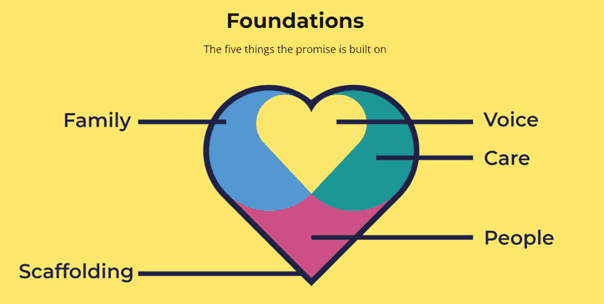
The ‘voice’ of the child is central to The Promise3. Talking mats should be considered the ‘scaffolding’ to enable a voice to be heard.
Last year I rolled out Talking Mats foundation training to Social Workers and Senior Social Care Officers working within Services for Children, Young People and Families, in Perth and Kinross Council. Fundamental to Talking Mats is the framework; the ability to use an appropriate top scale, open questions, silence and pass control to the thinker. Having demonstrated the importance of the framework in the training, we then went on to develop symbol sets specifically related to the work of the Social Work teams. These covered a wide range of topics including:
- sleep
- becoming a foster family
- contraception
- sexual knowledge
- contact arrangements,
- behaviours that adopted children think might be difficult to deal with
- grief
- school life
- triggers (related to drugs and alcohol)
I was privileged to hear several reports of how Talking Mats had allowed the voice of the children and young people to be heard which had a direct positive impact on their lives. Here are two powerful examples from a parent and a social worker.
Parent
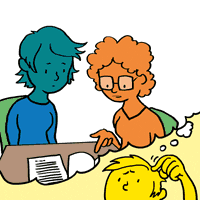
” I have really enjoyed using Talking Mats. It lets me see everything in an organised way. I really like that. It has also shown me the progress I have made; I have found using an advocate really useful in the past but I don’t need to use an advocate any more as I feel more confident. I used to struggle with making decisions but this mat made me realise that I make decisions all the time and they are not wrong decisions.”
Assessing Social Worker for Kinship Care
“As part of my role, I need to find out information from teenagers on how they feel their kinship placement is going. Typically I find that many teenagers give one word answers or sometimes they tell me what they think I want to hear. Talking Mats has been useful in my work in allowing teenagers to open up. It has also been useful with children who have English as an additional language. The children did speak English, but it made it easier to get their ‘story’ from them.
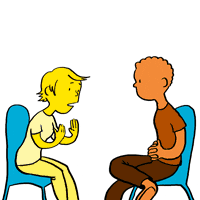
“There was one particularly quiet and reserved teenage boy who was reluctant to share information. The Talking Mat allowed him to tell me much more than when I had initially questioned him. Through the Mats we were able to distinguish the difference he felt between living at home and living with his kinship carers. The Talking Mat enabled him to express that his kinship carers were open to having discussions with him and talking about his worries whereas his Mum did not want to talk about his worries. this was something that I was able to support him in sharing with his Mum as part of the plan for him to return home.“
To uphold Article 12 services must be proactive in creating opportunities to listen to the voice of the child. Talking Mats is enabling the voices of children, young people and families to be heard in Perth and Kinross. This voice is influencing key decisions in their lives across a variety of forums including the Children’s Hearing System, Kinship Panels, and Child’s Plan Meetings.
- Children’s rights legislation in Scotland: quick reference guide – gov.scot (www.gov.scot) ↩︎
- Can Scotland be Brave – Incorporating UNCRC Article 12 in practice – gov.scot (www.gov.scot) ↩︎
- Foundations of the promise – The Promise ↩︎
Talking Mats Director, Margo MacKay, will be presenting with Laura Lundy, Professor of International Children’s Rights, QU, Belfast on Wednesday 1st of November, 2023 at NHS Education Scotland webinar; ‘The voice of the infant and child; rights- based participation for children and young people’
For more details please see the NES website.
Read ‘Can Scotland Be Brave, Incorporating UNCRC Article 12 in practice here