Online training login

 At the end of a recent training session, we asked the trainees to tell us how they planned to use Talking Mats as part of their work. Their comments were as follows:
- This tool will be useful in helping some residents make decisions, informed choices and express their needs. It will take time for some residents to feel confident in using this tool.
- I’d like to use it with some residents to be able to adapt Talking Mats more to their understanding.
- I’d like to use this tool for resident’s reviews to find out what the residents likes/dislikes are.
- Talking Mats will be great for service evaluation.
- Talking Mats will be great for asking residents about things they want to do.
- Updating Care Plans regularly from outcomes of Talking Mats.
- It can be used to get to know people’s needs and wishes more.
- Share the findings with colleagues and joint services.
- Hopefully through its use I’ll learn to pass it onto others.
- A gardening set. Service evaluation and well-being assessing stress levels/anxiety/emotional state?
- I’d use it to promote choices of activities.
- Care Inspectorate forms. Finding out how people enjoy time at the service and how to improve on it.
Can you let us know how you use Talking Mats as part of your work?
We are very grateful to David Brennan, a Dementia Support Worker from Ayrshire for this powerful blog.
Over the years our service has supported many people with a diagnosis of Dementia, now and then we encounter individuals whose cognitive difficulties have greatly affected their ability to communicate. This can (in some cases) result in distress for the services user and their families, distress that could be reduced or even avoided if the individual had a way of being understood by those around them.
As a service we welcomed the opportunity to engage in the Talking Mats Training and as a Dementia Support Worker I was eager to have a tool that could help me overcome communication obstacles, having experienced situations where those I support become so frustrated because they desperately want to relay a piece of information, but simply cannot find the words to express themselves.
I saw talking Mats as a communication system for those who struggle with speech. However, after using the practice in a practical environment I realise that I have had underestimated its potential, for it has much wider applications in our role.
My first experience of using Talking Mats was when producing the video for the second training session. I enlisted the help of a gentleman from the neighbouring Day Care centre.
We had never met prior to the session. The Gentleman had no communication difficulties that I was aware of.
Using the Talking Mats acted as an instant ice breaker, giving two complete strangers a reason to sit down and interact together, quickly striking up a rapport. The Gentleman appeared at ease and was happy to talk in detail about the tiles for the chosen subject of ‘Leisure Activities’
The activity revealed more than expected though. Through the course of the conversation he voiced feelings on things he was perhaps not happy with. I discovered he was unhappy that he did not get out in the open air enough due to poor mobility and that he would have preferred to see musicians coming into his Day Care Centre. This was crucial feedback
It occurred that Talking Mats also had an effective use in the assessment and quality assurance process that exist within services, providing crucial feedback for continued person-centred planning.
Taking this on board I considered examples of service users within my current caseload where the activity could prove beneficial.
I have been working with one gentleman for many months. He could be described as a Man’s man, someone who often replies to attempts at conversation with short responses, even when speaking with his wife. He may struggle to remember the names of people and places but he typically has little other difficulty in communicating.
I attempted the same topic with this man. Much of the answers were as expected. He spoke about football and his favourite team, but the structure of the Talking Mats encouraged him to open up about some of the smaller details that until now he hadn’t felt the need to disclose.
In the most recent example I was asked to take part in a colleague’s Talking Mat video for her training. She is one of our newest members of staff and although we have already developed a good working relationship the activity allowed her more insight to the nature and history of her co-worker.
For my experience, as someone who can struggle with sensory stimulation, it allowed me to express some of my needs and obscure preferences (around the office and in general) in a safe environment where I felt able to communicate what would normally be very personal information. And to have someone listen and thoughtfully consider this was a rewarding experience too.
As a service, new to the Talking Mats system, we are just scratching the surface of how we can best implement this into our roles, but the possibilities are already multiplying at a rapid pace, almost as much as the benefits we are seeing.
David Brennan
Dementia Support Worker
This post is about the importance of the Talking Mats blog and how it can be used as a rich resource of information for anyone interested in communication. One of the first ‘tasks’ that I was asked to do after starting my new job at Talking Mats was to create and give a presentation to an international audience of trainees at our most recent course for Accredited Trainers. I had only been in post for 2 weeks and I was also a trainee on the course, so the pressure was on!
The main aims of the presentation was to promote the Talking Mats Blog as a source of rich information which is accessible to anyone, that Accredited Trainers can use it in their own training courses, and also to encourage Accredited Trainers to write their own blog posts to describe how they use Talking Mats in their working and personal lives.
I wanted to try and make the presentation look a bit more dynamic than the usual ‘death by PowerPoint’ that can sometimes occur after a whole day of looking at slides! I decided to use Prezi, “a cloud-based presentation software and storytelling tool for presenting ideas on a virtual canvas”, as I’d had good feedback about it when I had used it in the past and thought this would be a perfect opportunity to roll it out again. You can see the completed presentation here.
When the day came to give the presentation, I wasn’t feeling on top form after having flu for a few days previously. Because of this my memories of it are rather hazy (which isn’t good for the purposes of writing a blog about the presentation!) but from what I’ve heard, apart from looking ill, I managed to get my points across without confusing (or frightening) the audience!
It was a fantastic opportunity to take part in the Accredited Training course and to hear the stories of all the trainees who are dedicated to using Talking Mats to improve the lives of the people they help on a daily basis.
I’ve also just found out that the team at Talking Mats have been blogging for 4 years, so get reading!
Many thanks to Sara Toyn, Head of Adult Speech and Language Therapy, who has given us her thoughts on an organisational Talking Mats training course recently held in Powys, Wales. Together with Katie Earing, Sara organised the training course which included participants from a variety of NHS backgrounds and who worked with a range of adults with communication difficulties.
‘I attended a Talking Mats training organised by our team and offered to trained and untrained members of staff working in hospital and community. As an SLT I found it good revision and review of my own practice and also helped refocus some of my ideas and approaches.
The evaluations from all participants were extremely positive. We were overcrammed into too small a room as is the case with many training rooms and usually this is the first comment made on feedback. I think it is positive that no one mentioned this at all on the evaluations as everyone was very engrossed in the activities and videos. I have had several individuals point out how much they learnt and they report an increase in confidence in communicating with clients.’
Here are some of the comments from course participants
- This has opened up a whole new world of communication. Thank you.
- Very worthwhile course, have learned a lot and will surely use the mats at work.
- Feel I could integrate this into everyday practice with stroke patients – goal setting, D/C planning etc.
- Good interactive session.
- Completely unique! Thank you.
- Thank you. Excellent training, very transferable skills and will benefit patients.
- Really good. Being specific in the topic and phrasing questions openly, not only using Talking Mats.
- Have a patient in mind for tomorrow morning.
- Thank you. Really useful WHO ICF framework and framework for thinking about people’s cognitive level.
For further information about the training we offer, please click here
As part of the Right to Speak initiative Talking Mats was funded to develop ‘Promoting Inclusion and Participation’: an online learning resource for staff working with children and young people who use Alternative Augmentative Communication (AAC). We have been delighted to work with NHS Education Scotland on developing this free resource and also have really enjoyed working in partnership with the learning and development consultancy: Forum Interactive.
The complexity of care for children and young people who use Alternative and Augmentative Communication (AAC) is multifaceted. Ensuring that goals are centred on the young person and family’s needs is a constant challenge to practitioners. There are several resources that focus on developing the technical skills of developing AAC but there is a scarcity of resources that focus on the impact of AAC on the child’s day to day life.
Promoting Inclusion and Participation is based on an earlier project which determined the key indicators of a quality AAC service from the perspective of AAC users and their families.
Promoting Inclusion and Participation uses the following frameworks to help practitioners structure their decision making:
- International Classification of Functioning, Disability and Health – Children and Young People (ICF-CY)
- Janice Light’s Communicative Competencies (2014)
- GIRFEC (Getting It Right For Every Child) wellbeing indicators
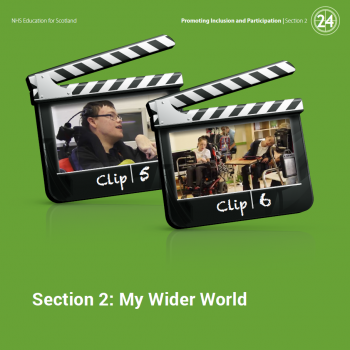 These are brought to life in a series of DVD vignettes which tell the stories from the perspective of the child, their families and schools. It poses the practitioners’ questions that allow them to reflect on the impact of AAC on the child’s day to day life. The resource is designed to be used for group discussion. The feedback from the expert practitioners that reviewed the material suggest that the DVD and resulting questions can enable AAC practitioners to have a rich discussion about best practice and how to time educational and therapeutic input to achieve holistic outcomes.
This on-line resource will help practitioners:
- Understand the role that collaboration and involvement play in delivering wellbeing outcomes for children who use AAC.
- Apply a holistic approach and outcomes focused approach to assessment, implementation and review which places the child at the centre.
- Recognise that as the child develops and changes, so the level of different team member’s involvement will ebb and flow.
Download the resource here. It takes a little time to download so be patient !
We would be delighted to receive feedback of how it is being used.
Ref
Light J , Mcnaughton D, Communicative Competence for Individuals who require Augmentative and Alternative Communication: A New Definition for a New Era of Communication? Augmentative and Alternative Communication, 2014; 30(1): 1–18
Handing over control of communication seems to be the most difficult of all the skills we need to have when we are taking part in communicative exchanges. Just how difficult this is, even for skilled communicators, can be clearly seen when people are using Talking Mats. Handing over control of communication is one of the fundamental principles of the talking mats framework. If the person has the physical skills, the facilitator physically hands over this control by handing the person the symbol (and of course other approaches are used when the person does not have the physical skills). The ‘thinker’ (the person who is doing the Talking Mat) then places the symbol on the Talking Mat, under one of the points on the pre-agreed top-scale, having been asked an open question e.g. how do you feel about …….?
When facilitators are learning about this approach, they seem to find it easier to ask open questions, slightly harder to stick to the agreed top scale but really difficult to hand over all of that control. As part of the training, participants film themselves using Talking Mats with someone. We use that clip to reflect on the facilitators’ skills, by taking about things that we liked and then reflecting on ‘it would have been good if…….’
The video clips work really well as participants can see themselves making the errors of retaining control in small (but nonetheless significant ways) e.g.
• Having the mat facing themselves rather than the ‘thinker’
• Moving the symbols after they have been placed by the ‘thinker’ to tidy them up/to make it easier for facilitator to see them
• Forgetting to give a neutral response where ever the symbols are placed (even if the facilitator thinks that the symbol has been ‘misplaced’)
• Telling people that they must place the symbols in rows underneath one another
• Not letting people use the top-scale creatively e.g. by placing the symbols at specific points between the top-scale e.g. to represent unsure but I am more happy with it than not.
The great thing about the Talking Mats training is that participants noticed these things that they were doing and will be working hard at noticing and doing them less in future.
We find it hard to give up control and find it hard to notice the things we do to retain this control, even when we are working within the talking mats framework. This is a framework where we are ‘symbolically’ handing over that control in the form of giving someone a symbol and so have a very obvious reminder of whose turn it is. How many ways then must we do it in everyday conversations and never notice? After all, in every day conversations, there are typically much less obvious reminders of whose turn it is and who should be in control.
Many thanks to Dr Jill Bradshaw, Lecturer in Learning Disabilities/Consultancy Development Manager, Tizard Centre, University of Kent for this thoughtful blog.
Getting feedback on AAC services is particularly challenging because of the communication support needs of this group of people. It is therefore really important for AAC users to have the chance to say how they feel about the services they receive. Services need to make sure that this group of people have a voice and that there is a mechanism for their views to be taken into account in monitoring the quality of services and service planning.
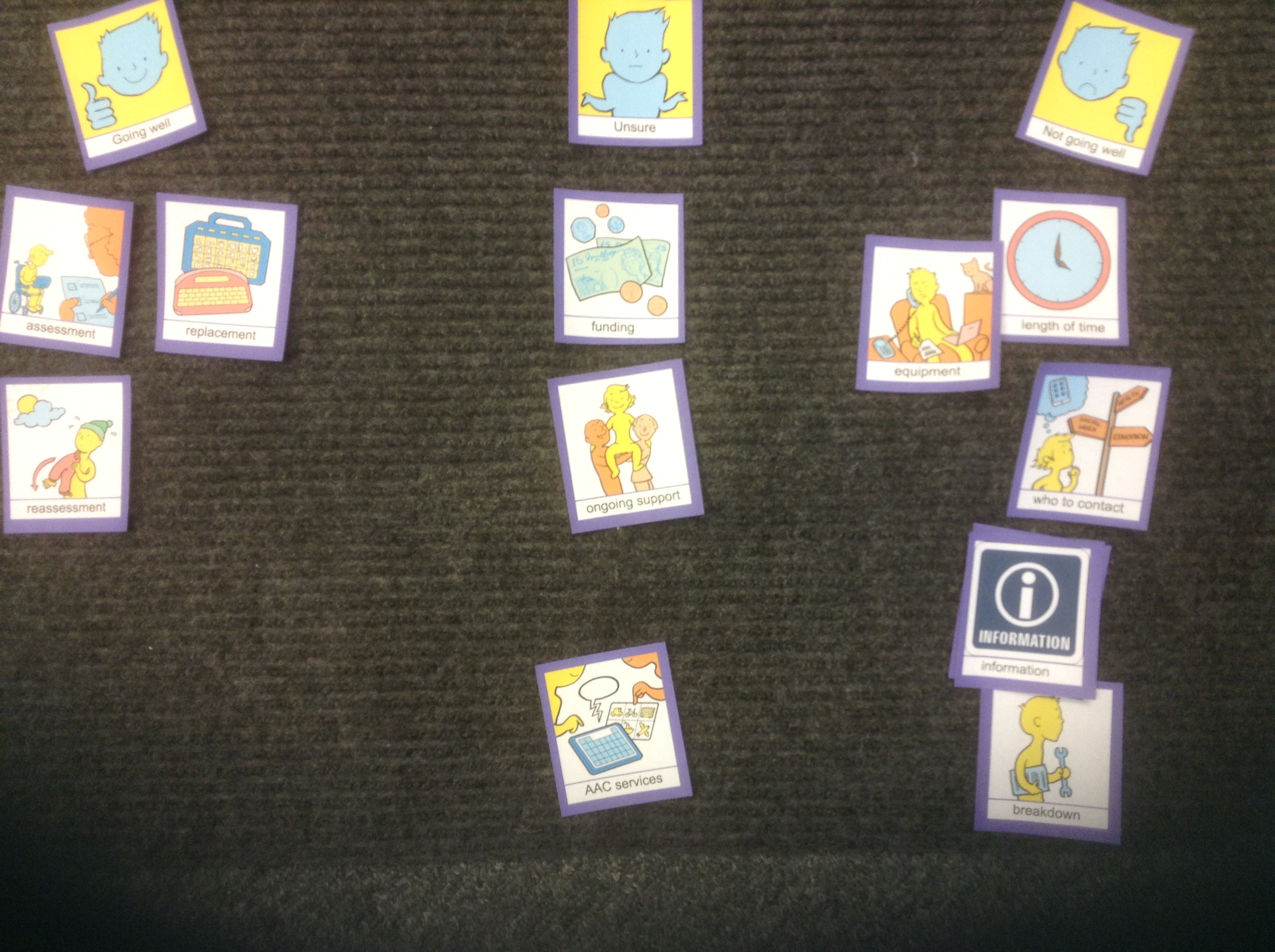
NES has funded the opportunity for professionals to attend a seminar and go away with a resource to support them to get feedback from AAC users about their service. The Talking Mats resource was trialled and developed with Forth Valley AAC partnership and is based on AAC quality indicators (NES 2013).
This opportunity is free of charge to people in AAC partnerships in Scotland. You will attend a half day specialist seminar and go away with a free resource to use in practice.
The resource will help people find out how AAC users feel about:
- People who work with them
- How AAC services are delivered
It provides a model of good practice which could be extended to evaluate other services.
4 dates and locations are available.
Edinburgh- Tuesday 17th March 1.45 -4-.30pm
Dundee – Wednesday 18th March 1.45 -4.30pm
Glasgow Thursday 19th March – 1.45 -4.30pm
Inverness Friday 20th March 1.45 -4.30 pm
If you are trained in Talking Mats and wish to take up this great opportunity, please book your place as soon as possible.
sally@talkingmats.com or rhona@talkingmats.com
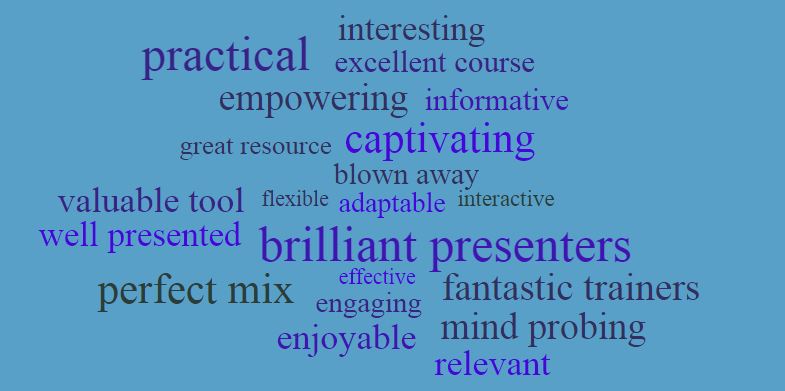
We really enjoy training people to use Talking Mats and are always inspired by the range of participants who are working hard to support people with communication disabilities. Here is some of the feedback we have received recently from the Talking Mats training courses that we have run.
 If you would like to find out more about our training courses please click here
Recently we delivered two Talking Mats specialist seminars in London:
- Talking Mats and the Eating and Drinking resource
- Talking Mats and Capacity
Both seminars were very well attended with lots of discussion from a wide range of professionals.
During the Eating and Drinking seminar, we provided background on how and why the resource was developed and showed some DVD examples of people using the resource. This really brought things to life and showed how important it is to give people (with and without speech) the opportunity to consider and talk about different aspects of eating and drinking. We also gave people hands-on practice in using the symbols from each topic.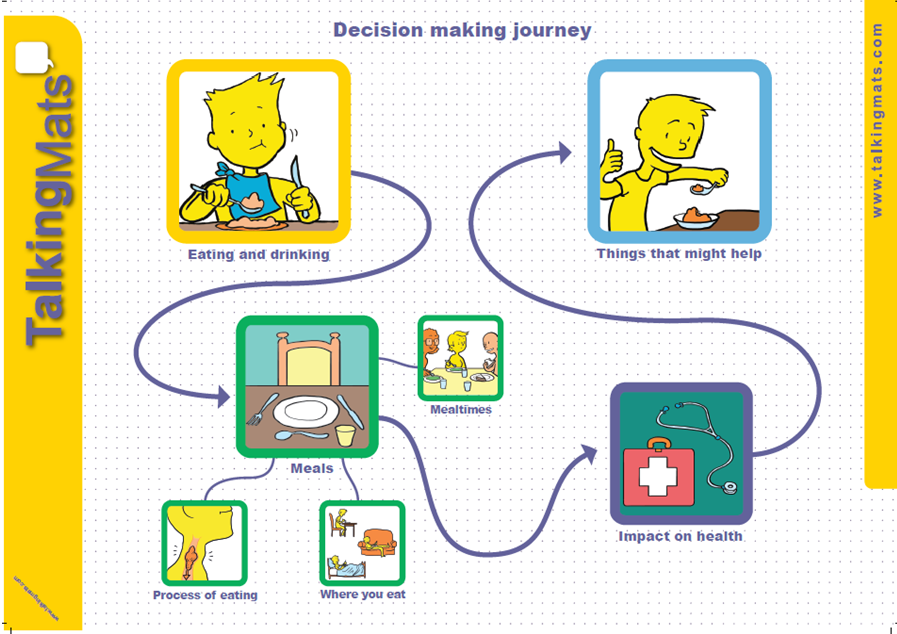
Each participant received a copy of the full resource, including symbols, a mat, and explanatory booklet.
During the Capacity seminar we discussed the fundamental principles the Capacity Act and participants had a chance to consider how Talking Mats can help people to:
- understand
- retain/remember
- weigh up information
- communicate their views/wishes and feelings.
They were also given the opportunity to work through some practical examples and think about options to help people understand issues and make decisions. 
If you would like to attend our next specialist seminars, we are holding them in Stirling on 17th February: Stirling Seminars Feb 2015 flier
Thanks to Anita Devi,Education Consultant, for her helpful contribution to this blog.
The implementation of the recent SEND reforms in England requires interdisciplinary teamwork. Integrated assessments will now be carried out in cooperation with the young person and the parents. Capturing the child’s own perspective and recording their views, interests and aspirations is now a statutory requirement. The principles of the SEND Code of Practice state that practitioners should encourage the child or young person, and the child’s parents to participate as fully as possible in the decisions affecting their lives and use a common language to shape educational and other outcomes.
Talking Mats has produced a practical and creative resource – “Consulting Children & Young People” that helps practitioners to ensure that they take account of the SEND Principles at all stages of the assessment process and development of the EHC Plan.
We recognised the need to develop a tool that would give a holistic picture of how a child or young person feels about their lives at home, at school and in their communities. Having a visual framework means that there’s more time for reflection. You can help young people to see their personal strengths and abilities and take time to consider what their problem areas are. Talking Mats gives greater choice and control about what kind of intervention is required to support them.
Communication is a two way process and the role of the facilitator is crucial. Talking Mats provides training at the following levels:
- Awareness – an introduction to the Talking Mats framework and the development of the CCYP resource.
- Enhanced – a whole day training to equip practitioners to use Talking Mats
- Specialist – In depth training which allows the practitioner to train others in their organisation.
(as stipulated on page 58 of The 2014 SEND Code of Practice for England)
Why not sign up for one of our training courses and learn more about –
 Improving the quality of your engagement
 Creating a visual framework for consultation
 A child centred approach to joint decision making.
Read Part 2 of this blog next week.