Online training login

Thanks to Helen Beltran for this thought provoking blog.
I am an Accredited Talking Mats Trainer and have just finished a great week of training in my local area, Inverclyde, Scotland. This was the first time I had given out symbol sets to everyone who completed the training. What difference did it make?
Everyone was able to see the symbol sets during the training and was really positive about the images and the design. I was concerned at the time that this would stop them really engaging with the process and individualising their mat. I was so pleased when they came back with videos that showed that they had selected the most appropriate options for their communication partner, they had removed those that were too abstract, they had thought about using photos, they had added symbols they had produced themselves. They had made the resources their own!
We talked about this as a group and all the participants felt that the symbol sets were going to allow them to get going with Talking Mats. They would then develop their bank of symbols, by making their own and buying further packs. Some participants told us that they felt having the symbol sets was allowing them to bring supportive colleagues on board who had not yet done the training and was combatting the negative attitudes of the vocal few who had the ‘not more work for us to do’ attitude!
They left with their symbol sets – full of ideas, not just about Talking Mats but about offering choice, hearing the individual’s voice, reducing vulnerability, relationship building and empowerment.
It has often struck me that some people are very much at home making picture resources and making their communication more visual, while others find it a real challenge. Is it reasonable for us to expect everyone to produce their own resources from scratch? Is the barrier to the use of visual communication the making of the resources, rather than the motivation to use them? On the other hand, is the making of the resources the only way to make sure that the supports meet the individual’s needs? What about the costs involved in buying in? Do those who are embracing visual communication need help with resources in order to spread good practice?
Food for thought?
My name is Karin Torgny, I’m from Sweden. My background is in journalism and culture studies. I used to work in “The Development Centre for Double Exposure” for many years, and our mission was to improve and spread knowledge about violence against women with disabilities. My special interest during these years was AAC. Today I work for Unicef and in different projects on human rights issues.
A year ago I did my accredited Talking Mats training in Stirling, Scotland. Since then I have given my first course in using Talking Mats when talking about abuse and harm. It was a great experience and an opportunity to work with an enthusiastic group of women who were open and willing to communicate using symbols. They are all in an organisation working with girls/women with intellectual disability exposed to violence and oppression in the name of honour.
I think Talking Mats is a good tool when approaching difficult subjects and I hope to run more courses like this in Sweden in the future. Lately I was interviewed on the Swedish Radio and talked about the use and possibilities with Talking Mats when someone is exposed to harm and abuse.
For those who know Swedish (!), here is a link to that program, http://t.sr.se/1mxZv9W
I am also curious if someone else is doing something similar. If so I would be interested to know more. Send an e-mail to: karin.torgny@gmail.com
Have a look at how Talking Mats has been used in Scotland to support people with a learning disability to disclose issues of concern: Survivor Scotland
Congratulations to our 5 new accredited trainers from Edinburgh City Council , Lothian NHS, Perth Kinross Council and SENSE Scotland
We had a great two days working together, exploring the Talking Mats framework and thinking about skills in terms of training and implementation of the Mats. Lots of chat but some key thoughts emerged that are worth sharing
- Keep calm with Talking Mats and have a blether
- Talking Mats gives the thinker the power to say ‘No’
- Open questions create open dialogue
- Children do but don’t get enough time to say
- Recap; Talking Mats provide a visual summary of the conversation
- It is easy to feel drowned out by other voices Talking Mats keeps the focus on the person
- It is good to have 1 to 1 time and not just when things go wrong
- The health and being resource is a perfect fit for the outcomes focused approach
There were lots of exciting ideas for future projects and further blogs which will expand on these ideas a bit more. So watch this space as the new trainers develop their ideas more.
If you are interested in becoming an accredited trainer click here
To mark Dementia Awareness week the Talking Mats team is keen to provide family training for relatives who care for someone with a communication difficulty.
Thanks to a generous donation from Miss Hendry Charitable Trust and support from Alzheimer Scotland, training has been carried out with family members at the Clydebank Alzheimer Scotland Resource Centre. Eight people who care for a relative with dementia (6 caring for a spouse and 2 caring for a parent) and one member of staff attended. None of the participants knew about Talking Mats before the training. They all cared for people who had difficulty expressing themselves and several told the group about the frustrations and despair they sometimes felt.
The training was carried out over 2 sessions.
Session 1 included an explanation to the background and purpose of Talking Mats, a demonstration, watching and discussing DVD examples, hands on practice, discussion of topics to be used at home with their relative and planning for next session.
Each participant was given a set of materials and by the end of the day all participants had understood the principles involved in Talking Mats and had gained the skills required to use it with their relative. They all said how much they had enjoyed the day and how much they had gained from it. They all committed to trying it with their relative and to bringing back their views to the follow up session. Each participant was given a post-it note at the end of the day and was asked to write any comments- positive or negative about the day.
Some of the comments:
• This was a very positive course today. It has made me feel very hopeful about establishing a time of coherent dialogue with my mother – albeit in a focused way and also in providing a tool for her to communicate in a simple way, her own thoughts, Thank you.
• Informative, informal, surprising. I enjoyed the course and felt I had gained from it.
• Could be a useful tool. Can’t wait to try it with my wife. Thank you.
• The course was very informative and well worth the time spent. Talking Mats is a very simple idea which seems to be working very well. I’m looking forward to trying it out and hearing how the others coped and what the outcomes will be.
• This was a very informative day and hopefully gives us a great way of communicating to find out my husband’s views on subjects.
The participants were assured that they could get ongoing support by phone or email and the staff member at the resource offered to provide local support.
Six participants plus two staff came to the second session. The others were unable to attend due to their relative being unwell. We had lively and helpful discussions where each person shared their own personal stories of how they had used Talking Mats and what it meant for them.
Overall they felt that Talking Mats was a powerful and helpful tool and that it gave them quality time together with their relative with dementia. The following comments illustrate this:
– small changes made a big difference
– It gives me time to sit down and listen to him
– It slows you down which is needed with someone with dementia
– It helps me know where he is at the moment
– It showed my husband the things he CAN do rather than what he CAN’T do
Relatives found out some things about their partner that they didn’t know e.g. one person with dementia had revealed that they didn’t like having the radio on all the time; another had toothache which the partner was unaware of; another said that food had become tasteless and he no longer enjoyed mealtimes as a result. The relatives were all able to do something as a result to help the situations – e.g. reduce the background noise of the radio, make a dental appointment, add more spice to their cooking.
One couple now use Talking Mats every few days on a regular basis to help the person with dementia think about issues and compare his mood from week to week
– He always feels up after he’s done a Talking Mat
This couple had also given a demonstration of using Talking Mats to a family meeting at the resource centre
Overall the participants found Talking Mats very helpful although two felt it had not been successful. We discussed the reasons for this and the group were very supportive and suggested that the staff could help by introducing Talking Mats as a group activity at the resource centre where these two people could be included. The staff at the centre were also very positive and plan to use Talking Mats both with individual people and with groups.
Overall it was agreed that Talking Mats is a very useful tool both for individual families and for dementia centres. We discussed future plans for individuals and also for the centre. This included designing a Talking Mat to discuss football and another to allow the people with dementia who attend the centre to be involved in planning the centre’s new allotment.
We plan to continue our involvement with the Clydebank Resource Centre and are now in the middle of running the same course in other Dementia Resource Centres.
Anyone wishing further information about Talking Mats training for family members, please contact us at info@talkingmats.com
Many thanks to Lynne Baxter who has answered the question: Is Talking Mats suitable for parents to use?
I have been asked to write an account of my experience, as a parent, of completing the on-line course available for Taking Mats. I completed this course in April this year 2014 and I am very proud of my achievement. First some background information. I am nobody special just a parent of a child who has a diagnosis of Autism Spectrum Disorder/Condition. My son is in a mainstream setting and has limited access to support and resources due to financial restrictions. Through time I realised that I was his main resource for support and really needed to improve my knowledge and understanding of this “hidden disability”. I had already heard about the wonderful resource that is Talking Mats, the tool that help makes communication easier for many. I started to do my research and find out more about it. I am not a professional who has been trained on the Autism Spectrum, my knowledge is only from my experience of having a child on the spectrum. I was unsure if I would be able to do this. After much consideration I took the decision to give it a try! I am so glad I did. While insuring that the product would be of benefit to my family, I nervously contacted the wonderful supportive team at Talking Mats and asked them what they thought. They were very encouraging and I felt empowered to try the training course! They assured me that they would help me as much as they could. This was very reassuring to know and gave me the reinforcement I was looking for.
Every week I was given access to each module which I completed to the best of my ability. Anxiously waiting for the result and the feedback from the team to see if I was able to attempt the next module was normal for a Wednesday while doing this course. To my great relief the feedback was positive and before I knew it I was nearing the last assessment and the completion of the course. The last assessment involved me and my son using the resource Talking Mats, this had to be filmed and sent for grading! Once again I had to push myself out of my comfort zone! It will be worth it for the benefit the training would give to my family. A friend came and videoed the situation and it was sent off for feedback and grading.
I passed! The feedback was amazing and now I can use the resource that will help my son explain his thoughts and feelings in a concrete way. The hardest thing for me was not to influence the results, I had to make sure it was his views and not mine! I have now registered to use the app and I am continually surprised by the evidence. I am delighted with the continued support from the team and I am very grateful to them for the resource. My son finds it hard to express his emotions, thoughts and feelings. This gives me hard evidence of his opinions and is great to have to reference too throughout the years!
Having to use open questions has helped my son communicate more than he knows! A very good result!
For information about the online training click here
When people have been in hospital for a period of time, for whatever reason, consideration needs to be given to discharge planning. There are often concerns about what a person may manage to do independently when they get home, and this often has an impact on where people are discharged to and what type of support they might need.
The ‘looking after yourself’ symbol sets in the health and well-being resource provide a good starting point for exploring some of these issues. This set is made up of three topic sets:
- Domestic life
- Self-care
- Work/education
I used these when I worked with a woman (Ruby) who had severe receptive and expressive aphasia. She had been discharged from hospital with a care package (carers came in three times a day to help her with personal care, meal time preparation and housework). Ruby had difficulty communicating through speech but was able to use Talking Mats effectively to express her views. I used the ‘domestic life’ symbols to find out how Ruby felt about managing the daily running of the household. Ruby was able to tell me that she felt she could now do more things around the house, such as hoovering and the laundry. She was ‘unsure’ about cooking and shopping, but indicated that these were areas that she wanted to work on.
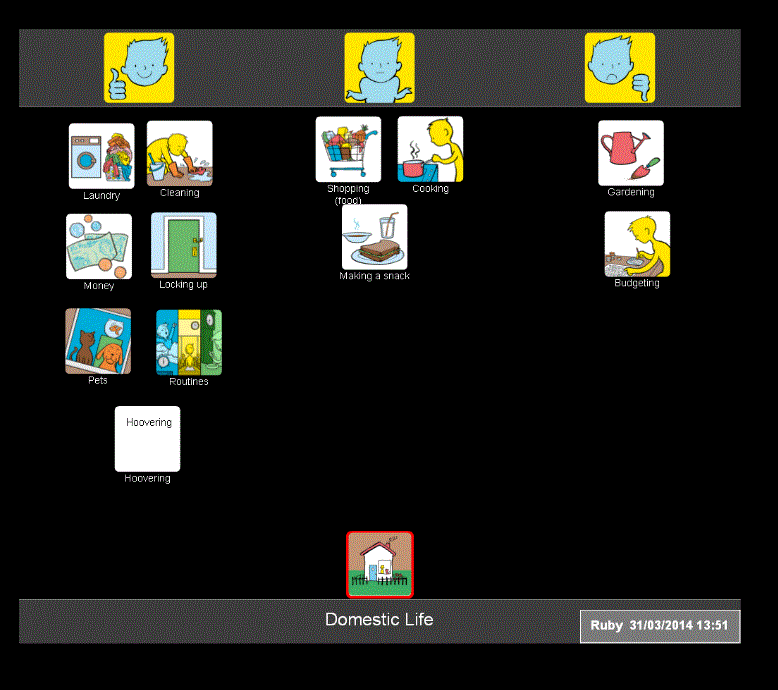
Using Talking Mats, Ruby was able to tell me that she wanted to try to do more things for herself. We used photographs of the completed mats to discuss these issues in more detail with Ruby’s social worker and her husband. Initially, Ruby’s husband was hesitant about her doing more things around the house, but seeing the mat in front of him meant that he really listened to her views and felt happier about her taking risks and trying things for herself. As a result of our discussions, Ruby’s social worker reviewed her care package. She reduced the daily visits by carers and Ruby was given support from the rehabilitation team to help her work on preparing meals. Her husband arranged for a friend to take her to the supermarket once a week so that she felt more in control of the cooking. Use of Talking Mats meant that Ruby was really involved in setting her rehabilitation goals and ensured that her views were heard when her care package was reviewed.
The ‘looking after yourself’ symbols can be used to include people with communication difficulties in the decision making process. This is particularly important given the current legislative drive to promote self-directed support. Find out more about how to use Talking Mats by signing up for a training course at Talking Mats.
I undertook the ‘Talking Mats’ on-line course to acquire a new skill and a way to enhance my communication with people with dementia in practice. I have found the learning strategies used are varied and interactive – so there is not a sense of sameness, even though visually there is a consistent layout to the presentation of each module (this expedites navigation). This enhances engagement and my interest so that I am never reticent in logging on to complete the next module! In the beginning, I felt that I could move a lot quicker through the course if the modules were available once each part was completed, instead of having to wait for feedback on each assignment. However, nearing the end of the training course, the benefits of this approach are now clearer. Spaced learning and spaced practice allows for thinking time and internalisation of the module components. In this way, I have come to appreciate the part skills involved in the overall process and how they come together. I now find myself observing the skills involved and the reactions of all communicating as well as the surrounding environment, body language etc. I have also found myself looking back over the past module materials to ensure I am integrating as I go and to remind myself of the rationales for the actions that need to be taken, as well as ensuring that I am more and more familiar with the new terminology that I have been exposed too.
Little did I know when I signed up that the benefits of learning about and how to use ‘Talking Mats’ would stretch wider than what I initially anticipated or wanted! In completing the course, I am now much more aware of my communication practice in general, and the part-skills involved. I can also now see the wide applicability of ‘Talking Mats’ to different populations, age groups and conditions. Communication is everywhere but it needs to be efficient and effective – I am now more confident that my communication practice will improve as a result of this course. For me this is the best outcome possible.
Please click here to find out how to book on the next course
The following are thoughts from Jenni, a Psychologist who attended the Talking Mats Accredited training course.
‘Meeting with five colleagues from Sweden, England and various parts of Scotland for the accredited Talking Mats Training this month has been a fascinating experience. I have been accustomed to using Talking Mats with children and young people over the past seven years, and have seen the value of the approach in helping young people give their views for a meeting – particularly if they have communication difficulties and would struggle either through lack of confidence or skill to speak out when others are present.
However, we were not just a group who work with children and young people. Most came from health settings and examples were drawn from elderly patients, some with dementia, others with autism. As we shared our videos and told our stories it was obvious to me how relevant Talking Mats can be in those settings too. Some of the stories shook me. One person told how she was deep in conversation with a lady over her Talking Mat when the tea lady burst in, poured a cup of tea for the resident, asked if she was having a good time playing at puzzles, then left before any answer could be given. Time and again we found ourselves asking what is it about our institutions that puts routines above real communication and above proper respect for an individual.
In preparing a video to bring to the training I undertook a Talking Mat with my father, who is almost 90. It was a new kind of conversation for us both, but we were surprised – the structure allowed us to talk about what was going well and what needed a bit of an adjustment in domestic life and we both learned from the conversation. I think we will do it again!
Indeed, at one stage in the training we were asked to dream big and look at how we might want to take use of Talking Mats into new areas. I identified some good friends – one 91, one 101 and one 104 – where conversation can become rather one-sided. I am interested in the power of Talking Mats to help create a genuine dialogue when these friends are reminiscing, in other words, to help me to be not just a listener but to enter the dialogue. Having a record of the conversation will help us take the discussion further when we return to it.
As ever, the time spent with Talking Mats colleagues was refreshing, stimulating and I can’t wait to go home and try out some new ideas!’
Jenni Barr, Educational Psychologist
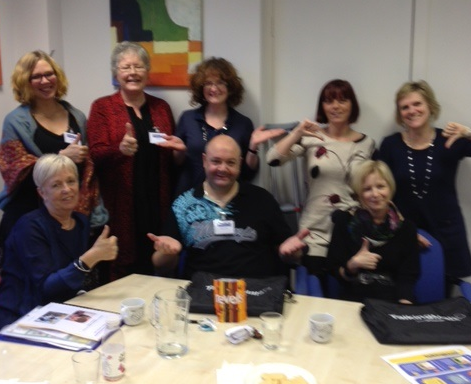
Thank you Joan and Sally for the fantastic hospitality and inspiring 2 day accredited train the trainer course at Stirling university.
I cant wait to carry out our first session with all of the fabulous advice and support materials you have given us. Talking mats can reopen doors to communication that others may fear were closed for ever.
I was so lucky to meet a group of lovely people on the course, who also share the same enthusiasm for using Talking Mats. It is absolutely fantastic to be part of something that is world wide and getting bigger, long may you reign and long live Talking Mats.
Anthony Howe, Assessor/Tutor/Internal verifier
Training and Development Team, Adult Social Care
Tyne and Wear