Online training login

Our final resource in our January Sale, the Social Care Resource, in its original form was one of our first. It will be reduced by 30% for the whole of January 2025!
“ it’s an amazing thing; that something so simple could be so useful to people”
James, Talking Mats user

This resource can help build an understanding of who someone is and what is important to them.
It has 3 topics:
You – how is your general health, emotional well being, appetite going at the moment?
Activities – what interests do you have?
Where you live – what works well in your home / where you live and what doesn’t?
Margo MacKay, now our Managing Director, tells a story of her early days using the Social Care Resource in a care home for people with dementia:
When I went back to the Care Home where I was piloting our new Social Care symbols the staff told me this story about Ann. Apparently she usually is very quiet and never joins in with activities or with other residents. However when we used Talking Mats with the Activities symbols, she told me that she really likes singing and had started singing to me. Later that day, one of the care staff had suggested that she sing again and Ann started a song with him. Gradually other residents joined in and they had a lovely sing-song with Ann leading it!
Joan Murphy, Founder of Talking Mats, recently published a report; Reducing the Burden of Dementia by Using the Talking Mats Framework to Help People with Dementia and their Carers Communicate More Effectively. 1 One study described in the report looked at the use of Talking Mats to support people with dementia and their carers to make decisions together. Here are some quotes from people with dementia in the study:
I found it (Talking Mats) a big help, sometimes I get the words muddled and can’t get out what I am trying to say.
The mat shows that I am able to do much more than I thought. I didn’t realise how much she is doing in the house.

The Social Care resource is available to anyone already trained in Talking Mats and between the 1st and 31st of January it will be reduced by 30%.
If becoming trained in Talking Mats is something you’d like to achieve in 2025 find out more here.
References
- Reducing the Burden of Dementia by Using the Talking Mats Framework to Help People with Dementia and their Carers Communicate More Effectively.European Society of Medicine Medical Research Archives, [S.l.]. Vol 12 No 9.
Available at: https://esmed.org/MRA/mra/article/view/5716
This blog continues our focus on the great deals being offered in our January sale.
I wish I’d had this resource as a newly qualified Speech and Language Therapist. Working on an Acute Stroke Unit a couple of things became clear to me quite quickly;
1 ) how much emotion surrounds changes in eating and drinking, not just for the person affected but also their family and friends
and
2) how seldom the person was included in decisions regarding food / drink/ and eating.
In my defence I qualified a good while ago and although the desire to include patients in these decisions was there the tools to help facilitate this, on the whole, were not.

Our Eating and Drinking Resource offers support in both these areas by placing the person affected in these situations at the heart of any decisions made.
Read these blogs to find out more about the Resource and how it can be used;
Speech and Language Therapist Gillian Callander reviews the resource from her background of working with adults with a Learning Disability.
Eating and Drinking Resource – a review
Mary Walsh, Senior Speech and Language Therapist at St Mary’s Hospital in Dublin, describes using the Resource as part of a project that considered how Speech and Language Therapists could facilitate people with dementia to become more active participants in the decision-making process around dysphagia management at the end stage of dementia.
My family have recently had experience of eating and drinking difficulties with our teenager and I have to admit prior to this I hadn’t fully considered the role our Eating and Drinking Resource could have. She doesn’t have a communication difficulty but the anxiety, fear, and shame around eating meant she shut down regularly and verbalising her wishes and needs wasn’t an option. My own anxiety and emotional involvement meant I didn’t use the Eating and Drinking resource with my daughter but the gift of hindsight lets me see the benefit it could have when supporting someone in this situation. At this time of year a lot of focus is placed on eating and drinking, particularly socially and creating a plan with this resource could make a big difference.
If you work with someone with an Eating Disorder and have used Talking Mats to support them please think about sharing your stories with us, we’d love to hear them. Contact paula@talkingmats.com
The offer of a 50% discount is only available between January 1st and 31st 2025, to those trained to Foundation Level. Available from the 1st in the website shop.
Talking Mats don’t do Pink Friday, Black Friday or Cyber Monday but we can tell you about our January Sale.
Starting on the 1st of January 2025 and running until the 31st of January 2025 we are offering;
- 30% discount on our Health and Well Being Bundle
- 30% discount on our Social Care Resource *
- 50% discount on our Eating and Drinking Resource *
*available if Foundation Trained
These are popular resources and over the next couple of weeks I will signpost you to some of our top blogs that showcase how they can be used.
This week:
Health and Well Being Resource Bundle
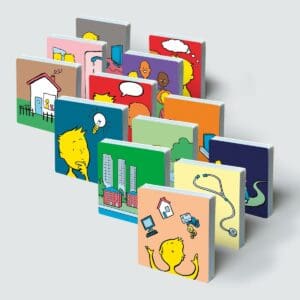
This comprehensive resource can support conversations around general health, a person’s environment, ability to look after themselves and their communication across different areas. Find out more about it’s development and use.
Read about the development and background to the resource and its use with Duncan who had had a stroke.
Kate was a woman with severe communication difficulties following a stroke. This blog describes how using the 4 communication topics Kate and her therapist were able to identify specific challenges that could be worked on to help her overcome her difficulties.
The Health and Well Being Resource complete with bag and mat will be reduced by 30% from the 1st of January and will be available to buy in the website shop from that date.
In her blog last year, Janie Scott told us about the use of Talking Mats within the Services for Children, Young People and Families of Perth and Kinross Council. READ HERE .
To coincide with our most recent batch of trainers completing the Licenced Trainer course, Janie’s second blog describes how the tool was embedded in the service and subsequently evaluated.
Having delivered several Talking Mats Foundation Training courses to colleagues and used the framework to develop resources specific to the Services for Children, Young People and Families, the challenge then was how best to share information and ideas. Janie writes:
Electronic Document Management Site (EDMS) for Talking Mats
As the new resources were developed they were initially emailed round the team but with support from IT a specific site for Talking Mats was developed. It included:
- Useful links – to websites and webinars
- New site – this celebrates when a group passes the training with a photo
- Documents – this contains all the resource packs that have been developed and the report templates
- Teams channel – this highlights any news from Talking Mats and any new resources

Access is given to the site after session 1 of the foundation training.
Ongoing Support
Part of the role of the Talking Mats trainer is to provide ongoing support. This has been done over the last year in the form of a Teams consultation. A webinar was also given via a direct work forum. This was attended by 70 participants from social work and education.
Feedback
The SLT sought feedback after every foundation course and sought to gather feedback a few months after the training. The SLT reported numbers back to Talking Mats and sought case studies from participants.
Numbers Trained
During 2022, 40 staff from Field Work and Looked After Services completed their Foundation Training. This increased to 74 by May 2023. All REACH staff were trained in Talking Mats, most to an advanced level, having done the ‘Keeping Safe’ training. In 2023 three members of the Child Protection Duty Team attended the online’ Keeping Safe’ Advanced Training, run by Talking Mats, after embedding the Foundation Training into their practice.
Measures of Impact
Feedback following Foundation Training
53 participants


Feedback overall was very positive with participants feeling that it would help to support gaining the voice of the child and parents.
Feedback following use of Talking Mats in Practice
18 participants responded to the questionnaire sent out several months after the Foundation Training. The feedback supported research findings that the quality and quantity of what is said increases and that the young person’s voice is heard.
Quotes from participants


Thank you to Janie for this blog. If you are interested in becoming a licenced trainer please contact licenced@talkingmats.com for more details.
Queen Margaret University Masters student Ciara Hamill is conducting research into the use of Talking Mats with children, read about how to get involved below, and click the link or scan the QR code to contribute to Ciara’s research.
Hi, my name is Ciara Hamill, and I am a MSc Occupational therapy student at Queen Margaret University. As part of my final year dissertation, I am working in partnership with Talking mats Ltd to explore occupational therapists’ experiences of using Talking Mats with children, and I need your help!
What is involved?
One confidential survey that will take approximately 15-20 minutes to complete. All responses will remain confidential and will only be used for research purposes.
Who can participate?
- Occupational therapists/assistants who have been trained in using Talking Mats.
- Occupational therapists/assistants who have used or are currently using Talking Mats in practice with children.
Why take part?
By sharing your experiences, you will be contributing to gaining insight into the practical use of Talking Mats and how it has been applied in the context of children. This research will influence future resources and training for occupational therapists.
How to take part?
Step 1: Click the link or scan the QR code at the bottom of the page.
Step 2: Ensure to read the participant information sheet and give informed consent before beginning the survey.
Step 3: Answer the questions based on your experiences.
Step 4: Submit your responses!
Thank you for your contribution!
Thank you for considering taking part in this research. Your participation is greatly appreciated. Feel free to spread the word with colleagues who may be interested!
Or
Scan the QR code below

We are delighted to share a poster from Licenced Trainers Brid Corrigan and Libby Mills of NHS Greater Glasgow & Clyde, and Student Speech and Language Therapist Heather Pollock, developed as part of an Impact Project with the University of Strathclyde.
The poster reports on an evaluation of the impact of Talking Mats training on clinical practice across several Child and Adolescent Mental Health Services (CAMHS) in and around Glasgow. We were thrilled to hear the poster had been accepted at the Solving the Mental Health Crisis: Global Solutions Across the Lifespan Conference, held on Friday 21st June.
The project demonstrates how Talking Mats can be used by several members of the multidisciplinary team to build rapport and set goals with young people in both the inpatient and community CAMHS setting. A huge well done to everyone involved in the project for shining a light on how Talking Mats can help to hear the young person’s voice as part of their CAMHS journey.


Talking mats are delighted to announce the new Talking Mats ’ Sexual health and relationships’ advanced seminar and resource which is now available to book.
Resource background and development
This resource has been developed in partnership with the REACH team in Perth and Kinross council. In her blog Let’s talk about sex: part one Julia Pollock, a speech and language therapist with this multidisciplinary team describes why this resource is much needed and how it has helped open up discussions on a subject that otherwise might be more challenging. Her second blog Let’s talk about sex: part two describes the impact that this talking mats resource has had on one young person as they navigate their way through the criminal justice system and their sexual development from childhood to adult hood’
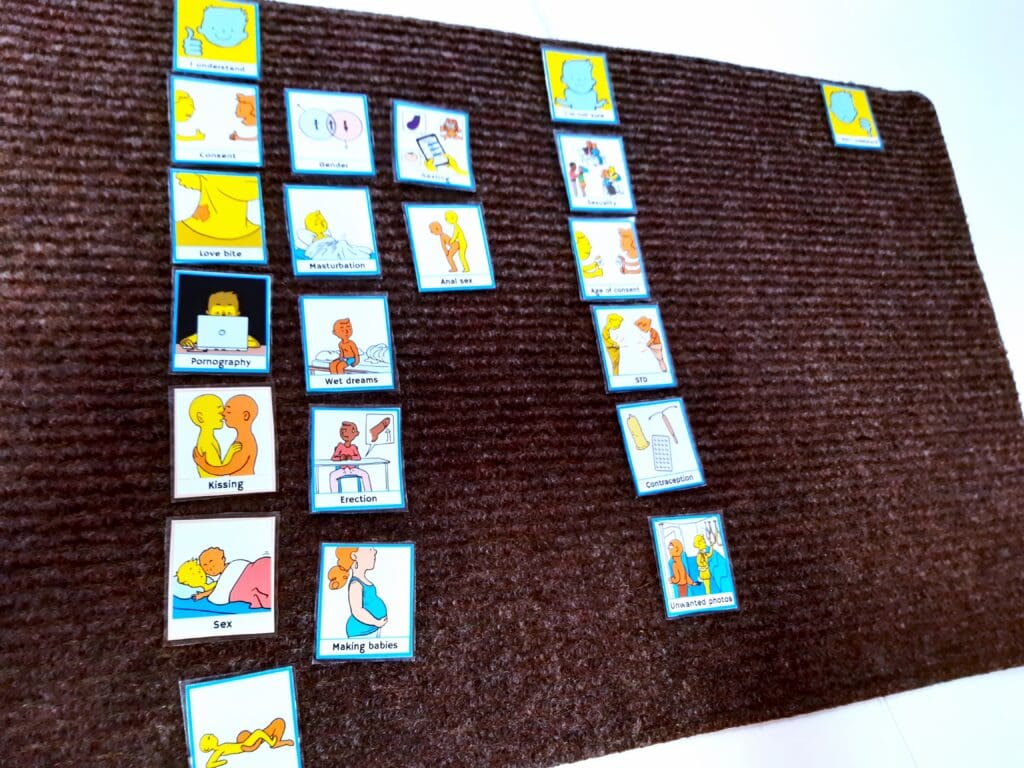
What is in the Talking Mats Sexual health and relationships resource ?
The resource has three topics:
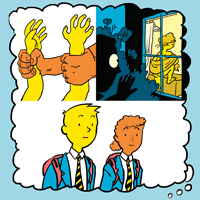
- Sexual knowledge. This topic allows practitioners to explore what young people know. It also includes a sub mat of body parts to be used if more concrete options are required
- Being close. This topic explores the young person’s view of intimacy. It can be used to explore what they have experienced in relationships and or what they want.
- Sexual interests. This topic grew out of the Reach team’s focus on working with young people at risk of being involved in harmful sexual behaviour so it is to be used with care and is not appropriate for all thinkers. The options need to be personalised carefully.

Using this resource
From our piloting and testing phase this Talking Mats sexual health and relationship resource has been found to be very helpful for those working in this field but, it needs to be used with sensitivity and care. The options and images that we have developed are clear but are sometimes explicit. It is for this reason that this resource is not going to be available on our digital platform. It is important that practitioners using the resource are aware of the issues and think carefully about which topics and options are helpful for the young person they are working with before presenting them. Practitioners using this resource need to work in a context that enables the young person to access any ongoing support for issues that may arise.
Accessing this resource
To access this resource, you need to:
- Have completed the Talking Mats foundation course.
- Be familiar with your organisation’s child protection and adult support and protection procedures
- Be clear about why you are using this resource and for what purpose for example to explore sexual relationships in general or to open up discussions about harmful sexual behaviour. You need to be experienced enough to be able to adapt the resource for those different contexts.
- Book onto our advanced seminar which we are hosting on the 5th of February 1:00 PM to 3:30 PM in conjunction with the REACH multidisciplinary team. This seminar allows for the context, challenges, risks and benefits of using the resource to be fully explained. This will include best practice examples and impact stories. It will give you the opportunity to explore the resource further and to ask any questions. The cost is £80 per participant and this covers the resource and the seminar.
Click here to book your place on this Advanced seminar. Places will be limited so make sure to book soon. Resources will be posted out the week before the seminar.
This week’s guest blog, the first of 2 from the authors (Lois Cameron, Nikky Steiner and Luccia Tullio), describes the development process of a set of symbols aimed at supporting practitioners to reflect on the role of identity within their practice.
Every person has their own unique identity, just like they have their own unique fingerprint.
Identity is about how we see ourselves and how the world sees us.
Background
The Royal College of Speech and Language conference 2021 was titled ‘breaking barriers and building better.’ Professor Harsha Kathard from the University of Cape Town gave the keynote presentation and reflected on the key role understanding identity has in clinical practise, stating that ‘understanding identity is key to inclusion’. Secondly, she stressed that if we want to develop better services and support then ‘Turning the gaze to reflect on our positionality is central to change’ .Ash R et al (2023) in their editorial for the British Medical Journal highlight how interventions normally focus on single categories of social identity and ‘fail to account for the combinations of, or intersections between, the multiple social characteristic that define an individual’s place in society.’ They argue that ‘systems of care may consequently overlook overlapping systems of discrimination and disadvantage and exacerbate and conceal health inequities.’
The Development group
Following feedback from clinicians and people who use Alternative and Augmentative Communication (AAC) a working group was formed in March 2021 to explore the role of identity, diversity, equality and inclusion with in AAC practice.
Communication Matters and AAC networks within the UK advertised the group and 12 people responded. These people came from a range of organisations and had a range of lived experiences of diversity including people who use a communication aid to help them communicate. The work was funded by the Central London Community Health Trust and Talking Mats Ltd facilitated the meetings and the work
The group worked shaped the resource by reaching a consensus about the components of life that contributed to identity. In the end the group agreed on gender, sexuality, disability, race, neurodiversity, culture, family structure, voice, bilingualism, religion, mental health, personality, politics, intimacy, connecting with others and occupation. The process of developing the symbols was hugely helpful in unpicking what was actually meant by the various aspects e.g. voice. The original image for voice represented accents but the group discussion shaped the image to represent much more so the final image included a rainbow flag, a more general sound wave to represent tone, a Spanish word and an image to represent disability. As one group member said ‘my cerebral palsy is part of my identity. If I am having a voice I want to reflect that identity – I want a cerebral palsy voice’. Identity and the issues surrounding it can be emotive but the focus on the symbols helped contain the emotion and supported group members to listen to the perspective of others.
The whole iterative process of developing the resource and clarifying what the symbols should look like allowed the group to be clear about the individual meanings of abstract topics. This wider understanding was captured in a glossary to go alongside the symbols. For example, Identity has the following definition: Every person has their own unique identity, just like they have their own unique fingerprint. Lots of different characteristics make up our identity. This is what makes us different from other people. Sometimes we may share some of these characteristics with other groups of people, which can also be part of our identity. Identity is about how we see ourselves and how the world sees us.
Equality, Diversity and Inclusion: a visual framework to support the exploration of Identity within practice.
The resource is seen as a support for constructive reflection by practitioners on identity and allows them to consider the different aspects of their patients’ lives that may impact on their interventions. The final Talking Mats symbols have the suggested top scale of ‘I considered a lot’, ‘I considered a bit’, ‘I have not considered yet ‘. It could be used individually or by a team as a group discussion tool.
As the resource uses the Talking Mats framework, it is recommended that practitioners have completed their Talking Mats foundation level training
If you are interested in completing Talking Mats Foundation Training, you can see the training options in our shop here.
References
Kashard H 2021 Keynote breaking barriers and building better The Royal College of Speech and Language conference.
Ash Routen, 1 Helen-Maria Lekas, 2 Julian Harrison, 3 Kamlesh Khunti1,2023 Interesectionality in health equity research BMJ 2003 https://www.bmj.com/content/383/bmj.p2953
As of Monday 10th June, our new address will be:
16A Beta Centre
Stirling University Innovation Park
Stirling
FK9 4NF
All other contact details will remain the same.
Please bear with us as we get our systems up and running again after the move – there may be a delay in responding to enquiries over the next few weeks.
Keep an eye on our social media channels for updates on our office move! Thank you all for your continued support.
Talking about sensitive issues can be challenging at times. We are so excited to publish this guest blog from Julia Pollock, Highly Specialist Speech and Language Therapist (SLT) from the REACH team in Perth, Scotland, explaining how a newly developed Talking Mats resource helps to open up conversations with young people about sex.
REACH is a unique team, one of a kind in Scotland, that provides intensive support for care experienced children and young people on the edge of care in Perth & Kinross. We are a multidisciplinary team bringing together professionals across health, education, social work and youth work. This allows us to provide prompt specialist care, while limiting the need for referrals to multiple agencies.
My colleague, Janie Scott, and I have worked for REACH since its inception, as Highly Specialist Speech and Language Therapists. Research shows that more than 60% of care experienced young people have some kind of speech, language and communication need (SLCN) and at REACH we work on the assumption that our young people may have an SLCN – until proven otherwise. This means that we routinely offer communication assessments and support to every single young person (and their parent/carers), in addition to keeping inclusive communication at the heart of everything we do. Adopting this approach ensures that none of our young people have to struggle with communication difficulties unsupported.
Working in a multidisciplinary team with a heavy social work contingent has been a very different experience for Janie and I. The team were open to our training and approaches and allowed us the freedom and autonomy to shape our own SLT service.
One of the first things we did at REACH was to introduce Talking Mats. We are both Talking Mats Licensed Trainers. All our REACH staff, as well as any other colleagues across the council and NHS who also work with our young people are Talking Mats trained.
Despite some initial scepticism around using pictures with teenagers, the resource has since proven to be incredibly useful and engaging for this particular client group. It has now become a staple resource that our staff will reach for regularly to facilitate conversations with our Young People and to help them express their views on complex issues.
Our young people can occasionally find themselves in conflict with the law and wrapped up in the complexities of the criminal justice system, as a result of their often disadvantaged backgrounds, and/or due to a range of ongoing challenges such as developmental trauma, social emotional and mental health difficulties, and/or Speech, Language and Communication Needs (SLCN). In addition to supporting REACH clients through their criminal justice journey, our team also specialise in harmful sexual behaviour assessments, for both internal and external clients.
The idea for a Talking Mats resource for harmful sexual behaviour initially came from one of our Senior Practitioner Social Workers, Amy MacKinnon, who suggested that Talking Mats might be a useful tool to support their harmful sexual behaviour assessments (AIM3). The assessment, which involves interviewing the young person about incredibly sensitive and personal issues, can be quite confronting for young people. We discussed the possibility of having visual resources which would not only cater to the SLCN of our clients, but that would also make the assessment feel less intimidating for the young people, encouraging more open and honest responses.
We often start by assessing a young person’s existing level of sexual knowledge and understanding, as how can young people possibly share their version of events if they do not understand the basic concepts of which they were being accused of?
This includes exploring their understanding of the language around sexual physiology and anatomy, in addition to the social and legal considerations of sexual behaviour. The introduction of this resource allowed us to explore existing knowledge much more effectively than we had previously, with a more logical progression of concepts ranging from the very concrete language for body parts, through to more abstract ideas such as consent. More careful consideration of the young person’s language level really helps to ensure that the Young Person’s responses are accurate. We recognised that our existing pictures/resources needed development and so I approached Talking Mats to ask if they would consider working with us to create an official Talking Mats resource using their own artwork and branding. I know from experience that their artist, Adam, always does a fantastic job creating simple images that are so easily understood while also being sensitive and inclusive.
We developed a small working group with a handful of REACH and Talking Mats staff who have focused on developing a new healthy relationships resource to open up these tricky conversations. We have now completed the pilot stage, and have a fantastic resource. Talking Mats did not disappoint and as expected, they worked wonders with the images!
One interesting development along the way was the group’s reflection that the resource had felt quite negative and that perhaps we should keep a more neutral stance when developing the concepts – leaving room for much more general (or even positive) discussions around sexual development too. This allowed us to expand the resource to include concepts relating to puberty and gender identity. We felt that this would make the resource more far-reaching and impactful, while still retaining the option to use the more niche resources for addressing harmful sexual behaviour, when required.
The feedback we have received has been overwhelmingly positive, with comments such as ‘It’s amazing’ and ‘We’ve been sitting waiting for a resource like this.’ Those trialling the resource for us unanimously felt that the resource helped them to discuss the topic with their clients, helping to ‘open up’ discussions that would otherwise be more challenging to initiate. We have also received a lot of positive feedback on the clarity of the concepts and images; the consensus being that the visuals are easy to understand and unambiguous. This is fantastic feedback given the complex and abstract concepts we were tackling with this resource!
Read the second part of Julia’s blog here, with a powerfulexample of the positive impact this resource has already had.
This Resource is only available with the Online Information Session and to those already trained in Talking Mats.