Online training login

We are delighted to be travelling to Australia and New Zealand in May 17 and look forward to the opportunities the trip gives us to discuss Talking Mats in these countries.
Firstly, we are pleased to have been invited over to Australia to be involved in the Agosci Communication Conference in Melbourne from the 18-21 May 2017. Agosci is an inclusive organisation that supports the participation of all people with complex communication needs. The theme of this conference asks participants to involve people with complex communication needs in all aspects of life to create a more welcoming society for people with communication support needs.
Lois and Nicki will be attending for Talking Mats and their involvement at the conference includes
- A one day pre – Agosci conference Foundation training for professionals in Melbourne
- 2 presentations – one on the potential use of Talking Mats in National Disability Insurance Scheme (NDIS) and one on our current Keeping Safe project
- A poster on using Talking Mats in Eating and Drinking
- A stand which will run throughout the conference and where we can and meet and chat to delegates
In addition prior to the conference we are running
- A one day Foundation training in Sydney for Hammond Care
New Zealand
Plus we are really pleased to have linked with the Talk Link trust in New Zealand and will be visiting both Christchurch and Auckland and running foundation courses in both those places. New Zealand can be proud of their world record of electing Robert Martin in June 2016 to become the first person with an intellectual disability to serve on the UN committee dealing with people with disabilities. It feels a privilege going to a country which is providing such leadership in self-determination.
Train the trainers
We fly back to Melbourne and run a two day Accredited Training in St Kilda’s Melbourne for Australian and New Zealand professionals previously trained in the use of Talking Mats via our online course. This course will allow them to train others within their respective organisations. By providing our accredited training and ‘training the trainers’ we are facilitating the increased use of Talking Mats in Australia and New Zealand . This increases professional skills, improves the quality of the service being provided and most importantly improves the quality of life of the person with the communication difficulty by assisting them to express their views.
So a busy schedule but exciting and we hope to have some time off to relax and enjoy new sites and a different culture. There will be more blogs to follow……… Plus if anyone has any top tips for coping with long distance flights we would like you to share them!
Talking Mat would like to wish you all a Happy Christmas
2106 has certainly been a busy year for us at Talking Mats. We have seen some staff changes saying goodbye to Jill hall and welcoming Morag Crawford. We were delighted when we brought Kirsty onto our staff . Kirsty originally volunteered with us as part of a school transition programme for people with autism. Laura Holmes joined us as a Talking Mats external associate for the North West of England.
If you are interested in what we do and want to see our activity in numbers then have a look at the Talking Mats Year in numbers . Click on image to see the enlarge ! 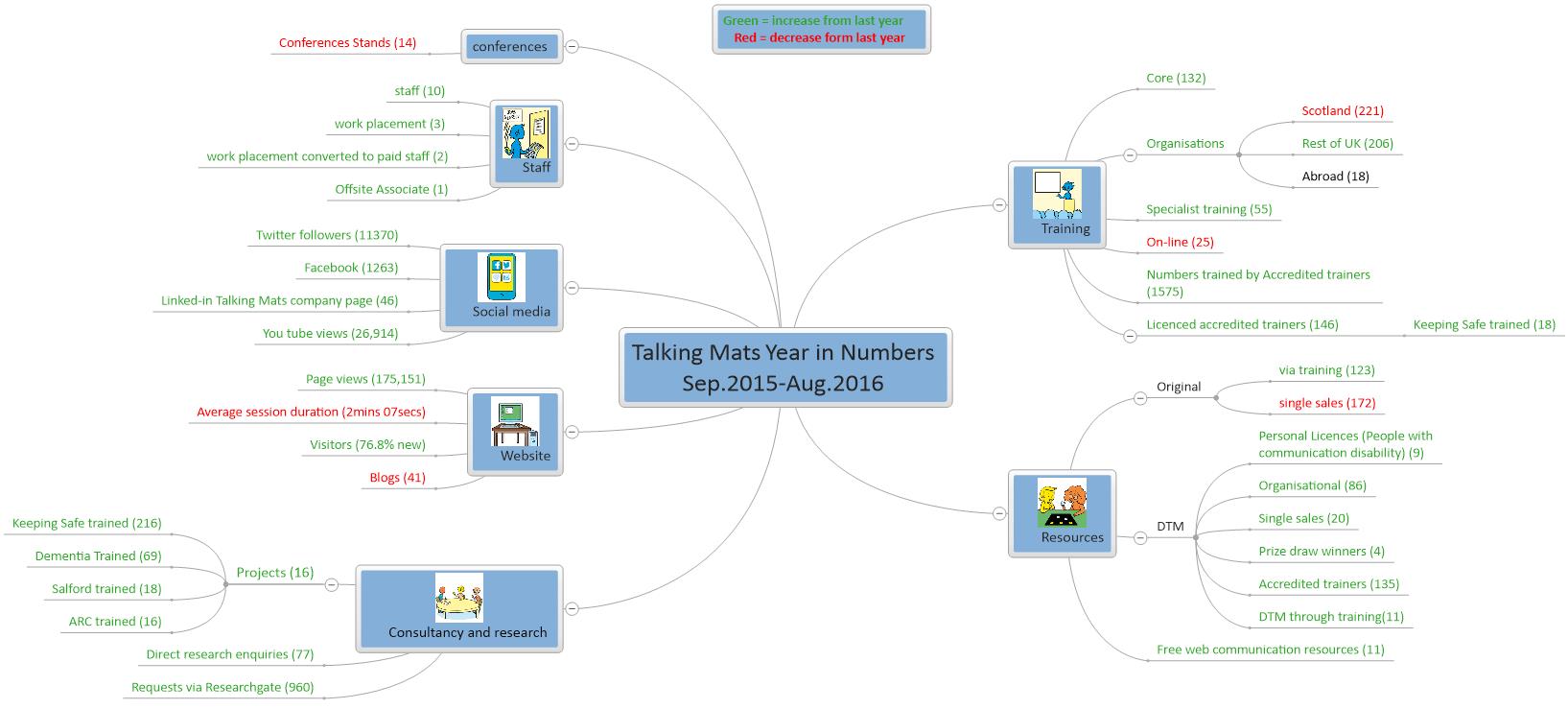
At the moment we are busy preparing for 2017 and we are looking forward to
- The evaluation of our following projects in The New Year
- The National Involvement Network on our partnership with ARC Scotland
- Our programme of service wide training with Central London Community health
2 Continuing to work with
- Patient Opinion
- The Alliance Self-management digital project
- Colleagues in Germany
3 Launching more resources
- Keeping Safe- so far this resource has only been available to people working with people with learning disability in Scotland. We will be holding a specialist seminar about this resource in London on the 17th March so its use can extend south of the border .
- Launching our conversation sets: gardens, holidays, trips out, sports indoor, sports outdoor and football. These were developed as part of the family training for people with dementia but they have much wider use and will be available as additional Talking mats sets
Plus Talking Mat is planning to go to Australia in May!

Nicki and Lois have their flights booked. Agosci here we come ! Then we are over to New Zealand to run foundation training in Christchurch and Auckland before we head back to Melbourne to run the first ever accredited training course in Australia. We will also be running a specialist seminar on Keeping Safe in Melbourne. If you want any details about the trip please get in touch.
We really appreciate all the support we get from everyone involved in Talking Mats and wish you all a happy and peaceful festive season
Delighted to introduce you to ‘The Communication Game’ : a board game for staff to improve their communication skills.
How we listen, talk and engage with people is fundamental to the quality and effectiveness of health and social care services. Although communication underpins everything we do in a work context, it can be a difficult topic for staff to talk easily about. Add to that the possibility of service users having an additional communication support need, through reasons like stroke, learning disability or dementia, then there is much potential for things to go awry and unfortunately, they often do. ‘Poor communication’ is cited as the most common cause of frustration in complaints about services.
The Communication Game was developed by Focus Games, NHS Education for Scotland (NES) and Talking Mats. It is a learning tool to help staff working in the health & social care sector increase their knowledge and skills around communication. The Communication Game is fun and easy to play. It can be played with or without a facilitator, and allows staff groups to have discussions and reflect on their communication skills. It allows them the chance to learn from each other. It will improve knowledge, but more importantly enable them to think about the small steps they can make to improve their interactions.
The project grew out of two previous projects funded by NES: Making Communication Even Better and Through a Different Door. In these projects, it was recognised that the experience of services for people with a communication support need is something of a lottery. For them, there was a considerable difference in the experience of interacting with a staff member who was empathetic and able adapt to their communication, to interacting with a member of staff who was struggling and unable to adapt their interaction. Training and understanding of inclusive communication practice is key. It has been a great privilege for Talking Mats to continue to support the work of the previous 2 projects and work with Focus Games Ltd to develop The Communication Game. Support during the development process from the Stroke Association Scotland, Capability Scotland, RCSLT, Scottish Care, Communication Forum, Queen Margaret University and NHS Ayrshire & Arran SLT Department have been invaluable, and we are very grateful; also to NHS Education for Scotland for their continued input and funding.
If you are working with staff in the health and social care sector, then this will be a great resource for you. You can get The Communication Game from the Focus Games online shop. It is guaranteed to promote laughter learning, and a touch of competitive team spirit. Most importantly, it will be a catalyst to help develop staff communication, making interactions better for people with communication support needs.
You can find out more about the game at www.communicationgame.co.uk
, and follow the game on Twitter on @Comm_Game.
Get your copy at www.focusgames.com.
We are very grateful to Kristine Pedersen from Kommunikationscentret in Denmark for sharing the findings of 2 projects with us. The first project found Talking Mats was effective in supporting communication for people who have dementia when compared with both unstructured and structured conversations.
‘t is important to know how to give people with dementia the right support’
At Kommunikationscentret in Hillerød (Denmark), we have been using the Talking Mats framework since our first trainer was accredited at the Talking Mats Centre, University of Stirling in 2010. We have been using Talking Mats with both children and adults across a range of communication difficulties e.g. caused by Aphasia, Cerebral Palsy, Downs Syndrome, learning difficulties etc. Inspired by the important research project by Dr. Joan Murphy and others ‘Decision making with people with dementia’ (2010), our next step was to gain our own experience within the framework specifically aimed towards people with dementia.
As in the rest of the world, the number of people in Denmark with dementia is increasing. Symptoms of dementia vary from person to person but many of the symptoms are related to communication: Difficulties finding words, using familiar words repeatedly, losing track in conversation, difficulties in focusing and paying attention etc. The growing dependence of the person with dementia on a caregiver makes communication essential to express wishes and needs. Therefore, it makes sense to look at the consequences of the illness (dementia) within the perspective of communication and how family members and professionals around the person with dementia can support communication using AAC.
The purpose of the first project was to compare the communication in conversations about views on I) Daily activities and II) The importance of information, using three different communication methods. The methods were: 1) unstructured conversation 2) structured conversation 3) the Talking Mats framework. The project involved 6 participants having early to moderate stage dementia, all living in residential care homes.
Like the study ‘Decision making with people with dementia’ (2010), the report concludes that the Talking Mats method was associated with better communication for the majority of the participants. The Talking Mats framework was found especially helpful regarding the participant’s ability to understand subject and question of the conversation, the participant’s ability to reflect, and the participant’s ability to make themselves understood. The graph below shows that only one participant (A1) did not benefit from the visual method. She had poor eyesight, which strongly indicates that visual support compensates the difficulties that people with dementia have.
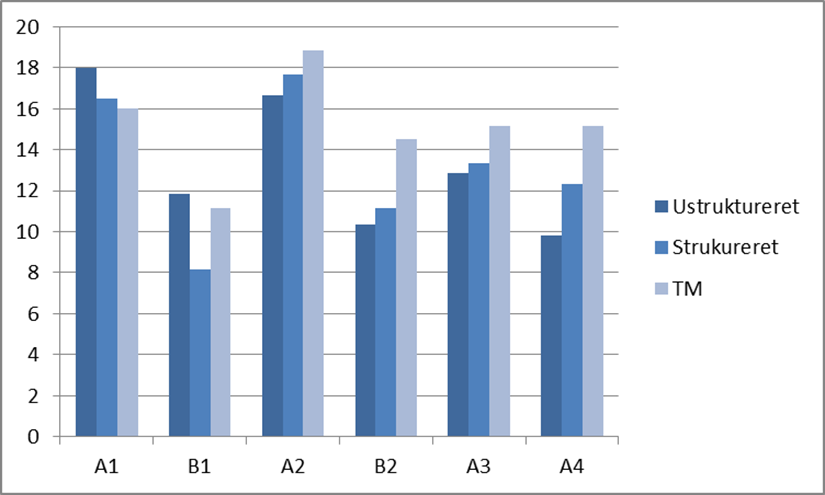
The report also concludes that the Talking Mats framework increases the interviewer’s ability to detect and compensate for some of the communication difficulties. Finally, it seemed that several of the participants have been able to learn how to use Talking Mats in the process.
The photo underneath shows a Talking Mat conversation from the project. This Talking Mat gives an insight into how this person feels about what information is important to her, and what isn’t. It is in some way a difficult and abstract question, but most of the participants managed to both understand, reflect and answer the question when we used the Talking Mats framework.
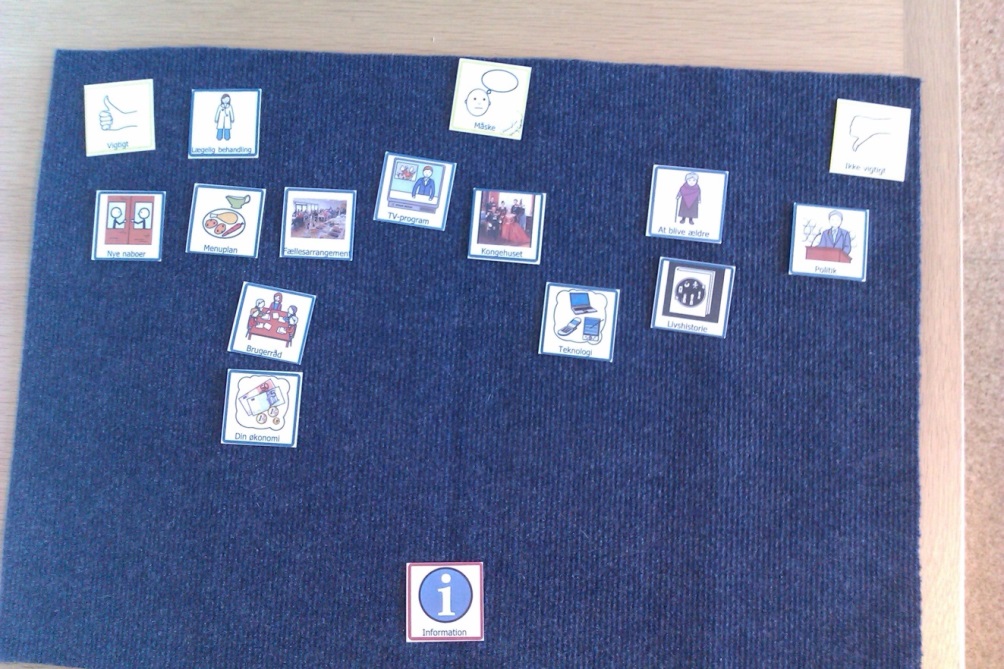
Important information to this participant is information about new neighbours, the menu at the residential care home, economy etc. Less important is news about the Danish royal family, technology, getting older etc. Politics is definitely not important to her.
 At the end of a recent training session, we asked the trainees to tell us how they planned to use Talking Mats as part of their work. Their comments were as follows:
- This tool will be useful in helping some residents make decisions, informed choices and express their needs. It will take time for some residents to feel confident in using this tool.
- I’d like to use it with some residents to be able to adapt Talking Mats more to their understanding.
- I’d like to use this tool for resident’s reviews to find out what the residents likes/dislikes are.
- Talking Mats will be great for service evaluation.
- Talking Mats will be great for asking residents about things they want to do.
- Updating Care Plans regularly from outcomes of Talking Mats.
- It can be used to get to know people’s needs and wishes more.
- Share the findings with colleagues and joint services.
- Hopefully through its use I’ll learn to pass it onto others.
- A gardening set. Service evaluation and well-being assessing stress levels/anxiety/emotional state?
- I’d use it to promote choices of activities.
- Care Inspectorate forms. Finding out how people enjoy time at the service and how to improve on it.
Can you let us know how you use Talking Mats as part of your work?
As part of the Right to Speak initiative Talking Mats was funded to develop ‘Promoting Inclusion and Participation’: an online learning resource for staff working with children and young people who use Alternative Augmentative Communication (AAC). We have been delighted to work with NHS Education Scotland on developing this free resource and also have really enjoyed working in partnership with the learning and development consultancy: Forum Interactive.
The complexity of care for children and young people who use Alternative and Augmentative Communication (AAC) is multifaceted. Ensuring that goals are centred on the young person and family’s needs is a constant challenge to practitioners. There are several resources that focus on developing the technical skills of developing AAC but there is a scarcity of resources that focus on the impact of AAC on the child’s day to day life.
Promoting Inclusion and Participation is based on an earlier project which determined the key indicators of a quality AAC service from the perspective of AAC users and their families.
Promoting Inclusion and Participation uses the following frameworks to help practitioners structure their decision making:
- International Classification of Functioning, Disability and Health – Children and Young People (ICF-CY)
- Janice Light’s Communicative Competencies (2014)
- GIRFEC (Getting It Right For Every Child) wellbeing indicators
 These are brought to life in a series of DVD vignettes which tell the stories from the perspective of the child, their families and schools. It poses the practitioners’ questions that allow them to reflect on the impact of AAC on the child’s day to day life. The resource is designed to be used for group discussion. The feedback from the expert practitioners that reviewed the material suggest that the DVD and resulting questions can enable AAC practitioners to have a rich discussion about best practice and how to time educational and therapeutic input to achieve holistic outcomes.
This on-line resource will help practitioners:
- Understand the role that collaboration and involvement play in delivering wellbeing outcomes for children who use AAC.
- Apply a holistic approach and outcomes focused approach to assessment, implementation and review which places the child at the centre.
- Recognise that as the child develops and changes, so the level of different team member’s involvement will ebb and flow.
Download the resource here. It takes a little time to download so be patient !
We would be delighted to receive feedback of how it is being used.
Ref
Light J , Mcnaughton D, Communicative Competence for Individuals who require Augmentative and Alternative Communication: A New Definition for a New Era of Communication? Augmentative and Alternative Communication, 2014; 30(1): 1–18
In June 2012 the Scottish Government published “A Right to Speak” (Scottish Government 2012) which included a four million pound fund to help improve services in Scotland for people who use Alternative and Augmentative Communication (AAC). At that time we were a small fledging social enterprise with a vision to improve the lives of people with communication difficulties in Scotland. We have been fortunate to be able to make our contribution to Right to Speak and as the initiative ends at the end of this month it is good to reflect on the work that we have contributed to over the past 3 years.
AAC outcomes
At the beginning we were heavily involved in the research aspect of the project, carrying out a critical appraisal of outcomes for people working in AAC. This led onto a second project to evaluate the validity and reliability of the Therapy Outcome Measure for AAC. We were pleased to be able to do this in conjunction with Prof Pam Enderby and a number of AAC professionals throughout Scotland. The Therapy Outcomes Measures, third edition has just been published which includes a section on AAC co-written with Joan and Sally. This should allow professionals to be much more specific in monitoring and measuring the impact of AAC intervention.
Quality indicators
A second piece of research we carried out was to explore what matters to AAC users in terms of service delivery. It was a great privilege to listen to the views of people who use AAC from all over Scotland and we were able to theme those views into 10 key quality indicators. This led on to one AAC partnership asking us to design a Talking Mat to enable AAC users to give feedback on their service. This was successful and NHS Education then asked us to roll that out across Scotland. 40 people have just attended 4 specialist seminars and received the resource. We believe that taking the time to listen to people and ask for feedback in a structured way is really important and so to continue to support that we are making the ‘Talking Mats AAC feedback’ script ,symbol set people and symbols set services available on the free stuff section of our web site.
Promoting Inclusion and Participation
We were fortunate to win the tender to design an online learning resource for staff working with children and young people. It is designed to help professionals take a holistic and values based approach to working with young people to support their health and wellbeing. The resource contains a collection of film clips that depict three different environments in which young people use AAC: a mainstream primary school, a mainstream high school and a specialist school. It provides a Learner’s Workbook which shows the learner how to use the film clips to improve the way they promote inclusion and participation for young AAC users. It will support equip practitioners to shift from a model of working where interventions are done to the child/young person to a process where work is done with children and families to focus on what is important to them. It is about to launch on the NHS Education web site.
Training and accredited training
There has been a significant focus on developing a well trained staff through the right to speak initiative and helping people understand about communication. We have been delighted to play our role in that. Up and down Scotland we have run training courses for different AAC partnerships e.g Lanarkshire, Fife, Highland, Western Isles, Tayside. We have also had people coming to train here in Stirling .We are particularly pleased that there have been several people who have completed their accredited trainers and who will be able to continue and sustain training in their local area. In one Health board for example, there is a plan to train a further 300 front line staff in Talking Mats
Moving forward
It’s been a busy 3 years and it’s both exciting and gratifying that so many more people know about AAC and know that it is not a responsibility that rests with just one profession . The complexity of communication means we all have to play our part but we all recognise there is still much to do to really ensure people who use AAC are fully included in society.
As a social enterprise we would no longer describe ourselves as ‘fledgling’ –we have well and truly hatched ! We are grateful that during our critical start-up period winning tenders for right to speak also helped us on our journey. We will continue to fulfil our vision of supporting people with communication difficulties and we recognise right to speak has given us a legacy of research and resources that will help us do that.
Getting feedback on AAC services is particularly challenging because of the communication support needs of this group of people. It is therefore really important for AAC users to have the chance to say how they feel about the services they receive. Services need to make sure that this group of people have a voice and that there is a mechanism for their views to be taken into account in monitoring the quality of services and service planning.
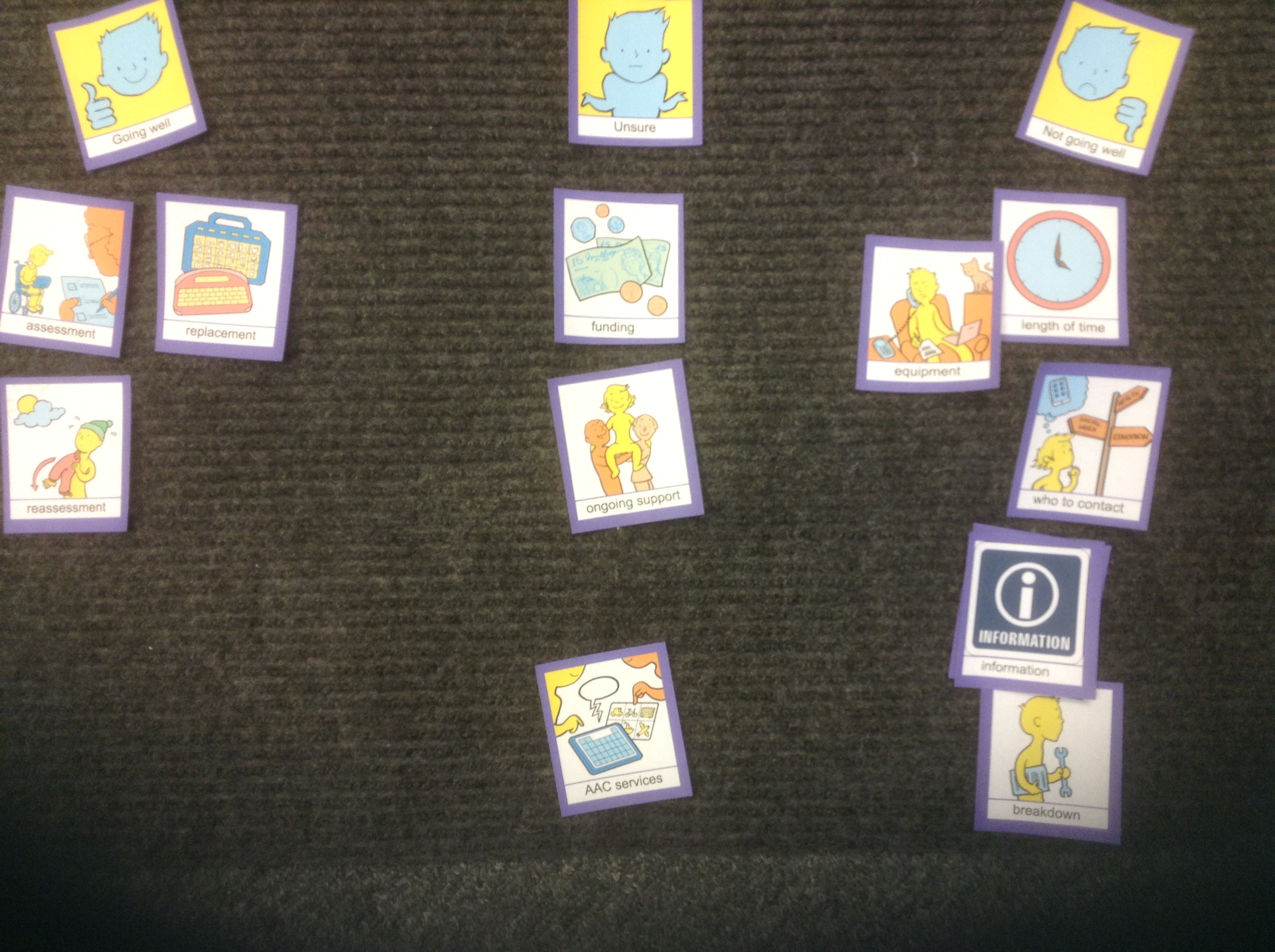
NES has funded the opportunity for professionals to attend a seminar and go away with a resource to support them to get feedback from AAC users about their service. The Talking Mats resource was trialled and developed with Forth Valley AAC partnership and is based on AAC quality indicators (NES 2013).
This opportunity is free of charge to people in AAC partnerships in Scotland. You will attend a half day specialist seminar and go away with a free resource to use in practice.
The resource will help people find out how AAC users feel about:
- People who work with them
- How AAC services are delivered
It provides a model of good practice which could be extended to evaluate other services.
4 dates and locations are available.
Edinburgh- Tuesday 17th March 1.45 -4-.30pm
Dundee – Wednesday 18th March 1.45 -4.30pm
Glasgow Thursday 19th March – 1.45 -4.30pm
Inverness Friday 20th March 1.45 -4.30 pm
If you are trained in Talking Mats and wish to take up this great opportunity, please book your place as soon as possible.
sally@talkingmats.com or rhona@talkingmats.com
It is recognised that it is difficult for people with communication disability to give feedback to health service staff. The group that developed the Making communication even better resource decided that mystery shopping would be a good way to find out whether health staff were supporting their communication and enabling them to access the services that they require and are entitled to. Funding was sought and gained from NHS Education Scotland for a small mystery shopping project.
20 people with communication disability were involved in the project which was coordinated by Talking Mats Limited and the Stroke Association Scotland. There were different aspects of the project – making phone calls, face to face visits and recounting personal experience . It covered the 14 Health boards in Scotland. The project report was named ‘Through a Different Door’ as this reflected the overall findings that people had highly varied experiences of interactions with health service staff ranging from the excellent and supportive to poor which had the further risk of endangering patient safety . Click here to read the final reports
We’re delighted that Andrea Powell, an Occupational therapist in Edinburgh has written a Blog for us about her experiences of being involved in group work with people who use AAC.
As a student occupational therapist, I worked part time as a support worker with an amazing lady Jennifer, (Jennifer is a pseudonym) Jennifer just happened to use an iPad to communicate. At this time I was about to commence my final year studies and was required to research and write a dissertation on a subject of interest. The lightning bolt of inspiration came when I, with Jennifer attended a weekly AAC user support group which was run and organised by a group of SLT’s.
The group was a wonderful resource that truly benefited the people who used it. I witnessed how much Jennifer valued spending time chatting with friends who also used an AAC device and who understood the unwritten rules of engagement. Such as patience while I set up my speech, don’t look at my screen while decide what I want to say etc. Her confidence in using different types of conversation grew while attending the group. It encouraged her to add to her already wide and variety vocabulary. As her support worker I also valued the opportunity to gain access to training on how to use her AAC and how I could provide better support to her.
I began reading around AAC and how people integrate of devices into their lives. I was however shocked to find that the wonderful group Jennifer attended was a rare occurrence for many users. The more I read, the more I realised that many users struggled to continue using an AAC device due to lack of support, access to trained professionals and most did not have wonderful resources like user support groups.
As an OT I was interested to explore the role in which I would play within AAC provision and found that as an OT I would be mainly providing support and advice on positioning, accessing devices and ergonomic type support.
However I felt that as an OT we have many more skills that didn’t appear to be to be getting utilised, within in my dissertation proposal I postulated that OT’s could expand their role within AAC to i) collaborating on assessments for AAC; ii) training on devices once they have been issued to users; and, iii) running and facilitating groups for AAC users and communications partners in the community.
OT’s are highly trained specialists skilled at understanding what is achievable and realistic for an individual. Occupational therapists assess individuals holistically in order to establish realistic and manageable goals which can be graded and adapted to suit the individual. Through the utilisation of appropriate grading of an occupation, a user can experience success and therefore less failure and frustration, ensuring the challenge is set at the appropriate level for the individual concerned (Park 2009).
Running and facilitating groups as a therapeutic tool is something that occupational therapists have been doing since the earliest days of the profession and groups are now utilised in many areas of practice (Howe and Schwartzberg 2001). By continuing this tradition, occupational therapists are well placed to take the lead in running and facilitating groups for AAC users, integrating social and community activities into the groups, for example, meeting in local shops to provide real life experience of interactions and, importantly, promoting the use of AAC to the general public. There are similar projects being attempted in Motherwell to increase the awareness of Dementia and make local businesses “Dementia friendly” (Shafii and Crockett 2013). Providing groups for AAC users not only enables them to learn how to use their devices, but also provides a support network of other users and communication partners.
I feel that if the skills of an OT were utilised in more than ergonomics then more positive outcomes could be seen for the user of AAC. I believe that if there were more OT’s taking on additional roles within AAC provision it could help reduce the pressure for SLT’s and the waiting lists to see SLT’s. It would also enable more users to be assessed to use AAC.