Online training login

 This is a fabulous film that really shows Talking Mats in action and how it supports and promotes involvement on so many levels.
Talking Mats and the National Involvement Network (NIN) have been working together for the past year to enable the NIN members to develop a Talking Mat and to use that Mat to listen to the experiences of people with learning disabilities . It has been a great project and we wrote up the experience of running the training in two earlier blogs.
The first blog described how we worked with the group to develop a Talking Mat to link with the NIN’s charter for involvement . The second how we developed and delivered a Talking Mats training course to meet the needs of the NIN members all of whom have learning disabilities
The group then set off to carry out their Talking Mats conversations supported by staff from their respective organisations and or ARC Scotland. The group decided they wanted to make a film about their experiences of using Talking Mats and ARC Scotland supported them to do this . Rhona and I were delighted when we got this link to the film all about their experiences of using Talking Mats. We really enjoyed watching it and we are sure you will to. https://www.youtube.com/watch?v=0BTlYuqLBXs
Five short stories from our recent accredited training course in Stirling.
- A looked after child was unhappy but no one knew specifically why. Using the Talking Mats, she indicated that she was upset by the weekly phone call with her mother because it always happened when it was her playing time. The time of the call was moved to just before her bedtime but this resulted in bad dreams. The time of the call was finally moved to Saturday afternoon which helped her settle and reduced her distress.
- Talking Mats was used with an Iraqi boy who had come to England via Libya, Italy and the jungle camp at Calais. When he picked the symbol of a waiting room he indicated that despite all she had been through he really liked this because it reminded him of all the children in his family and made him happy.
- A 76-year-old man with a learning disability disclosed that he had been attacked and suffocated by his upstairs neighbour one week previously. It was only when he used the Talking Mats that he disclosed to anyone what had happened.
- A lecturer usually used quantifying measuring with her students to find out how they were managing their studies. Instead she used Talking Mats to find out how they were coping with their work life balance. One student told her that she was managing fine except that her pet rabbits always escape under the bed and it takes her a long time to get them back out so she does not let them out very often!
- Talking Mats was used with a man who had had a stroke and had to go into residential care because his family could no longer look after him. They were very worried that he was unhappy with the new care set up. He was able to show with the Talking Mats that he was happy about everything except that he was not given enough time when he went to the toilet. Once the staff realised this they then gave him more time which resolved the situation and reassured his family.
Please send us your Talking Mats stories – we love hearing them.
Health professionals from Stockport have shared how using Talking Mats has positively impacted on their clinical work.
Laura, our North West Associate, met up with Carla Innes, Clinical Psychologist for learning disability from Healthy Young minds Stockport (a child and adolescent mental health service provided by Pennine Care NHS Foundation Trust) and Clare Royle, Family Support Worker,from the Children’s Learning Disability Team (provided by Stockport NHS Foundation Trust). The two organisations work closely together to provide joined up care to young people with a learning disability.
Six months ago Carla, Clare and seven others from the Healthy Young Minds Stockport Team received training to enable them to introduce Talking Mats as part of their challenging behaviour pathway.
Carla and Claire said that the staff team are very positive about the impact of Talking Mats. The overall impression is that Talking Mats has enabled staff to gain an individualised sense of the child or young person they are working with, as well as empowering the children and young people to share their views and opinions. Carla also notes that using Talking Mats has helped her to focus on the child/young person’s abilities/potential – their ‘zone of proximal development’ – and to ensure that everyone is working within that.
Some of the other positive features of using Talking Mats include:
– Providing ‘headspace’ for the child/young person to process their thoughts and to really consider what is important to them.
– Giving a holistic, child/YP centred account and narrative of their feelings and behaviour.
– Helping to inform and direct clinical decision making e.g. introduction of an approach such as CBT.
– Enabling children/young people who have previously refused, or been very reluctant, to share their views and opinions about topics which have been troubling them for example, school attendance and issues with sleep.
– Providing of a communication framework which is neutral and non-threatening – much less intense than direct verbal questioning or conversation.
– Helping to make abstract concepts more concrete for the listener to understand.
– Being a safe, flexible and quick method of finding practical solutions and determining direct actions.
– Enabling the listener to gain a better understanding of the thinker’s level of knowledge and understanding about a particular topic such as healthy eating. This can help inform capacity assessments e.g. in terms of medical consent or the use of medication. The mental capacity act states that appropriate support should be given to young people to make informed decisions and to communicate those decisions.
In addition, from a wider team perspective, Carla and Clare report that they have all noticed benefits in terms of consistency of Talking Mats use by all members of the multi-disciplinary team. Each team member using the Talking Mats tool is working from a slightly different perspective; using Talking Mats ensures that the child/young person is kept at the centre of the process. This results in a truly holistic view of the child/young person’s feelings, views and opinions.
It was great to meet with Nikki Steiner, Principal Speech and Language Therapist with Central London Community Health Care Trust (CLCH), to evaluate the work that was commissioned by CLCH. The project started in the spring of 2016 and aimed to support a person-centred and inclusive approach to health planning and intervention using the Talking Mats framework.
Those words ‘person-centred’ and ‘inclusive’ are easy to say but much harder to implement. Our approach was threefold:
- We provided 100 staff with the Talking Mats resources to use in their practice (both the original and digital versions).
- We ran 3 Enhanced Talking Mats training courses for those staff which involved two days training. The first day introduced the framework and built staff confidence in using the resource. The second day supported staff to reflect on their use of the Talking Mats in their work setting, and allowed them to think creatively about further application and development.
- To sustain the capacity of CLCH to continue with the project we trained three accredited trainers. The plan is they will continue to build staff skills and training on an on-going basis and provide local leadership and expertise.
The evaluation framework that we are using looks at impact of this investment using the Kirkpatrick model of evaluation. This allowed us to evaluate:
- Participants’ reaction to the training,
- Participants’ learning – did they increase their knowledge skills and learning?
- Transfer and application – did they apply their learning to the workplace?
- Result – this was based on the impact that using the Talking Mats skills and resources had on the lives of people with communication disability
We had different measurements for each part of the model and these ranged from course feedback, a quiz, personal reflection and stories from people with communication difficulties. It is these that we are in the process of analysing so watch this space for the final report. Nikky said ‘This is such an exciting project that impacts on all the different client groups that we support’.
If you would like to discuss implementing Talking Mats at an organisational level then have a look at this link – Organisational Training
Many thanks to Cheryl Strutt for this lovely blog about how she developed and used an Aromatherapy Talking Mat with people with learning disability.
I am an Aromatherapist who works with adults who have a learning disability and often additional communication difficulties. As part of a recent service review I wanted to develop patient involvement. Talking Mats (TM) was suggested as a possible option to support patient feedback. I decided to look into this tool further and access training. During my TMs training I was supported to develop my specific Aromatherapy TM. The main aim behind this initiative was to adopt a system that could identify how each patient felt about the service and identify if there were areas where changes or improvements could be made. I wanted to work closely, alongside each patient, in order to learn how they really felt about their Aromatherapy treatments, their likes/dislikes etc. and to give them a sense of ownership of their sessions. It’s all about giving individuals with a communication difficulty a voice that can be heard.
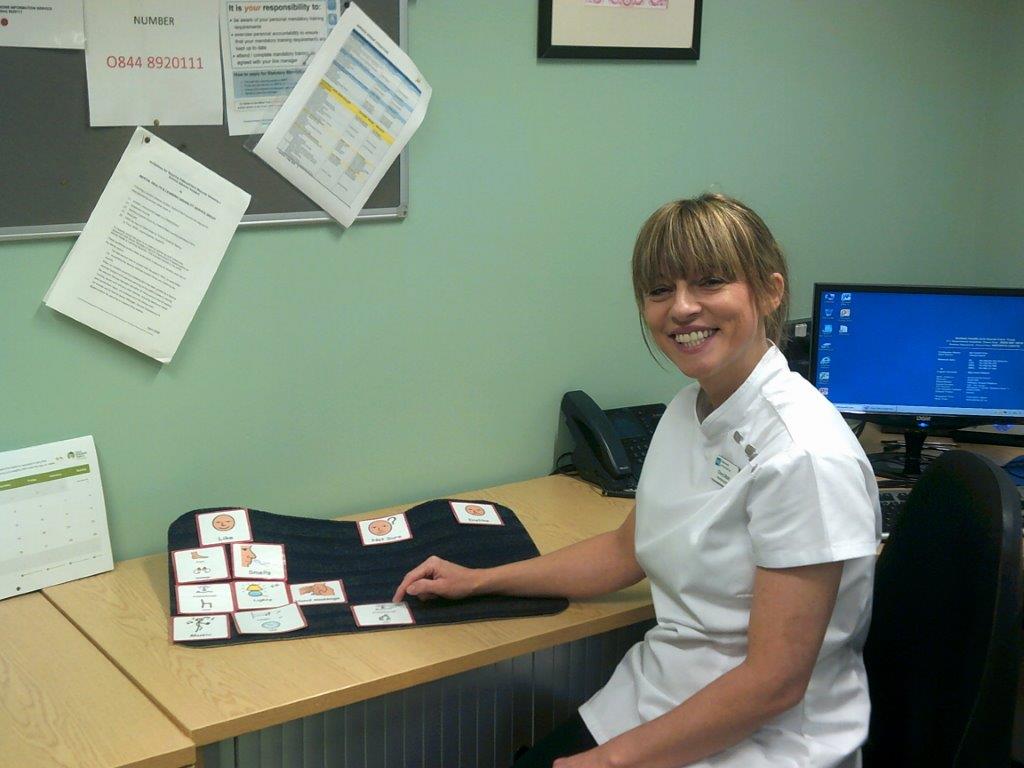
The Aromatherapy TM supported patients to understand what is involved in an aromatherapy session and has been effective in helping them to personalise their session.
I used the Aromatherapy TM within the patient’s first session and following their last session, taking a photograph of the completed mats as evidence. The TM is an excellent way of offering a range of different types of massage experience and the patient can select their preferences. I found it an excellent way, to obtain valuable feedback on patient experience. One patient with a severe learning disability and autism was able through the use of symbols, to indicate his dislike for the music being played during his Aromatherapy session. He has no verbal means of communication and feedback like this would not have been achieved if the Aromatherapy TM wasn’t used. Through the implementation of the TM I now have evidence of patient centred practice, in relation to the therapeutic value of the Aromatherapy Service. The Aromatherapy TM supported patients to understand what is involved in an aromatherapy session and has been effective in helping them to personalise their session.
Since the implementation of the Aromatherapy TM, patient feedback is now at the heart of the Service. The patient is now able to openly give comments, make choices on their treatment plan, which in turn is making their attendance at the department, a very pleasurable one and it’s very personal to the individual. Another patient who said that he wasn’t able to read or write, was able to explain what the symbols meant and chose the symbol for happy. He went on to indicate his preferences stating ‘I like foot-spa and a foot massage.’ Prior to using the TMs, I was often reliant on observing the patient’s body language to assess their level of enjoyment and gain feedback. The Aromatherapy TM now allows for a more accurate method of evaluating interventions. I am so enthusiastic about the increased level of patient involvement and the willingness of the patients to become involved in this activity. This project clearly demonstrates the value of involvement, leading to improved partnership working and better experiences.
Cheryl Strutt, Aromatherapist, Cheryl.strutt@belfasttrust.hscni.net
Talking Mat would like to wish you all a Happy Christmas
2106 has certainly been a busy year for us at Talking Mats. We have seen some staff changes saying goodbye to Jill hall and welcoming Morag Crawford. We were delighted when we brought Kirsty onto our staff . Kirsty originally volunteered with us as part of a school transition programme for people with autism. Laura Holmes joined us as a Talking Mats external associate for the North West of England.
If you are interested in what we do and want to see our activity in numbers then have a look at the Talking Mats Year in numbers . Click on image to see the enlarge ! 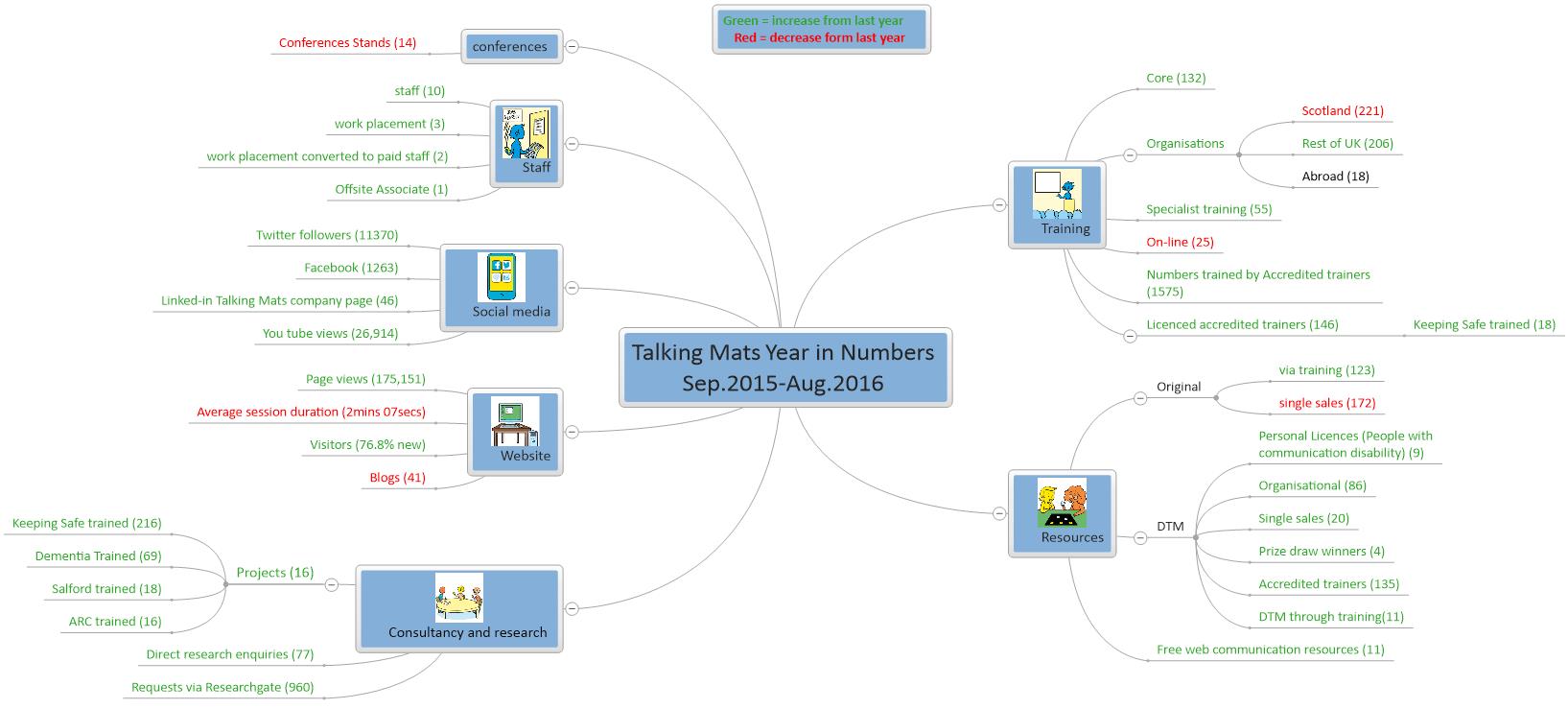
At the moment we are busy preparing for 2017 and we are looking forward to
- The evaluation of our following projects in The New Year
- The National Involvement Network on our partnership with ARC Scotland
- Our programme of service wide training with Central London Community health
2 Continuing to work with
- Patient Opinion
- The Alliance Self-management digital project
- Colleagues in Germany
3 Launching more resources
- Keeping Safe- so far this resource has only been available to people working with people with learning disability in Scotland. We will be holding a specialist seminar about this resource in London on the 17th March so its use can extend south of the border .
- Launching our conversation sets: gardens, holidays, trips out, sports indoor, sports outdoor and football. These were developed as part of the family training for people with dementia but they have much wider use and will be available as additional Talking mats sets
Plus Talking Mat is planning to go to Australia in May!

Nicki and Lois have their flights booked. Agosci here we come ! Then we are over to New Zealand to run foundation training in Christchurch and Auckland before we head back to Melbourne to run the first ever accredited training course in Australia. We will also be running a specialist seminar on Keeping Safe in Melbourne. If you want any details about the trip please get in touch.
We really appreciate all the support we get from everyone involved in Talking Mats and wish you all a happy and peaceful festive season
This blog describes the foundation Talking Mats course we ran for members of the National Involvement Network. Following the seminars and the work to design a Charter for Involvement ‘Taking Part Talking Mat’ described in a previous blog , 16 people attended our course run over three days with about a month between each session. The participants were 8 NIN members who all had a worker to support them as a learning partner. Their role was to assist with embedding the knowledge gained, and the implementation of the pilot ‘Taking Part Talking Mat’. The learning partners were equal course participants, and expected to complete all course activities e.g. make a video of themselves carrying out a Talking Mat
In adapting the foundation Talking Mats course we learnt lots! Here is a summary of key learning.
- That we had a great group of people who were keen to learn and develop their communication practice to become Talking Mats interviewers, or as we call them in Talking Mats ‘the listener’ ( as they are listening to someone’s views). They appeared to really enjoy the learning experience and were enthusiastic, embracing all tasks including making a video of themselves using Talking Mats with someone in their organisation. In Talking Mats we call the person doing the mat ‘the thinker’.
- That it was really important for us as trainers to focus on key information, not all information so as not to overload
- That movement helped learning. It was good to design activities with some potential for movement so that people were not sitting too long and that they could get up and stretch.
 For example, on the Talking Mats foundation course there is an activity that thinks about abstract and concrete language. We adapted this by using cut out coloured circles and got participants to think about the language load of a particular concept and place the symbol concept in the relevant circle.
 - Teaching the principles of Talking Mats and getting the participants to follow the rules e.g asking open questions, introducing blanks, the check and change stage was relatively easy. What was more problematic was supporting a listener to be flexible and person centred in the way they introduced an concept . Often it is important to give a relevant example to support a thinker’s understanding and our listeners struggled with that. To overcome this, we wrote specific examples on the back of the cards and designed some activities to give time to practice. Repetition of learning was important
- A detailed script helped, including what to say to introduce the Talking Mat
- That you needed to pay particular attention to the quieter members of the group –coffee breaks proved to be a useful time to catch up on their thoughts and feelings
- The role of the learning partner is critical. We were very fortunate in our partners. They were natural enablers and it showed. We relied on partners sharing a set of values, and believing that people with learning disabilities could learn and be a key member of the pilot project.. One person did not complete the project maybe because she felt uncomfortable. It made us realise if we were to do this again we should be explicit about values and the roles of the learning partner from the outset
- That the recording of interviews needs support, and it was key that there were was both a NIN member and a learning partner to enable that to happen
- That our partnership with ARC Scotland was key as they provided individual follow up advice to each of the organisations involved and provided a source of learning reinforcement , observation and support to each of the NIN members and their learning partner. They were also able to feedback to the course organisers about any areas of difficulty that needed further attention and input
- That Talking Mats empowers both the thinker and the listener. It gives a structure to make a conversation flow. The training itself not only gave the NIN members who attended a tool to communicate with others about how they feel, but also seems to have had a positive knock on effect on their confidence and we hope that continues.
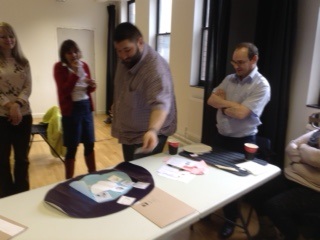
We are incredibly proud of our cohort of trained Talking Mats listeners. As part of the project they have been interviewing other service users in their organisations about 2 aspects of the Charter for Involvement –‘independence’ and ‘being involved in their community’ – ( 2 abstract concepts, as the NIN listeners will tell you). Not only has this included more people in service evaluation but has led to making changes that are improving lives.
For example
One woman was no longer being taken to church and she is now going and starting to be part of a local church community
One man who everyone thought was doing really well living on his own expressed a view that he was feeling lonely, He is now being supported to identify if there are enough people interested to start a local group.
Two videos were made by the group the first shows what they found out using their Talking Mats tool
This blog summarises a project we have completed providing Talking Mats training for families living with dementia. A key aspect of the work done by Talking Mats is to find ways to improve communication for families living with long term conditions. In particular dementia is a long term condition where deterioration in communication will eventually affect everyone. This makes it increasingly difficult to ensure that the person with dementia continues to be involved in decisions about their life.
We have completed a project funded by Health and Social Care ALLIANCE Scotland. Training in the use of Talking Mats was given to families living with dementia and staff who worked with these families. The Alliance Family Training final report highlights how this training helped people with dementia to communicate their views and be more involved in making decisions about their lives.
Families identified issues relating to self-management that they had not previously been aware of and new insights emerged as the following comments illustrate.(click on box to enlarge)
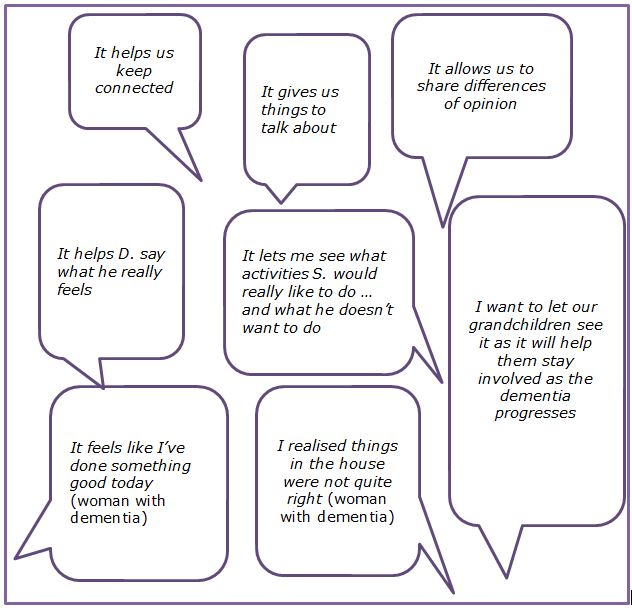
For some family members an important outcome was that Talking Mats helped them see that their spouse was satisfied with many aspects of his/her life. They found this very reassuring as many assumed that the person with dementia was frustrated and discontented.
The following is an example of how using Talking Mats helped with self-management.
When using Talking Mats on the topic of Where you live, G explained that he found it difficult to find his way to the toilet in the night. As a result his wife bought special senior night lights to help him which solved their problem. As a result, night times improved for both of them.
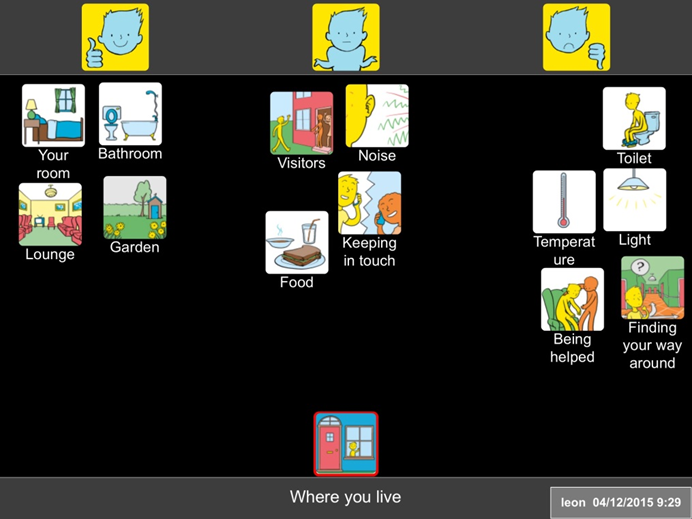
For further examples and information read the full report here Alliance Family Training final report and for further information about Talking Mats Family training please contact info@talkingmats.com
The Scottish Government has granted further funding for the Keeping Safe Talking Mats training and resources.
This extension coincides with the launch of the Keeping Safe report 2013-2016 at a seminar on Thursday 19th May at the Raploch Community Centre Stirling. It’s great to hold our event during Learning Disability week where the theme is Celebrating Success. This project has undoubtedly been a success. 234 Keeping Safe communication resources are in use across Scotland. Staff who have used the Keeping Safe resource report that it supports Safeguarding and helps people think how their life is going, enabling them to express concerns they might have, either big or small. The impact that the resource has on the lives of people with learning disability is powerful. You can read more about this in our previous blog or in the Keeping Safe report 2013-2016
The seminar on the 19th of May is an opportunity to share experiences and explore further some of the issues that exist for people with learning disabilities.
The next tranche of funding provides more training courses for:
- People who work with adults with learning disabilities in Scotland to learn the skills and use the resource to support listening to their service users and
- The staff who use the resource regularly to become Keeping Safe trainers and support the aim of ensuring adults with a learning disability in Scotland have access to this communication tool. We particularly want to target geographical areas that do not yet have Keeping Safe trainers, e.g. Dumfries and Galloway and Aberdeenshire.
If you work with adults with learning disabilities in Scotland and would like to apply for Keeping Safe training please contact the office info@talkingmats.com Application for
Striling course 19th August and 16th September is here; 20160610 training flier
Aberdeen Course 9th September and 7th of October is here 20160909 Aberdeen flier
Dumfries and Galloway course 20th October and 25th November is here 20161027 training flier
Further courses are being planned in the Autumn in Dumfries and Central Belt .Please contact Info@talkingmats.com if you wish to be sent the relevant flyer
Following the success of previous seminars we are holding further specialist seminars in Stirling and London for anyone who has done the Talking Mats training. The topics will be:
- Talking Mats and the Eating and Drinking resource (morning)
- Talking Mats and Capacity (afternoon)
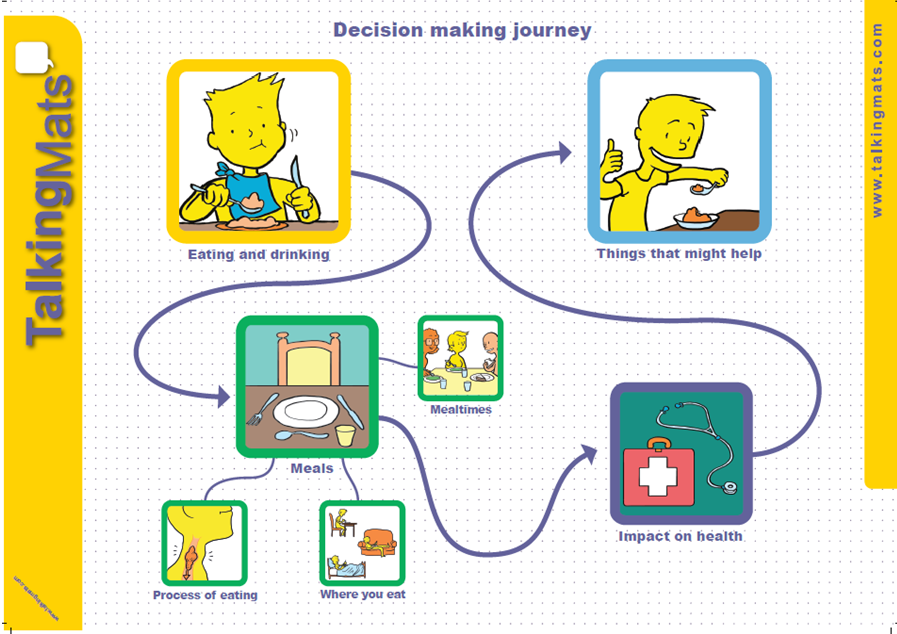
During the Eating and Drinking seminar, we provide background on how and why the resource was developed and showed some DVD examples of people using the resource. This really brings things to life and shows how important it is to give people (with and without speech) the opportunity to consider and talk about different aspects of eating and drinking. We also give people hands-on practice in using the symbols from each topic. Each participant will receive a copy of the full Eating and Drinking resource, including symbols, a mat, and explanatory booklet.
During the Capacity seminar we will discuss the fundamental principles of the Capacity Act and participants will have a chance to consider how Talking Mats can help people to:
- understand
- retain/remember
- weigh up information
- communicate their views/wishes and feelings.
They will also be given the opportunity to work through some practical examples and think about options to help people understand issues and make decisions.

If you have completed a Talking Mats training course and would like to attend either of specialist seminars, please click on the relevant course and fill in the registration form.
Stirling on Friday 29th April Stirling Seminars flier Apr 2016
London on Friday 10th June London Seminars flier June 2016
Registration form Seminar registration form 2016